

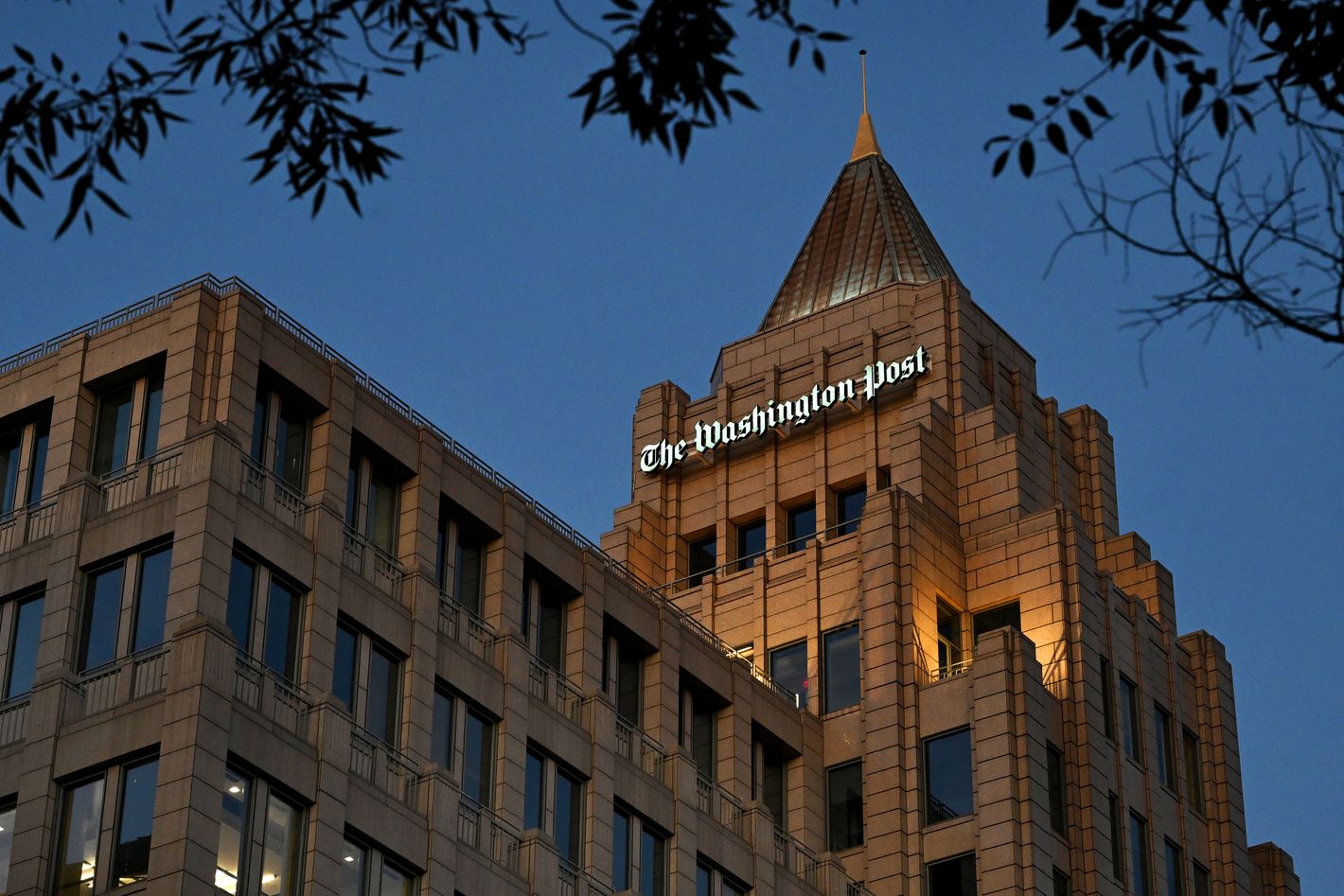
It briefly felt like the Washington Post had gained a semblance of stability after a tumultuous six months. Several high-profile reporters and editors had departed, but there were new hires, and the paper was doing good work, with coverage of the Texas floods drawing tens of thousands of new subscribers over a two-week period. But as the deadline to accept buyouts nears — offered this spring to all newsroom staffers who had been at the paper ten years or more as well as all of the “Opinion” section — it is becoming clear how much further the paper has to fall. “There’s been a lot of optimism that we were at the worst part a while ago, and I just don’t think there’s any reason to believe that anymore,” said one Post staffer.
Several newsroom leaders are taking the buyout, including Krissah Thompson, who oversaw WP Ventures (formerly known as the third newsroom); deputy managing editors Ann Gerhart, Monica Norton, and Mike Semel; politics and government editor Lori Montgomery; and features editor Hank Stuever. A handful of people on the video team — a key part of the Post’s digital strategy — are also departing, including the paper’s TikTok star Dave Jorgenson, who is starting an online video company with Micah Gelman, the Post’s former director of video, and Lauren Saks, Gelman’s former deputy.
In some cases, these buyouts mean not only a loss of talent and institutional knowledge but a big gain for the competition. Ann Marimow, who covered legal affairs and the federal courts at the Post for more than a decade, accepted the buyout offer and joined the Supreme Court team at the New York Times, where she will find some of her old colleagues; two of the three editors who signed her hiring announcement joined from the Post in recent months. “It’s a really bad business model to push out talented reporters and then have them report against you,” said another Post staffer.
Meanwhile, in “Opinion,” Adam O’Neal, who was named editor in June, has been meeting individually with editors and columnists, brief conversations in which the 33-year-old editor has signaled uncertainty ahead. O’Neal, formerly a correspondent at The Economist (and, before that, an editorial-page writer at The Wall Street Journal), has told multiple people that their work does not align with his vision for the future of the section, which owner Jeff Bezos in February said would be “writing every day in support and defense” of “personal liberties and free markets.” For his part, O’Neal announced his appointment with a video claiming the section would be “unapologetically patriotic” and “rooted in fundamental optimism about the future of this country.” He has also told some people that he anticipates the section will need to get smaller in the future — the implication being that they should get out while they can. Thus far, those taking the buyout include columnists Jonathan Capehart, Molly Roberts, Philip Bump, David von Drehle, and Perry Bacon Jr. Karen Tumulty and Dana Milbank are moving over to the newsroom, a decision others in “Opinion” are weighing.
Several “Opinion” staffers told me they had anticipated that the Bezos announcement meant the section would take a more economic-focused, libertarian bend and that O’Neal would likely get rid of the more liberal-leaning voices. But the depth and breadth of the cuts have taken many by surprise, as those whose jobs didn’t seem to be at risk — copy editors, assignment editors, politics and economics writers — are also having conversations with O’Neal. “It was initially framed as a voluntary buyout, but I think they’re using it as an opportunity to redo the staff,” said one “Opinion” staffer. “What’s really alarming is it doesn’t even feel like it’s designed to improve the bottom line of the paper, because they’re getting rid of people who readers really like,” said another staffer. “If Bezos wants more conservative columnists, he can do that, but to do that while showing the door to the name-brand journalists that are, forget editorially, commercially important to the institution, it’s hard to know what the game plan is.”
“Opinion” staff were informed of the voluntary offer in May, which the acting head of the section said was “meant to give people security to make a clear-eyed decision on whether they want to be part of the new direction for Post Opinion.” Some staffers were waiting until the new editor started before signing any papers, reasoning they would first see what changes he planned to make. But O’Neal didn’t start until last week. “He was surprisingly silent between the announcement that he’d gotten the job and his actual arrival. I would have expected him to do a lot of outreach in that period, but I think he only spoke to two people,” said one longtime “Opinion” staffer. Meanwhile, executive editor Matt Murray and CEO Will Lewis were taking a new tone, with Lewis emailing staff earlier this month encouraging those who “do not feel aligned” with the company’s plan to consider the buyout offer, echoing the are-you-in-or-out tone that Murray took in a previous email.
“It’s mystifying. When David Shipley left, Will Lewis reached out to a number of us to say that he thought it was an overreaction, and he didn’t see why David felt he needed to do that, and nothing really significant was going to change,” said the longtime “Opinion” staffer. “Now, here we are, a few months later, and the whole message is 180-degrees different: ‘Huge change is coming; get onboard or get out.’ Still, though, really no meat on the bones about what the change is going to be.”
Lewis’s big initiative since taking over the Post in January 2024 has been WP Ventures, which was initially conceived as a space for service journalism and social engagement. It was supposed to be a kind of incubator for innovation led by Thompson, a beloved newsroom leader who would focus on “expanding our presence on social media and creating new commercial opportunities for consumer and lifestyle journalism,” Murray wrote in a memo this past December. Video, audio, newsletters, special initiatives, and the “Health” section moved to Ventures, and Samantha Henig, a veteran in the journalism product space — she co-founded the New York Times’ audio department and helped create The Daily — joined as general manager.
But in addition to announcing Thompson’s departure, the Post on Tuesday said it would be moving Ventures outside the newsroom to focus entirely on “creator-driven experimentation” and “strong commercial opportunities,” while “the teams that are deeply tied to the newsroom will remain in the newsroom.” The next iteration of Ventures will report to chief strategy officer Suzi Watford and be led by Henig. I’m told that over the past six months, the Ventures team has been grappling with the limitations of being part of the newsroom, which has guidelines and structures that might hinder creator-like content and sponsorship deals for paid products. Lots of people are unsure what all of this means — is the Post going to invest in newsfluencers? Video spon-con? — but in general the dismantling of the third newsroom is one more reason for skepticism among staff. “The question is, What has Will Lewis accomplished? That was the question going around all of the group chats this week,” said one Post staffer. “The only thing he seems to have accomplished is driving off talented people and reducing head count. Maybe that was the point. But all of his flowery vows about what the Post was going to do, and his ‘Fix it, build it, scale it’ campaign — that led to nothing. And the third newsroom is now defunct.”
For some of the Post’s journalists, the buyout is too good of a financial offer to pass up, but the chaotic state of the Post doesn’t help. “The leadership has been dispiriting. No one has painted a picture of this affirmative message of what the Post needs to be. And if you’re at a point in your career where there’s a lot of good money and you’d rather take it than be pushed out six months from now, it makes sense to me,” said the Post staffer. “The sad thing is the Post is still doing pretty good work through it all: There are still scoops and stories that move the dial. But it continues to all be overshadowed by this.”