

We started our hour’s walk around Rome with a visit to the Pantheon (that didn’t count within the hour). I hadn’t, honestly, been hugely looking forward to it. The Pantheon is the ancient building that now has the greatest wow factor: still standing, plus roof, after 2,000 years, including its vast concrete dome which had the largest span until it was beaten in 1958 by the CNIT building in Paris. There have been a few changes over the centuries. The building was preserved thanks to its conversion from an ancient temple of “all the gods” into a Christian church, which also involved some internal alteration. But it still gives you a wonderful idea of what it would have been like to walk into a very grand example of Roman imperial architecture. That said, I hadn’t been there since they started charging for entry, and I had heard that the new arrangements meant that visitors were restricted to the edges of the interior space – that you could no longer wander freely under the dome. Disappointment beckoned.

I need not have worried. Leaving the ticketing aside, there were no inconvenient barriers, and our group had a great time, wandering around, and paying a little homage at the tomb of the painter Raphael, who had specially asked to be buried there. I am a great fan of that splendid internal space. Perversely perhaps, I am always more intrigued by the outside of the building.
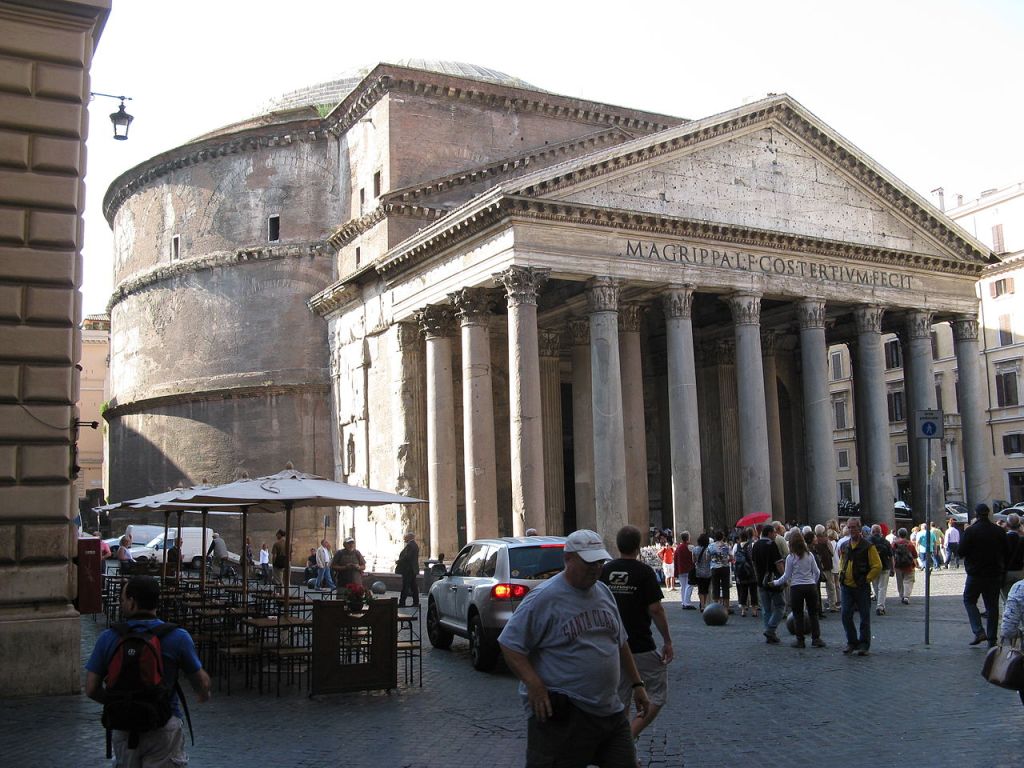
That starts from the prominent inscription across the pediment: M(arcus) Agrippa L(ucii) f(ilius) co(n)s(ul) tertium fecit (Marcus Agrippa, son of Lucius, consul for the third time, erected this). It looks as if it was built by Agrippa, the emperor Augustus’ right-hand man, in his third consulship in 27 BCE. And that is what used to be thought. But the stamps on the bricks make it clear that the building, as we see it, was constructed in the reigns of the emperors Trajan and Hadrian, in the early second century CE; that’s more than a hundred years after the reign of Augustus. The later emperors had carefully commemorated Agrippa’s role in the first building on the site, which had been destroyed by fire – so misleading future generations.
But it’s also the question of the size of the columns, which would probably have amazed the average ancient visitor as much as the lavish interior. A few of the columns on the left side of the portico are modern replacements (reusing ancient columns from other sites in Rome). But for the most part the line-up consists of grey and pink granite monoliths, quarried in (and transported from) Aswan and Mons Claudianus in Egypt. The shafts are almost twelve metres high. The cash and the labour required for all this is almost unthinkable, something that only an emperor could sponsor.
In fact, they nearly didn’t pull it off. If you look carefully at the photograph of the façade (and at the painting at the head of this post), you will spot that there is the outline of a triangular pediment on the wall behind the porch. The angle of the photograph makes it look as if it is lower that the “real” pediment of the façade, but in fact it is higher. Presumably these pediments were meant to align exactly. So how do you explain the difference? The best explanation is that the builders had planned for taller columns, but when the precious consignment arrived, the columns were almost three metres too short. If so, it is not hard to imagine the reaction of the architect when the columns were unpacked. But they must have decided that it was better to adjust the design and to make the front pediment lower, than to go through the whole process of starting from scratch and getting new columns. Accidents happen – here preserved for ever.
There was a special extra sight for us, one that I think will be soon on public display. Thanks to some very special arrangements, we were allowed to go and see the seventh- or eighth-century icon of the Virgin, which had been the centrepiece of the “Pantheon as church”, and is now kept in the ancient buildings at the back of the main building (the “grottoni”). As I understand it, these buildings will soon be open to the public, and the icon will be on view too. It will be well worth a look.
The post The Puzzles of the Pantheon appeared first on TLS.