

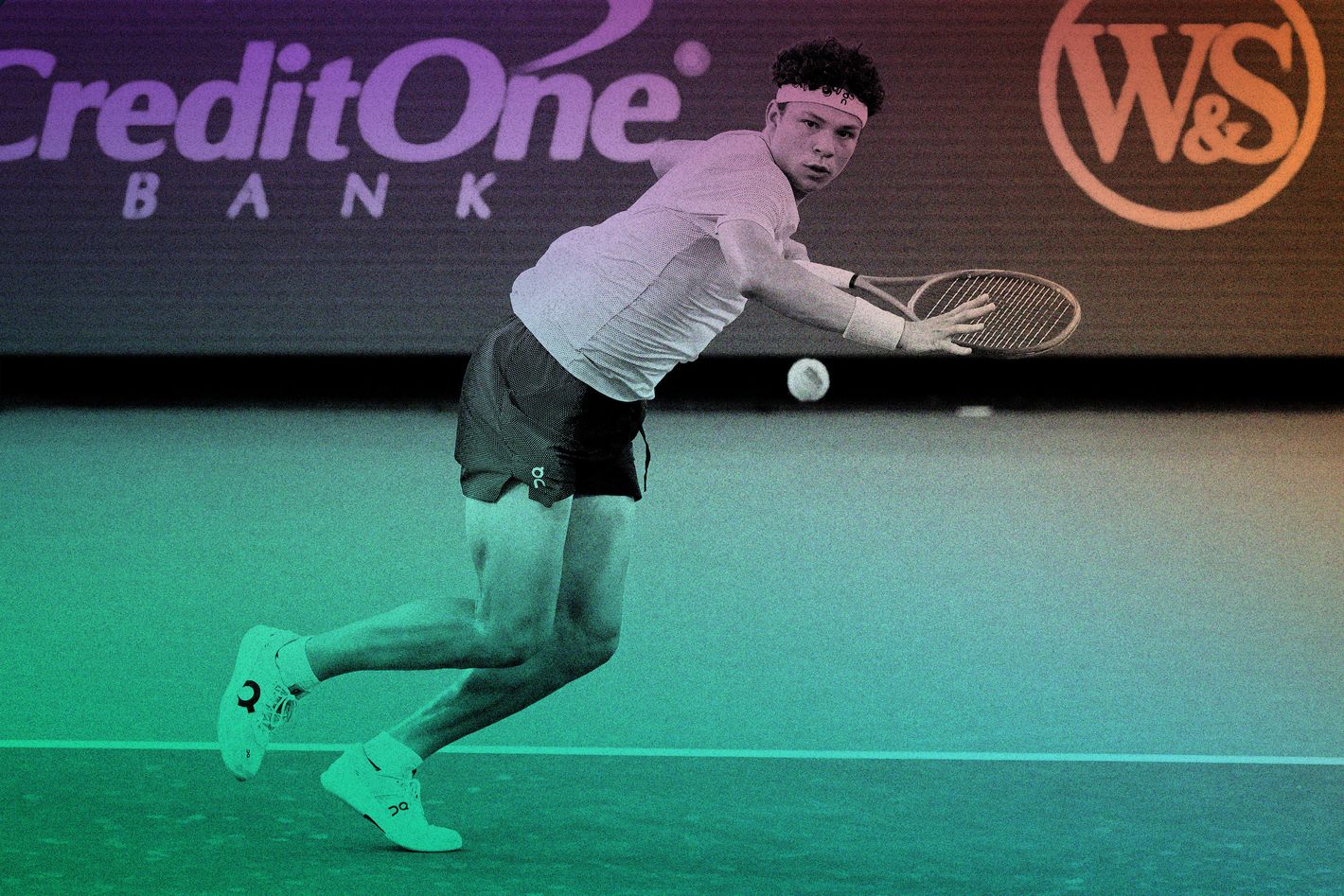
At the 2023 U.S. Open, a then-20-year-old Ben Shelton burst onto the scene with a run to the semifinals, familiarizing New Yorkers with one of the game’s biggest serves and a particularly memorable victory celebration. For fans desperate to see an American man win a Grand Slam for the first time since 2003, Shelton — who broke into the top ten this summer and went on to win the biggest title of his young career earlier this month at the Masters tournament in Montreal — has since emerged as one of the few players who appear capable — just maybe — of breaking Carlos Alcaraz’s and Jannik Sinner’s strangleholds on Major championships, the past seven of which have been split between the Spaniard and the Italian (Shelton’s compatriot Taylor Fritz came closest at last year’s Open, losing to Sinner in the finals). A showman who relishes the sport’s biggest stages, Shelton has the moxie, power, and sheer athletic ability to do one better. But at each of the year’s first three Grand Slams, he had the misfortune of running into either Alcaraz or Sinner, who most recently beat Shelton in the Wimbledon semifinals.
If you ask Team Shelton, though, those are the matches the 22-year-old Floridian lives for. “One of the things we’re trying to do is have him feel like he’s going up against Jannik or Carlos every time he takes the court,” says his father and coach Bryan Shelton, who himself spent nine years on the ATP Tour before coaching both the 2007 Georgia Tech women’s team and the 2021 Florida Gators men’s team to NCAA Championships. Two years ago, he retired from collegiate coaching to work with his son full time. But if relationships between tennis players and their coaches have historically been fraught with tension, the Shelton partnership seems unusually steady. “Most of the coaches out here are working for the player, and the player is paying their bills,” Shelton the Elder told me on Tuesday evening. “It’s important to be able to tell the truth and not worry about losing your job.” Ahead of his son’s second-round win over Pablo Carreño Busta
at Arthur Ashe Stadium on Tuesday night, Shelton spoke about managing expectations and raising a superstar.
Two years ago, Ben had his breakout run here at the Open. Each year since, it feels like the pressure has been turned up a little higher on him. How have you all adjusted to those expectations?
There are just so many more eyeballs on Ben, even just going to practice. There are no more quiet moments in practice — the stands are already full because they announce when and where the guys are practicing. He can’t get through the grounds without security. It’s hard because he wants to say “yes” to a lot of things and a lot of people, and you can’t say “yes” to everyone. So those things are kind of tugging at you. There are opportunities that come up, like Netflix, stuff like that — you see some of the guys doing a lot of those things even throughout the Open. I remember last year they followed around Frances Tiafoe and some of the guys, and Ben just elected not to do that because he knew that’s an energy drainer. It’s great exposure, but at what cost? And I think Ben’s pretty good at seeing what takes away a lot of his energy and what actually gives him energy. My wife and I just try to support him in those decisions and give advice where we need to and then just trust that he has a good head on his shoulders and will make good choices and good decisions along the way.
I’d love to talk a bit more specifically about your coaching arrangement. You’ve been coaching tennis longer than your son has been playing. You’ve coached multiple NCAA Championship–winning teams. Aside from his being your son, of course, what sets Ben apart from all the other really promising tennis players you’ve had a hand in molding?
It’s a combination of a lot of things. The great players I’ve worked with, most of them have a burning desire to work and to get better. That’s one quality he definitely has in a huge way. And I think that’s huge because when you have success, you can treat it one of two ways: You can think you’ve already arrived, or you can get a taste of it and want more. For Ben, it’s always been the latter. He has a good balance of inner confidence but also the humility to know that he’s not a finished product by any stretch of the imagination. I think those are some of the qualities that really help him move up the ladder. And then I think, physically, he’s an athlete first. A lot of people get into tennis early and become a tennis player; they hit the ball really well or do specific things very well on the court. But Ben’s an athlete first, and I think having played a lot of other team sports has really helped him in that respect. He played football, so contact and tough coaching and stuff like that just come easy for him.
He was a quarterback, right?
Yeah, he was a quarterback. He also played defense. He loved to hit. So I think the one-on-one game for him — he backs himself as being more athletic sometimes than the other guy across the net. When you have offensive tools you can hurt people with but also have the athleticism to defend and move around the court, that’s a great combination because not everyone has a mix of those skill sets. He’s a little bit raw in the experience category. At this level, most of these guys have played Junior Wimbledon and Junior U.S. Opens and ITFs and traveled the whole world before they’re even 18 years old. Ben’s doing that a little bit later than everybody else on the tour. He didn’t travel outside the United States until he turned pro just a few years ago. And I think the quality that’s brightest or stands out the most is just his fearless nature, especially when he’s in a situation for the first time — first time on Arthur Ashe Stadium, first time on Rod Laver Arena, first time on these big stages. For me, I was scared to death the first time I went on a stadium court. But he wants to be out there. He’s begging to be on those courts. He has a totally different mind-set than most people who get scared or fearful of those moments. He was 2 years old and riding a two-wheel bike. It’s just like, “What?” This kid’s a little different.
Where do you think the showman in him comes from?
I think it’s just natural. From a young age, he was just a little bit different that way. You could always tell because of the kind of clothing he always wanted — the neon stuff, greens and oranges and those vibrant colors that stood out. And then just little things you would see him do at a young age. He loved to put on little shows for the family, him and his cousin. Whether it was athletic stuff or anything else, he just loved to be in the center. I always thought the football field would be where he’d shine the most. And it turns out he changed course when he was 12 or 13 and decided he really wanted to play tennis.
I’m sure he would’ve had some great touchdown dances.
Oh, I’m sure he would’ve.
The tennis-player, tennis-coach dynamic is a unique one, and you see a lot of cautionary tales on the tour. What do you think Ben gains from having you as his coach that might be harder to come by in a more traditional player-coach relationship?
Most of the coaches out here are working for the player, and the player is paying their bills and everything else. So our situation’s a little bit different that way because I’ve always been Ben’s father and he understands I have his best interests at heart and will tell him things that are honest and true, even if he doesn’t want to hear them sometimes. At the same time, I have total belief and trust in his abilities and what he’s capable of, and he understands that without question. It’s hard to get that. I think it’s important to really know the player you’re working with in order to work effectively. And it’s important to be able to tell the truth and not worry about losing your job. If you can do that, you have a chance to really improve and develop and make up some ground on the field. But if you’re wasting a lot of time tiptoeing around because you don’t want to lose your job or you’re not quite sure how your player’s going to take it, it takes a lot longer to get where you want to go. So I think this has helped us accelerate the process.
And it’s important for me to be aware that I’m not dealing with a little boy anymore. For instance, they asked us our preference for when Ben would want to play on Tuesday, during the day or the night. I really wanted him to play during the day; he really wanted to play at night, and I had all these reasons why I thought day would be better. I gave him those reasons, but I said, “Ultimately, Ben, it’s what you want.” So I said, “Guess what? Let’s ask for night and if you get it, we’ll play it at night and there’ll never be another talk about it.” It’s not about being right or anything else. It’s just about working together and finding ways to help him do the things he wants to do, not the things I want him to do.
You guys seem to get along pretty swimmingly and avoid some of the more fraught aspects of that dynamic. That said, I’m curious if there have been moments when you faced your own limitations in his development, times when you needed to step aside and enlist outside counsel.
Yeah, it’s been great because I have worked with other coaches. For instance, at the University of Florida, two coaches I worked with were there when Ben started at the school. A lot of days, I would have been working with them on the court, but I couldn’t put all my attention on him. It was great for his growth and development to hear from other coaches I obviously respect, like Matt Cloer and Scott Perelman. Those relationships for Ben are still very much intact. Matt is here working for the USTA, but he’s helping us with the analytics and is now in Orlando, where Ben lives. So the days I’m not able to get to Orlando because I still live in Gainesville, Matt will get out on the court and work with him. So it’s just nice to have other resources and people I trust, who Ben trusts, who can help steer him in the right direction.
Ben has obviously turned a corner this year. He’s got the fifth-most wins on the ATP tour. Earlier this month, he won his first Masters title in Canada. From your perspective, what’s the biggest change or improvement that’s put him where he is now, right on the cusp of the top five? And does that align with your goals coming into the season?
One of the things I really wanted for Ben, and we discussed this in preseason back in December, was to bring up his low end because we felt his high end was already really high. So on his best days, he could compete with everyone out here on the tour, but there were too many days when his low end was just too low and he could take losses from a lot of different guys. We identified areas he could improve so those days wouldn’t be as frequent as the year before, and I think he’s done that. He’s shored up his game. Mentally and tactically, he’s making better choices on the court. He’s a little more thoughtful with things before they happen. He takes a little more time between points and recognizing what the right decisions need to be in those moments. He’s eliminated some of the unforced errors, some of the questionable shot selection. He now has a bit more understanding of his most effective plays, and he’s more aware of what the opponent on the other side of the net is trying to do and has a plan to attack their weaknesses. He’s just doing a better job of watching video and being more a student of the game, and I think that that has really helped him.
It seems like it because Ben made some deep runs at Slams this year, where his only losses were to Sinner and Alcaraz. What did you guys learn from those matches, and what does Ben need to do to get over that hump?
We’ve learned a lot. One thing we keep saying is that we want to continue to improve so he has more opportunities to play against those guys more consistently. I think that’s starting to happen. I don’t know how many times he’s played Jannik in the past two years, but it seems like five or six. He hasn’t played Carlos as much yet — I think only twice. But Ben has got to be willing to play an aggressive style of tennis. He’s got to find ways to make those guys uncomfortable and use the tools he has to do that. I thought he did a great job at the French Open this year against Carlos because most of that match was played on Ben’s terms, where he wasn’t just reckless in making a lot of unforced errors but was the one initiating the offense. Carlos was responding and having to play more defense than normal. If I could give him three or four points, if I selected exactly when I gave them to him, I think he’d win the match.
At Wimbledon against Jannik, I felt he didn’t play aggressively enough. He wasn’t willing to come forward enough off his first serve when Jannik was standing deeper in the court. He wasn’t willing to bring Jannik forward a little more to get him out of his comfort zone with the shorter slices we’ve been working on. There are some nuanced things he didn’t do against Jannik last time, and we said, “Okay, throughout this summer period, we need to make sure we’re not only working on these things in practice but also implementing them in the matches so that the next opportunity you have, which will hopefully be at the U.S. Open, you can make sure you have the right plan in place and execute it properly.” One of the things we’re trying to do is have him feel like he’s going up against Jannik or Carlos every time he takes the court.
That’s a good trick.
Right, to have that feeling and put yourself under that type of pressure. If you’re willing to do that against Pablo Carreño Busta and you’re willing to do that against whomever else you’re going to play in the tournament, then when you come up against those guys, it’s not the first time you’re trying to implement it. The thought in our heads throughout the summer is like, Every match you play, I need you to serve and volley X amount of times. And every match you play, I need you to implement these types of plays consistently because these are the ones you’re going to need in those matches. It’s kind of like when the guys are getting ready for the Masters in golf. Even though they’re not playing Augusta, they’re still working on those shots they know they’re going to need on the first hole and the fifth hole and the seventh hole and Amen Corner and whatever else. So that’s where we’ve been this summer, really trying to implement and put in play the things he’ll need if he reaches those later rounds here at the U.S. Open.
You were a formidable player yourself. I’d be curious to know what Ben does on the court that you wish you had been able to do in your own career.
There’s so many things, but I just wish I had his fearlessness. That’s the biggest thing. I mean, I wish I had his forehand, too. That I did not have. The forehand was not too good. But yeah, more than anything, his fearlessness and his attitude and his joy for the game. He has those things in abundance, things I didn’t have fully. But it’s pretty cool to be able to see your son do the things you never did and go further than you’ve ever gone. And for that, I’m totally thankful and grateful.
This interview has been edited for length and clarity.