

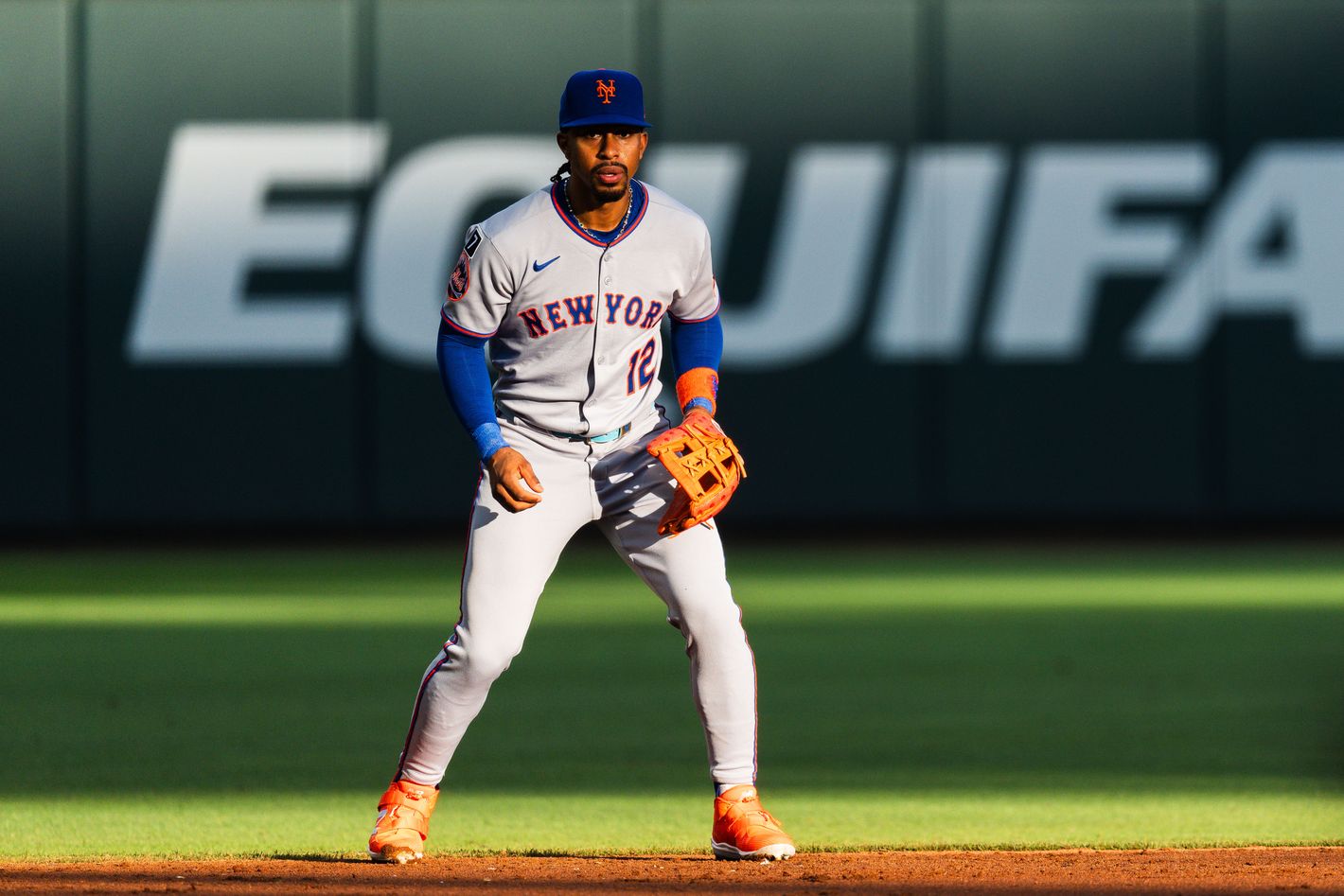
It’s not easy being the face of a sports franchise in New York City, but Francisco Lindor often makes it look like it is. After arriving from Cleveland in 2021 for $341 million and enduring a difficult first season, Mr. Smile, as the Mets’ star shortstop is known, guided his team to the playoffs twice, became a clubhouse leader, and will start his first All-Star Game as a Met in July. The switch-hitting shortstop with power has a sense of occasion and often comes up big when it matters most. Though the team spent big this offseason acquiring other stars and is considered a favorite to reach the World Series, it will ultimately fall on his shoulders to bring the Mets there. Off the field, Lindor, who grew up in Puerto Rico, cuts a rare figure in baseball as a serious fashion enthusiast and a devoted husband and father.
In conversation, Lindor is confident but not cocky with the kind of introspection and self-awareness that feels unusual in a player of his stature. Yet there’s always the sense you’re talking to a star. He shares what Major League Baseball can learn from Puerto Rico, why childhood memories never fade, the real reasons fans cheer or boo, and the advantages of a great walk-up song, and how fatherhood changed him.
As a kid in San Juan, you would go to work with your mom in the summer but then you would leave and walk around the city. That sounds like such a cool childhood experience.
Yeah, I would get bored at my mom’s office, so I either had to do some of the lunch errands, go get them sandwiches or coffee, or I would wander around the city. My mom worked in Old San Juan for 27 years, so once she was bringing me around, people knew me already, so I would just walk around the city and sightsee. I would look at watches and jewelry. There’s a place called Parque de las Palomas where there’s a lot of pigeons, and I would just sit there and spend some time outside. I didn’t want to be inside the office, and it was cold.
Walking around the city, would you ever wander into baseball games?
Yeah, of course. Baseball was all I did. My punishment wasn’t to go to the corner. My punishment was to take the glove and the bat away from me. I was always doing something with baseball. When I got grounded, it wasn’t about “Go to your room; no video games.” It was like, “Give me your bat, give me your glove, give me your ball.”
What are some of the things that baseball on the mainland can take from Puerto Rico and the way that the sport is watched and played and treated there?
Music. Recently I went to a Knicks game, and there’s always music. There’s no silent moment. And that’s how baseball is in Puerto Rico: There’s always something happening. Whether it’s music, whether it’s just some form of entertainment and then the game, it’s almost like people go to it and you know you’re going to have a great time.
I’ve been to Mexican baseball games, and they’re always playing music between pitches. And then the music goes silent as the pitcher gets into his windup.
Yeah, I think that’s how it should be here. For me, baseball is timing and rhythm, so if there’s music and there’s a beat, there’s timing and rhythm. And then we do so much to try to entertain the fans and try to make a great atmosphere for the fans, so why not incorporate something like that?
When you were first offered a shoe by New Balance, I understand you were reluctant at first because you felt that you hadn’t earned a signature shoe yet — which feels extremely unusual in sports today. What was the moment when you changed your mind and you felt you’d earned it?
I mean, it was a lot of conversations with my agent. A lot of conversations with family. It was like, “You are that person, and you can help drive fashion, and you can help drive a positive energy to the shoe and the brand, and they view you like that. Just embrace it.” I was like, “All right, let’s do it.”
Your father used to tell you you weren’t tough enough because when you would play with older kids, you made excuses about feeling hurt or being injured. Now you hardly miss a game. Is that toughness because of him?
One hundred percent. It’s almost like a pride thing, too, when it comes to playing the game. I take a lot of pride in posting up and being available, making it where the coach can see me and say, “Okay, yeah, he’s available. He’s ready to compete; he’ll do whatever it takes today.” That started at a very young age, when my dad was always telling me that I couldn’t do it because I was always making an excuse about playing against people that were older.
It’s interesting to me how those things that fathers say to you as a kid can be so influential throughout your whole life.
Yeah, it’s a core memory on our hard drives, from when our brains were pretty empty when we were little. So there’s a lot of things that, when they say it, it just sticks. It’s something that the older you get, you have so much information that you forget certain things, but when you’re little, you remember a lot of things.
You keep baseball bats around almost everywhere you go, and in every room in your house. What do you do with them — or what does their presence do for you?
Well, it’s all about mental reps. It’s all about just feeling like I’m in a good place. Wherever I go in the house, I probably have three, four, five bats around the house here, whether it’s in the closet, in the living room, in different places. Whenever I get a chance, I grab them and I get in my hitting stance and I act like I’m hitting.
Obviously the Mets have some big names on the team this year and some big contracts. We’ve seen a lot of teams loaded with stars where the egos don’t get along and things just don’t work out. In your experience, what do all the stars have to do to make it work day to day and over the course of the season for the team to win games?
Understand that it’s all about having fun. Understand that we are there for a reason. We’ve just got to put our heads down and have fun and play the game the right way. I get it. It’s going to be individual athletes and stuff, but at the end of the day, we all play a team sport. And if you don’t understand that, then you’re in the wrong sport, you’re in the wrong organization. Essentially what it comes down to is just enjoying the ride that you get put on. Stay in the moment and understand that 26 guys together are stronger than individuals.
But there are plenty of legendary athletes who took the game so seriously that they were miserable to be around, so it’s interesting to hear you talk about having fun.
We’ve all got different backgrounds; we’ve got different personalities, and it’s not about everybody being the same person or acting the same way. It’s about being who you are, having fun, understanding who you are, staying true to yourself — but understanding that we have a task and we have a goal, and as a unit we can do a lot more things and do much better than an individual.
You’ve said that it’s not always easy to be a star in New York. What do fans not understand about it?
I think what happens is — and I’ve been guilty of it — when athletes reach the NBA or Major League Baseball or the Premier League or PGA, tennis, all this stuff, once you make it to those levels, people think that you have to perform: that it’s a must. It’s a given. And it doesn’t work like that! I wish I could show up and say, “All right, today I’m getting four hits.” It just doesn’t work like that.
And people also think that success comes overnight. And that’s just in life in general, not just sports. I’m guilty of it too, where I’ve seen people and I’m like, “Well, that comes easy for them,” but it’s not. I’m sure they worked at it. People don’t see what’s happening behind success.
And it’s hard to understand — even for family members — that sometimes you get up early to prep for the game because you’re not feeling too well. We all get sick, but at the end of the day, our jobs are to perform and to play and to win a game, so nobody really cares when you’re sick.
Your relationship to the Mets fans has changed a lot since 2021: the booing and the thumbs-down incident and all that. What emotions go through your head when you look back on those times?
I love it.
Really?
Yeah. I mean, it made me a better person. I grew. I said it then that it was going to make me grow up: “It’s going to make me a more mature person.” And it has.
I came in with a newborn; now I’ve got three kids. I came in as a 27-year-old, and now I’m 31. I didn’t understand the culture. I understand the culture a little more. And I love it. I think everything happens for a reason. There are no coincidences. Everything has its purpose, and I’m glad I got put in this situation, and I’m glad I have gone through the hurdles I have because it made me a better person. It made me a better player, and it continues to make who Francisco Lindor is.
That’s a pretty wise answer.
It’s a real answer.
The front offices of the Mets and the Yankees have both expressed concern that New York sports fans are booing differently in the past five to ten years. Do you think fans are different or more toxic than before?
I don’t know. I’ve only had the experience from when I first came here. I have understood that it feels like they’re booing the player, but they’re booing the result. They want results. I don’t blame them for wanting results. And they cheer the result. They cheer the person. Yes, you feel like they’re cheering the person, but it ultimately comes down to: They want results. When you give them results, they’re celebrating. When you don’t give them results, they let you know.
How long did it take you to realize that?
My first season.
Back in Cleveland, you reached the World Series in your first full season, but you haven’t been back yet. Was that a good thing to have happen so early on, or did it affect your sense of success?
I mean, the experience was fantastic. I was a very young player, and I thought it was going to be easier to make it to the World Series because in my first full season, I made it. You start looking around at third base, first base, catchers, right field, left field, pitchers; you go, “Yeah, we can definitely do this again!” And I was far from reality.
The fact that you’re into fashion definitely stands out in baseball, which is interesting because the sport doesn’t have the same connection to the fashion world as soccer or basketball. I’m wondering if there’s anything inherent in baseball as to why. I have a theory it’s because other sports have more individual expression, whereas baseball is so heavy into fundamentals and repetition and especially superstition.
I think that you hit it when you say superstition. I believe there’s a lot more superstition in baseball than there is in any other sport. So there’s that, but also in other sports, they show up to the field a little bit closer to game time. By the time they show up, there’s more photographers and more people taking pictures, and they take a little bit more pride in what they wear and how they look.
In baseball, you play 162 games, 81 games at home, and you play a night game to a day game to a night game to a day game, where you’re showing up to the field 1:30, one, two, when no one’s there. So players think, Why am I going to dress up? I’ll just put on shorts, flip-flops, a T-shirt. They’ll take pictures of me at 5 p.m. when I go take batting practice.
Baseball is doing a better job of taking pictures and showing players’ personality and making us a little bit more real rather than just: You see this person on the field and then never again.
So it’s a different culture now, but that doesn’t mean baseball players didn’t have an interest in fashion. It doesn’t mean that baseball players didn’t have an interest in looking good. A lot of the players do, it’s just a little bit more diverse. You have the Latin players, the Asian players, the European players, the American players. There are people that like to dress up and others that like to be a little bit more subtle but still have a sense of what to wear and how to put it together.
You said recently to GQ that there are a lot of guys in the league with style that you don’t like. Without naming names, what’s that particular look?
I don’t like when someone looks sloppy. There’s a difference between wearing streetwear and looking sloppy. I believe you express yourself through your clothing. You can tell me who you are by dressing up. So when somebody looks sloppy, I’m not a big fan of it.
Your wife gave birth in the spring. How does parenthood and being a father change the nature of your job as a pro athlete?
It changes big time. Instead of being at the field for six hours and not worrying a lot about what’s happening at home, now I’m checking in; I’m calling, “Hey, how’s everything?” And then sometimes I bring them to the field. But also, when you are at home, you’re Dad, you’re a husband — you’re not the baseball player.
When they go to bed, then I can go back into baseball mode and study and prepare myself for the next day. But while they’re up, I’m a father, I’m a husband. So I’ve got to maximize the time that I have with them because every second, every minute I take away from them doesn’t come back.
How do you maintain your performance with the added roles of father and husband?
My wife has done a fantastic job. She has helped me to separate both arenas, but on the days I can’t really separate them as well as on other days, she has allowed me to stay in the baseball arena. We’re humans. I tell people I’m the same as anybody else. I have a brain, I have bones, I have blood. I have skin just like everyone. Sometimes I just get stuck in work mode. And having a good partner can help you: If she recognizes you need to stay in work mode, she allows you to stay in work mode.
Sometimes you don’t need to stay in work mode, and it’s like, “Hey, we’re here.” And then that’s when you flip the switch.
I’m asking because flipping that switch is the tough part.
Yeah, it is. It’s very tough. It’s not easy. Sometimes you get caught up in your daily grind and you take things for granted a little bit.
You’ve said recently that for your kids, playing sports and music will be nonnegotiable. Why is that so important to you?
There are nonnegotiables in life. Brushing your teeth: nonnegotiable. Going to school: nonnegotiable. Katia is a musician, so they’re going to play music! It’s nonnegotiable. Music has given Katia life experiences that a lot of people don’t have. She has best friends from music. They come from being in the same class, learning how to play the violin.
Same thing with me. My best friends, I’ve met them through baseball. Sports have allowed me to experience so many things in life and open so many doors for me. And I’m not asking them to be professionals. They’re going to create their own path. They’re going to be whatever they want to be in life. At the end of the day, as long as they’re happy and they’re true to who they are, that’s all it matters. Me and Katia are going to try to do the best job that we can to instill great values in them — have self-respect and have respect for others. And ultimately, when they’re in their 20s, we can look back and say, “Yeah, we did good.” Or “Damn, we messed them up.”
So even if you hadn’t continued with baseball, playing sports as a kid would’ve still added a lot to your life?
One hundred percent. I mean, you go outside, you meet people, you interact, you create mental toughness, resiliency, and endurance. You create new challenges for yourself. Sports is not just about the money; it’s about all the different ups and downs that you encounter that are going to help you in life. Sports and music can teach you about life.
This brings me to one of your walk-up songs: “My Girl,” by the Temptations. I know you chose it as a tribute to your wife and daughters, but did you anticipate the crowd getting so into it, singing along?
I’ve always picked walk-up songs based on how I feel — the vibes. In that particular moment, it was a gray day, I wasn’t playing as well, and I just said, “You know what? Family’s everything, and my girls are everything.” And I picked that song hoping it was going to make my girls happy, but also hoping the fans could vibe to it and they could enjoy the song and make the atmosphere even better.
When you stir up the atmosphere like that, how much of a difference does it make to you when you’re up to bat?
It pumps you up. You play for the fans, you’re here to brighten the fans’ days up. So if you get put in a position where you feel like the fan base is behind you, ultimately you play better. That’s exactly what home-field advantage is.
“My Girl” is such an interesting choice because, on the one hand, it’s not your average walk-up song, but on the other hand, it’s a multigenerational classic that nearly everyone loves.
I didn’t know the song was this massive when it came to weddings. I have so many people come up to me and tell me, “I danced to this song with my dad at my wedding.” And it’s like, oh my god, I didn’t know.
Exactly — everyone’s got a connection to it.
Yes, yes. I think that’s what’s happening. And on top of that, I was hitting, so then people got into it because I was hitting. I could have picked a different song and if I was hitting, people would’ve probably vibed to it — but this song has a special connection with a lot of people.
Speaking of likable things, what do you personally like most about living in New York?
Oh man, there’s a lot. But the first one that comes to my head is this: In 2021, when I first came here, somebody said to me, “Don’t worry, you’re going to love it.” I’m like, “I’m sure I will, but why?” And they said, “The city will always match your energy. If you want to be crazy, you can be crazy. If you want to be low-key, if you can be low-key. If you want to be a hippie, you can be a hippie. If you want to be a businessman, you can be a businessman. If you want to be undercover, you can be undercover. If you want to be loud and be out there, you can do all that.” And it’s very true. Everywhere you go in the city, you can be whoever you want to be and you fit in. And I love that.
How much does the presence of the Yankees and sharing a city with them fuel you, and how does it affect the Mets?
It doesn’t affect the Mets from my point of view. We are who we are. We are a fantastic organization, and we’re going to work as hard as we can to be the best organization in the world.
I think it’s a great thing for the fans to go back and forth in the barbershops or at work. The back-and-forth and the trash-talking fuels a lot of people. I think that’s how the city was built. It’s part of the history here, and I think it’s fantastic. But at the end of the day, the Yankees are the Yankees and the Mets are the Mets. It’s two completely different organizations.
From the outside, something that really colored last season was how the Mets incorporated random outside elements like “OMG” and Grimace and just rode with them into the postseason. That stuff is fun and meaningful for the fans, but to what degree did the actual team embrace that stuff inside the clubhouse? Is it at all helpful, even indirectly?
For us, it was more about the “OMG” song. That was actually something that was played in the clubhouse. Everything else, no one really cared about it in the clubhouse — we just went about our business, and we tried to win as many games as we could. And we were loving each other, and playing for each other, and enjoying each other’s success, and that’s how we went about it.
It’s just interesting how some seasons take on a life of their own — say, with a McDonald’s character, or who knows what.
Yeah, I’m sure this season there’ll be something different, and that’s cool. If you’re a fan, you get behind it — but we are not “fans” of what we are doing. You know what I’m saying? We support it, but in the clubhouse, you don’t have time to think about what you’re doing. You’re in the moment, you enjoy it, and then once everything’s done, you step back, you look at it, and then you’re like, Okay — and you go back in it. You know what I’m saying? I’m a fan of the sport. I’m a fan of baseball. I watch baseball every night. I’m addicted to the game — but I’m not a fan of what I’m doing.
You’re a life-long switch-hitter, yet it’s steadily declining. Why don’t more players focus on it?
Because analytics is driving that. Before, for the fast guys, if you were right-handed, they’d put you in the left side of the batter’s box so you can get to first base quicker. Or there are some fences that are shorter on the right side, so now you become a lefty to hit the ball in that direction. That’s what it was from the naked eye. Now there’s a lot more data, and they sometimes say you don’t have to switch-hit — you don’t need to be on this side to get quicker to first base. So there’s that.
Also, there are always trends: Back when Roberto Alomar, Chipper Jones, Bernie Williams, Jorge Posada, and Carlos Beltrán played, you had guys trying to be switch-hitters like them. Then I’m sure there’s people trying to be like me right now that are switch-hitters, but then you also have a lot of guys trying to hit like Aaron Judge. With Shohei Ohtani, a pitcher and a hitter, there’s going to be more young players trying to pitch and hit. It’s just the reality. With Elly De La Cruz, a switch-hitter shortstop, you might see more Dominican players being switch-hitters.
What makes you persist with switch-hitting if analytics discourage players from doing it?
You mean now or growing up?
Both.
Growing up, I wanted to prove that my dad was wrong. Because my dad would say, “If you can hit .500 from one side, why would you go to the other side?” So to prove him wrong. And now I have a good track record.
Speaking of what you were talking about with the naked-eye test, switch-hitting seems to add so much value to a team.
Yeah — that’s what I thought.
Speaking of hitting, what’s going through your head as you jog around the bases when you hit a home run? Oftentimes you look so calm.
Breathe, embrace the moment, look around, see people’s faces. Stay present, don’t go in the future. I touch first base; now, as I’m jogging to second base, I get to see the second baseman and the umpire. You now look at the bullpen. And you touch second base. Now you get to see the shortstop, you get to see the center fielder, you get to see the people in left center. You touch third base, and you get to see the third-base umpire, the third-base coach, the third-base dugout. Then as I’m coming down, I look up at the suite: There’s my family. There’s home plate. I touch home plate. There’s my teammates. That’s it. Breathe.
So you’re completely living in the moment.
I am. It’s the best way to live.
Related