

I have become increasingly interested in Roman chariot racing, from the charioteers’ point of view. I explored the spectators in the Circus Maximus when I wrote my Roman emperor book. There’s a lot to know about them, from the many deaths caused, more than once, when part of the structure collapsed, to the ways in which the emperor handled the crowd there. Julius Caesar and the young Marcus Aurelius both got into trouble for catching up on their correspondence from their seats, when they should have been concentrating on the races (it was taken as a snub to the crowd, a suggestion that the ruler considered himself above such plebeian pleasures).
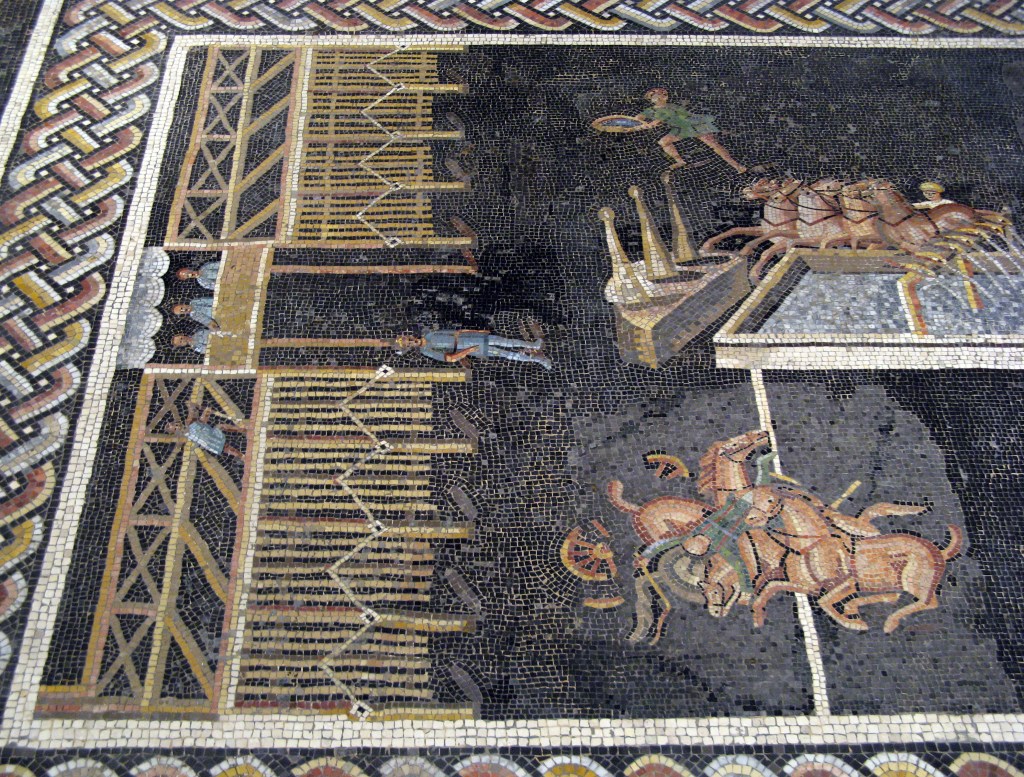
I suppose I also was a bit too sniffy to spend much time in thinking about the charioteers. But over the last few weeks I’ve been turning my sights to them. First there’s the awful danger of the whole “sport”. It is one thing to race in a straight line or round gentle bends. It is quite another to negotiate the sharp bends at each end of the track at speed. That was where the terrible accidents happened, or “shipwrecks” as they were nicknamed. You can see one here at exactly that risky spot, in a Roman mosaic from Lyon.
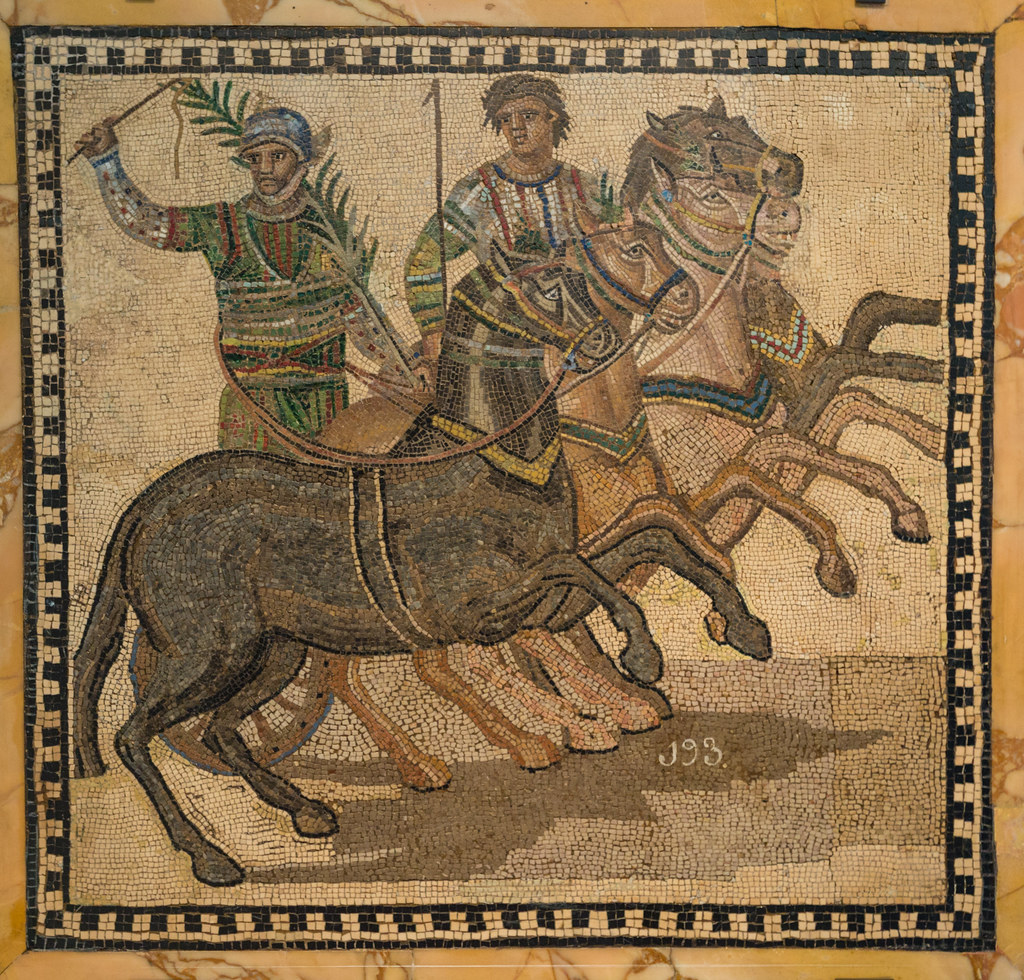
Then there’s the sheer skill of it all. I am no equestrian (a bit of a trot at a couple of pony clubs was about as far as I got), so this may be less difficult than I imagine. But the idea that the charioteers mostly had the horses’ reins round their bodies not in their hands, and controlled them by twisting and turning, defeated me. There’s a picture that implies that here, from another mosaic.
But I have just been looking harder at the inscription on what is (probably) the tombstone of one of the most successful chariot racers ever, Gaius Appuleius Diocles (I say “probably” because the inscription was copied in the seventeenth century but has since been destroyed or at least “lost”). Over dozens of lines, it gave an account of his racing career and his victory statistics.
His main claim to fame now is the vast prize money he amassed over a twenty-four-year career: 35,863,120 sesterces. Equivalences with modern cash are always difficult, but that is roughly the cost of the entire grain supply of the city of Rome for a year. Some people have reckoned that this makes him the highest rewarded sportsperson of all time. But more interesting than that is the glimpse the text gives us into the inside talk, the jargon if you like, of the Roman racetrack.
Diocles, or his heirs, carefully document the way his victories were won. The epitaph refers to the victories he won when he took the lead from the start and held it to the end (“occupavit et vicit”), when he won after coming from behind (“successit et vicit”) and when he made a late dash for the finish line (if that is what “eripuit et vicit” means). And all is documented with precise numbers. He came from behind and won sixty-seven times, took the lead from the start 815 times, and so on. This must be how fans (fanatici) talked about the races (“a brilliant late dash”). And (unless Diocles nerdishly recorded his every move) it suggests that there were archives of the races (like footballing stats) – but held where? At one point there is even mention of the acta (the “records”) which apparently noted the winners.
It’s a great glimpse of those micro-cultures of the Roman empire (here the chariot racers and their fans) that are so often lost to us.
The post Champion charioteers appeared first on TLS.