

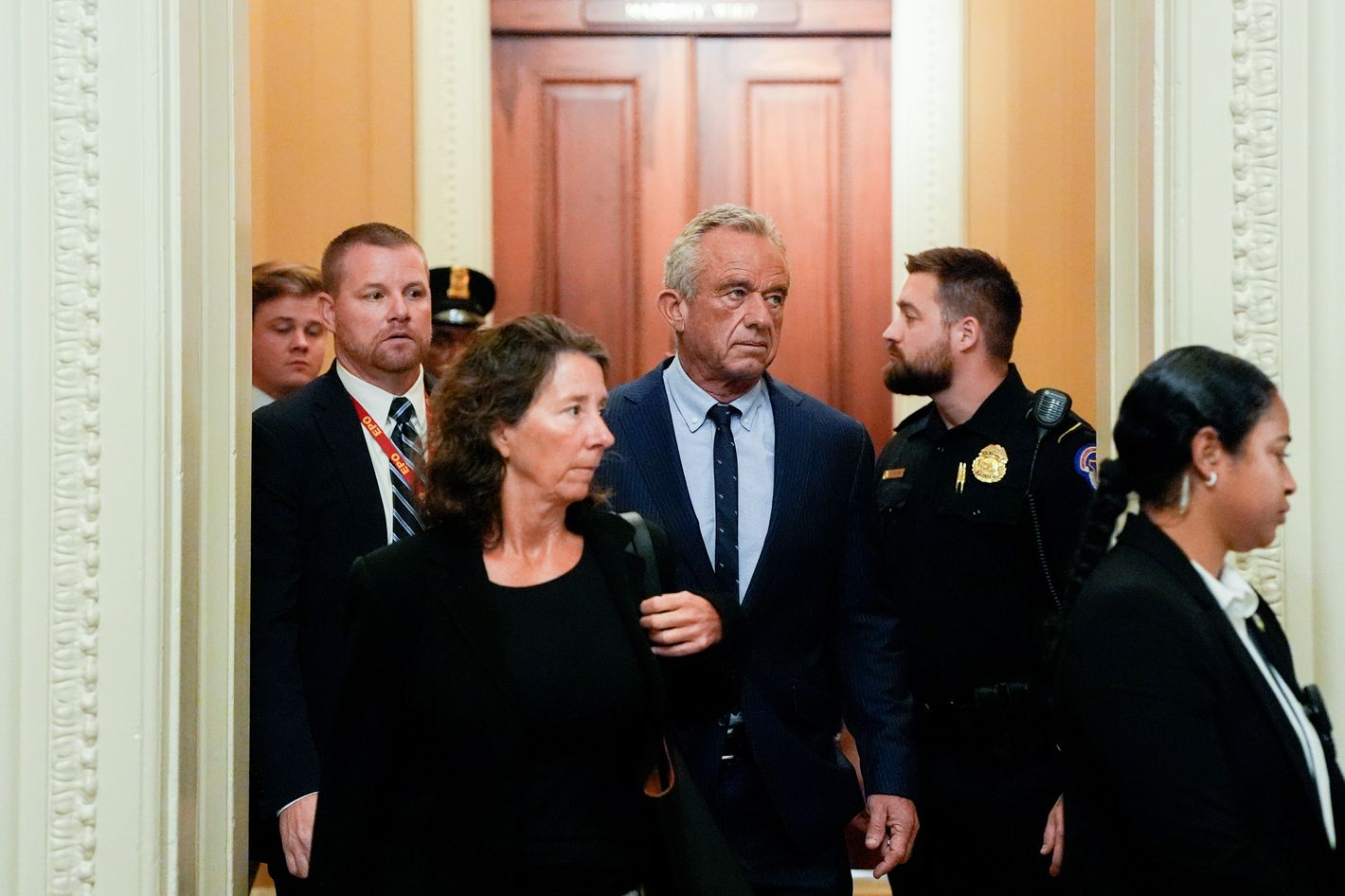
Health and Human Services Secretary Robert F. Kennedy Jr. announced Tuesday that his department will be terminating close to $500 million in mRNA-vaccine contracts and would not fund mRNA development in the future — a significant curtailing of the federal government’s investment in the technology that saved millions of lives during the COVID-19 pandemic. In a video shared to social media, Kennedy said the government’s Biomedical Advanced Research and Development Authority reviewed 22 investments in mRNA-vaccine development and began to cancel them. Kennedy falsely claimed that mRNA vaccines are ineffective against upper-respiratory illnesses like the flu and COVID-19 and that the shot can cause the viruses to mutate and prolong pandemics. He provided no evidence for his allegations.
We reviewed the science, listened to the experts, and acted. BARDA is terminating 22 mRNA vaccine development investments because the data show these vaccines fail to protect effectively against upper respiratory infections like COVID and flu. We’re shifting that funding toward… pic.twitter.com/GPKbuU7ywN
— Secretary Kennedy (@SecKennedy) August 5, 2025
“After reviewing the science and consulting top experts at NIH and FDA, HHS has determined that mRNA technology proposes more risk than benefits for these respiratory viruses,” Kennedy said.
Though Kennedy implementing anti-mRNA or anti-vaccine policies is hardly a surprise at this point, the move has been widely condemned by the medical community (and praised by vaccine skeptics and anti-vaxx activists).
What experts are saying
Rick Bright, an immunologist and former head of BARDA during Donald Trump’s first term, is one of many emphasizing that canceling the vaccine contracts could impact the government’s ability to respond to public-health crises. “BARDA invested in mRNA technology precisely because it could deliver safe, scalable vaccines in record time, a capability proven during COVID,” he wrote on X. “By dismantling that platform, we’re crippling our frontline defense, just ahead of unknown biological threats.”
“This isn’t prudent oversight, it’s self‑inflicted vulnerability. We’re weakening critical countermeasures at the very moment that global-health risks are intensifying,” he told STAT News. “This decision will have severe consequences, measured in lost lives, when a rapid vaccine response is needed.”
Others have pointed out that ending federal support for mRNA development represented a threat to national security. “These tools serve as a deterrent to prevent other nations from using certain biological agents. The speed of the technology to create new biodefense capabilities is a national-security asset,” said Chris Meekins, a former HHS deputy assistant secretary for pandemic preparedness.
Others, like Michael Osterholm, the director of the University of Minnesota’s Center for Infectious Disease Research and Policy, have warned that walking away from the mRNA platform will make the next flu pandemic longer and deadlier. He spoke with STAT News, too:
Osterholm, whose center has done considerable work on pandemic vaccine preparedness, said that the global capacity to make pandemic flu vaccine using conventional production methods would mean there would be about 2 billion doses made within about 18 months of the start of a pandemic. With mRNA-based production, the world could probably be vaccinated within a year, he said.
“This is beyond shortsighted,” Osterholm said of Kennedy’s announcement.
“I’ve seen a lot of decisions by the federal government over my 50 years in the [public health] business, but I don’t remember one that was as dangerous as this one.”
Even Jerome Adams, the former Trump surgeon general who was criticized for his own efforts during the COVID-19 pandemic, expressed concern about the move:
I’ve tried to be objective & non-alarmist in response to current HHS actions – but quite frankly this move is going to cost lives. mRNA technology has uses that go far beyond vaccines… and the vaccine they helped develop in record time is credited with saving millions. 🤯 https://t.co/xUntdhoJJK
— Jerome Adams (@JeromeAdamsMD) August 6, 2025
The anti-vaxxers want more
Anti-vaccine groups and activists praised Kennedy’s move, with many hoping the secretary goes even further in fighting against mRNA technology.
Mary Holland, the president of Children’s Health Defense, said her organization “applauds” the government’s decision to defund these projects. The nonprofit, known largely for its advocacy against vaccines, was previously chaired by Kennedy prior to the start of his political career. “While we believe that the mRNA shots on the market are unsafe and should be off the market, this is a welcome step in the right direction. The pandemic preparedness industry as it exists today is a threat to human welfare,” she said in a statement.
Mary Talley Bowden, president of the anti-COVID-19-vaccine group Americans for Health Freedom, called the announcement “good news” and a “tacit admission” that mRNA vaccines are not safe. “Let’s take this a step further @SecKennedy and pull all mRNA shots off the market,” she wrote on X.
Related