

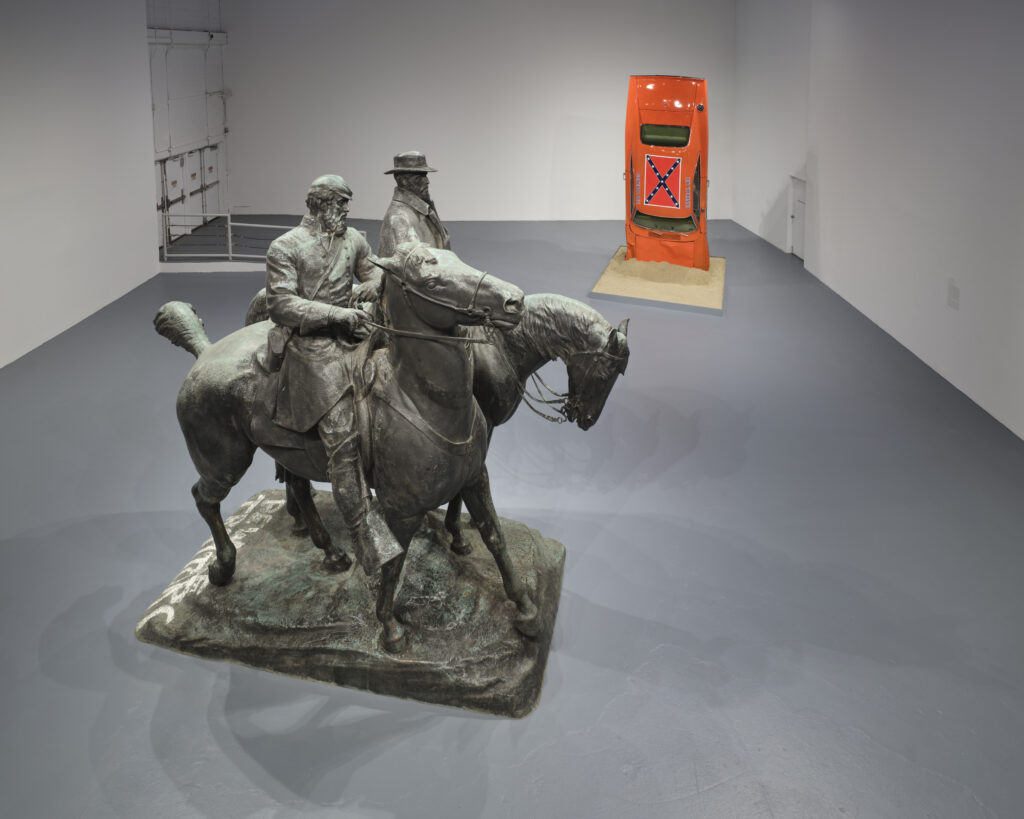
Installation view of MONUMENTS, October 23, 2025 to May 3, 2026, at the Geffen Contemporary at MOCA. Courtesy of the Museum of Contemporary Art (MOCA) and the Brick. Photograph by Fredrik Nilsen.
This is not a traditional review but a look at the set of myths and the sublimated pursuit of dominance that have made it necessary to mount an exhibition featuring decommissioned Confederate monuments disrupted or forced into deeper layers of disgrace by remix and recontextualization. The result is a humiliation ritual that both targets and empowers white nationalism in the American South, instigating its reactionary temperament just enough to arouse productive tension but not enough to alleviate it or rehabilitate the temperament itself. Since its opening this past October, which came in the wake of the brutal, live-streamed assassination of Charlie Kirk and public fallout that ranged from glee to real mourning to opportunistic purposing of the optics of both grief and outrage, MONUMENTS, at the Geffen Contemporary at MOCA and the Brick in Los Angeles, has been an institutional zone wherein real and symbolic clashes between far-right extremism and bourgeois liberal dismay are played out in pantomime. We are all of us characters in this impromptu theater of convoluted archetypes.
Paradoxically, in the museum or gallery, ornate propaganda for the Confederacy gains some of the dignity of archaeology. Its monuments become pendulums swinging backward, gathering the momentum that comes from being the subject of protest and outrage, kept at bay and in check by that attention, but not for long. They haunt better there, stalking the mind like hunters in an offseason. Think of Billie Holiday’s tawny tone belting “This year’s crop of kisses are not for me, for I’m still wearin’ last year’s love” or the deceptively whimsical opening line to “Strange Fruit”: “Pastoral scene of the gallant South.”
***
The stable of statues and monuments that once adorned U.S. cities, tasked with subtly flaunting white nationalism’s triumphant past, have become petrified entities we can reanimate and make dance at will. This is their logical karmic destiny if we remember the way the hired hands manning slave ships made their newly initiated labor force dance on the decks so their muscles wouldn’t atrophy in the holds. Our grand assets become our marionettes. Those dances were the first phase of what is called the entertainment industry in the West—men and women in shackles, practicing for forced labor, improvising horrified waltzes into prayers to ward off death and shipwreck. Perhaps, besieged and desperate for touch and fresh air, some grew attached to these brutal aerobics, experienced them as a reprieve from more severe humiliations, and invented new styles of movement and music to accommodate forced performance. The captives staged rituals of possession and exorcism, as if rehearsing the spirit’s escape while captors cheered and celebrated what was, to their smug gaze, an exquisite spectacle of allegiance to their system. The dances were simultaneously promises of surrender and premonitions of rebellion.
When that system was overthrown, statues that heralded the Confederacy’s glory arrived in its place to haunt the idealism of freedom. These statues were enshrined in parks or town squares as silent, eternally resonant, speech. What did the Confederacy’s monuments want? What were they confessing through their passive-aggressive poses when commissioned by Southern and Northern states alike? Were they not merely biding their time before openly reverting to the plantation logic by which they could make you dance while bidding on or beating you into sublime resignation?
***
And we retaliated, remixed Confederate grievances with our good graces. We made new gospels, new genres of music and thought that they would of course borrow from or mimic but never master. We made our monuments transient, tricksters that seem one way while being another. We changed as soon as we were decoded, jazz into hip-hop into mumbling and back. New dance forms would accompany each, new uses of the body in space and time. We were ruthless and unsentimental about reinvention. Think of Miles Davis’s range, the permutations of his sound both becoming and toppling sonic monuments. Today, we’ve sampled and broken open stray archival video and audio that populates the internet’s many ghettos and gated communities, until even the literary canon’s assets and archetypes are up for grabs. (See Percival Everett’s retelling of Huck Finn, or Henry Dumas’s “Will the Circle Be Unbroken?” insinuated in Sinners; see samples of Baldwin’s and Morrison’s speeches deployed in every direction—sometimes meaningfully, sometimes because they are needed as mascots to signal virtue.) This is the cultural landscape the Confederate monuments were confronted with as they became increasingly conspicuous during the BLM years. Reckoning was inevitable, the culture would want to do with them what it had done with sound and language.
Beginning in 2017 with the removal of statues of Robert E. Lee in New Orleans, that reckoning or wrecking ball came. Monuments that heralded the culture of chattel slavery and segregation thereafter were vandalized with abandon, forcibly removed by protesters, or decommissioned by municipal governments in half-hearted gestures of reconciliation that ultimately felt like the gloved hand of an official person waving from a parade float—it sees you but it will not reach out to you. It seizes you without touching you. The trouble is, these statues and plaques are alive, and even or especially in uprooting and wounding them, we aroused them, daring them to reassemble as the walking dead. The territory they once occupied is now doubly haunted by exile and the ever-present threat of return. The nation is splattered with these zombie structures, or sutures, with nowhere to be and no path to total erasure. This is when Hollywood, our great cemetery of living-dead fantasies, came calling.
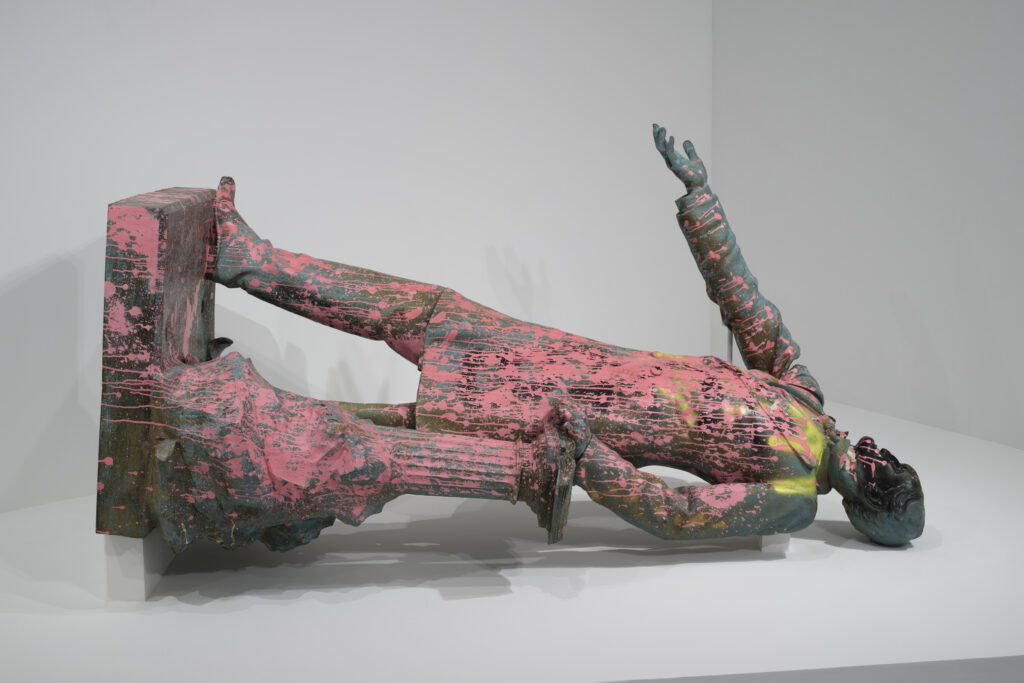
Installation view of MONUMENTS, October 23, 2025 to May 3, 2026, at the Geffen Contemporary at MOCA. Courtesy of the Museum of Contemporary Art (MOCA) and the Brick. Photograph by Fredrik Nilsen.
***
Curated by Hamza Walker and Bennett Simpson for the Brick and the Geffen Contemporary at MOCA, MONUMENTS is the ghost of Gordon Parks’s American Gothic reappearing to clean up the past decade of distinctly post-9/11 Obama-meets-MAGA era demolition. The physical act of transporting vestiges of the Confederacy and the protest songs they inspire to 2025 Los Angeles to become one ensemble merges with the ritualized everyday in a city whose economy was built on fantasy, shadow and act. With the feigned blasé of someone entering a nightclub with armed guards for bouncers, you pass security to enter the exhibition and gawk at the big band of bandits, survivors, and assassins. The most sinister of the objects, with a will of their own that bends toward opportunism, are there to be rehabilitated and made progressive by association. The museum, sterile and accommodating by nature, is a minimum-security prison, and the objects seem to relish an extended conjugal visit while we watch. I walked through this scene feeling a déjà vu of the shameful erotics of the Walk of Fame, and tried not be starstruck, both over- and underwhelmed, convinced and unconvinced, by this spectacle of propaganda and trauma. The villains have star quality, the heroes sing pretty; the tension between them, their endless rivalry, is as good for empire as it is for movies and other cultural capital. With the whole cast in one place, you can feel the artifice that binds Confederate ethics with neoliberalism’s policing of temperament in the hope of establishing a gentle, unproblematic affect of decency in the collective. It’s sad, like the liberals and the fascists need one another to sustain the discreteness of their personalities. They subsist on one another, are dependent on an opposition that can only be mediated by Black people. Black people, their forever minstrels and muses, go limp in the cross fire yet still put on a great show.
The archaic and the brand-new are in a familiar museum dialogue, whispering opinions to each other back and forth. There’s an upside-down lowrider not far from where a Julie Dash film loops, featuring the singer Davóne Tines, a tribute to the nine congregants killed during a prayer meeting at Charleston’s Mother Emanuel African Methodist Episcopal Church in 2015. One headline reads that the exhibition “topples white supremacy.” I’ll be honest and say that it helps us remember and reenact its hold. As I watched the Dash film at the opening, surrounded by mostly white people, I was hypervigilant of the spectacle of reaction. Though almost moved to tears, I refused them because it felt a bit like being danced, brought out to demonstrate an imposed sorrow in the semi-public of the museum. The exhibit topples the myth that the myth of white supremacy can be toppled.
The endeavor of this exhibition is so absurd and so ambitious that it courts the very convergences of disaster it laments, which is to say that it is fully realized. Kara Walker sacrifices a decommissioned Stonewall Jackson monument from Charlottesville, Virginia, to be its crowning, crow-cawing catastrophe. She forces the takedown that became a meme for radical triumph into the body, where it accrues momentum and substance like a drum machine, the mangled heartbeat of the matter quickening through her. Walker constructs her own monster, turning Jackson and his horse into a hideous centaur that stands solitary in the belly of the Brick’s gallery. Like a grotesque heap of stuntman costuming trapped in a film-studio back lot, the grammar of MONUMENTS collapsed into one hysterical high note. She calls the work Unmanned Drone, at once dehumanizing the dismembered Jackson and his stallion and rendering them into a freak of such character that the statue almost becomes amiable, one of those cinematic ghouls you come to love and want to confide in. And suddenly the men who martyred themselves to terrible ideas become fairy-tale creatures, an army of Tin Men born without hearts. These figures came into the world incapacitated. They’ve borrowed, then hijacked our emotional intelligence in order to survive. The U.S. will never outrun nostalgia for its own evil, its own proud freaks, and nor will the trickster spirit driving that nostalgia-sickness (always part envy-sickness) ever fail to convince us that it’s been humbled by having been remixed by an honest artist, while everybody else, the spectator, the dancer, the overseer, the danced, looks equally ridiculous. A masterpiece here, and mastery itself in the American context, is always part tragedy, part farce, part runner looking over her shoulder hoping to be captured and made famous for a lifetime of reiterations of her failed resistance. Jackson rides his broken horse onto Sunset Boulevard while the sunset itself backs away—at least on camera.
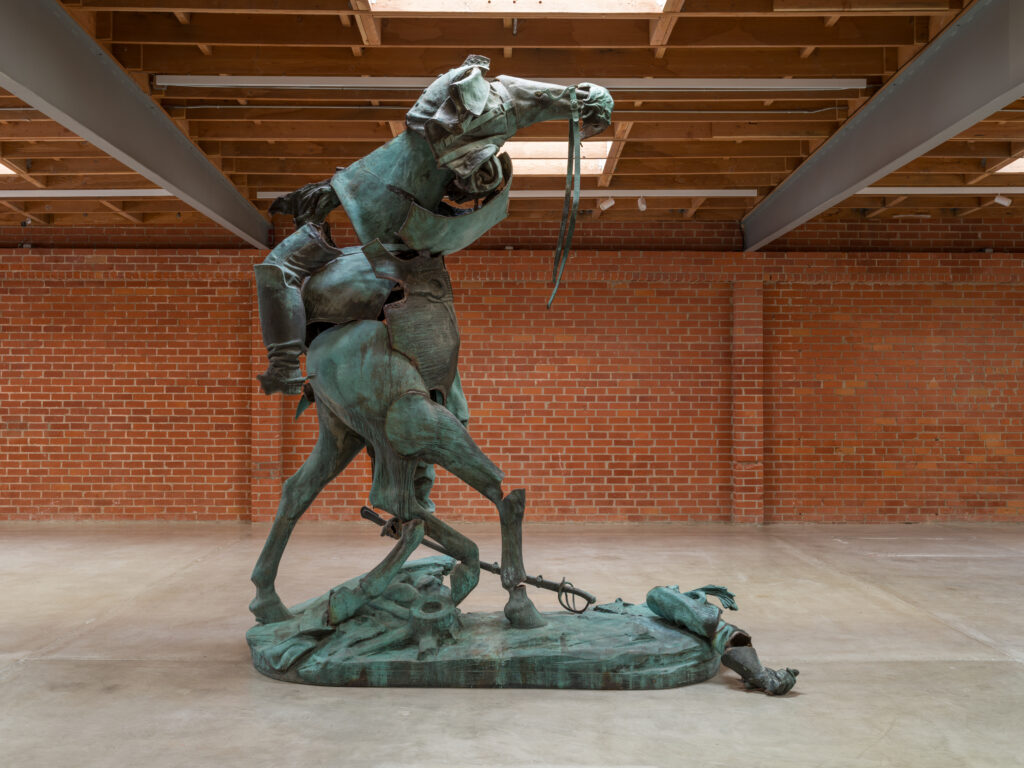
Installation view of MONUMENTS, October 23, 2025 to May 3, 2026 at the Geffen Contemporary at MOCA. Courtesy of the Museum of Contemporary Art (MOCA) and the Brick. Photograph by Fredrik Nilsen.
Harmony Holiday is a writer, dancer, archivist, filmmaker, and the author of five collections of poetry. She is currently at work on a biography of Abbey Lincoln, a book of memoir and music criticism, and her next collection of poems, among other writing, film, and curatorial projects. Her first solo exhibition in Los Angeles is now up at REDCAT through July 2026.