

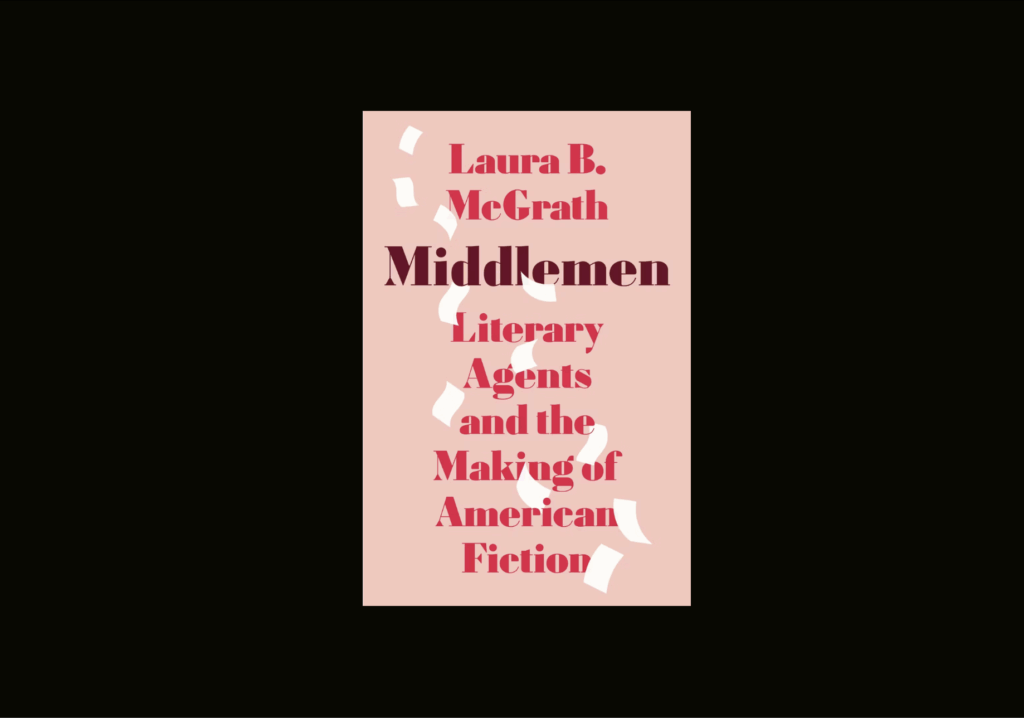
The literary agent is a mysterious and camera-shy creature, rustling busily in the literary undergrowth, her tracks visible only to those familiar with the species and its habits. If we were in the mood to further pursue this metaphor, we might compare her to one of those small but weirdly powerful wild cats one might glimpse in an episode of Planet Earth, only about knee-high but capable of causing great scurrying and alarm merely by swishing her tail. As Laura McGrath, a literary historian, argues in Middlemen, her history of the profession, “no figure has been more significant, and yet more invisible, in American literature than the literary agent.”
Take, for example, the agent Candida Donadio, a legendary figure with impeccable taste whose regular table at the Italian Pavilion restaurant in New York was “the undisputed central node in the network of the U.S. publishing industry” in the sixties. One of her clients was Thomas Pynchon, whose first novel, V, Donadio had helped to publish in 1963. A few years later, Pynchon’s trusted editor was moving to a new publishing house, and Donadio persuaded him to “throw something together” in order to fulfill his contract and follow his editor to Viking. The product of Donadio’s prompting was The Crying of Lot 49, today considered a masterpiece of postmodernism.
Agents, McGrath suggests, are the first and most consequential gatekeepers in contemporary publishing. Though the agent’s hand is rarely visible outside a book’s acknowledgments section, agents often play a decisive role in developing a manuscript long before an editor acquires the book. This can mean anything from editing “at the 30,000-foot level, thinking with their client about positioning their book in the market” to close line editing. “We all edit,” says one anonymous agent interviewed in Middlemen. “We think about the book not just as a piece of art … but also how it will be most appealing to the audience it’s intended for.” All of this will be obvious to anyone who works in the publishing industry, but one strength of McGrath’s book is that she comes to the subject as an unjaundiced outsider. A professor of English literature who has never worked in publishing, McGrath describes the mechanisms and eccentricities of the industry with a clarity and curiosity that insiders don’t necessarily have.
Over email, McGrath and I discussed the importance of the debut novel, the relationships between agents, editors, and clients, and the almost mystical significance of the publishing lunch.
INTERVIEWER
You call agents the unacknowledged legislators of the literary field—what do you mean by that, and how did you come to see them that way?
LAURA B. MCGRATH
Agents have so much influence over American literature, and yet they’re virtually invisible outside of a few square blocks of Manhattan or a few corners of the literary internet. Agents decide who gets access to the literary marketplace and who doesn’t, by virtue of their decisions about who to represent. They control the way books get published, by determining which editors to pitch and how to position a project and how best to advocate on their writer’s behalf. They educate writers about the ins-and-outs of the publishing industry and help writers decode, and sometimes appease, the market. Because agents serve as mediators between the author, on the one hand, and the publisher, on the other, they embody the contradictions of contemporary publishing. It’s not either art or commerce with agents—it’s always both.
INTERVIEWER
You say that before you started working on this book, you knew agents only by their stereotypes. What changed your view?
MCGRATH
I imagined literary agents were like Looney Tunes characters, walking around with dollar signs for eyes. I assumed that they were interested only in money. I’d been influenced by the Hollywood agents I’d met—charming but also sleazy, doing a lot of coke. But the days of making a fortune in publishing are past. I didn’t have a good sense of the financial realities of the industry. If they only cared about making money, they would’ve gone to work at Goldman Sachs.
My perspective on agents changed almost as soon as I began speaking to them. I found the agents I spoke with to be intelligent, compassionate, and reflective. Also charming! A professional requirement, I suppose. Aside from their general charisma, they were almost nothing like I expected. The biggest surprise to me was that they care about books! Many agents are extremely hands-on with manuscripts, at a much earlier stage than editors. Agents help writers to refine their manuscripts prior to submission, so they also do editorial work. Their eye for craft has been honed through years of work as voracious, highly analytical readers.
As advocates for authors, agents are making the case for the value and the future of books and reading, every single day. Every single pitch is an argument for why this particular book should exist in the world. Why this writer is worthy of readers’ attention. Why our mental and emotional lives, as readers, would be richer or fuller if we entered into conversation with this specific writer and this specific book and why publishers should make that happen.
INTERVIEWER
Why do you think these stereotypes are so pervasive?
MCGRATH
For writers, the agent is a walking embodiment of the market—for better or worse. I think that’s why agents tend to be such loathsome characters in books about publishing. For instance, Percival Everett’s agent character in Erasure, Yul, is largely on the sidelines—the entire hoax is Monk’s creation, and his agent initially tries to talk him out of it. Monk has such distaste for Yul because he represents Monk’s past—the modest literary successes that Monk thinks of with shame, as having sold out. The agent isn’t treated with contempt by Ben Lerner in 10:04, but she is responsible for the quagmire that the narrator finds himself in. She sold a hypothetical novel based on a short story in The New Yorker for quite a lot of money, and now the narrator must write that novel, without any real idea or desire to do so. In Danzy Senna’s Colored Television, the writer-professor Jane begins her downward spiral when she is fired by her agent. The agent doesn’t understand Jane’s literary vision and fires her because her magnum opus isn’t commercially viable. Jane holds her former agent’s poor taste responsible for the many questionable choices that follow. And though he is initially hesitant about his white author posing as Asian American, the agent in R. F. Kuang’s Yellowface enables, then encourages, and finally goads on June from the sidelines, persuaded by the cash she’s raking in. In the spate of mystery-thrillers set in and around the publishing world—please, make it stop—the butler is no more. Invariably, the agent did it.
INTERVIEWER
How did you go about researching the book?
MCGRATH
I spent a lot of time in archives, like at the New York Public Library, at the Harry Ransom Center at the University of Texas at Austin, and in Special Collections at Columbia and at NYU. Records of agents’ work are really only preserved through their clients’ archives. So finding historical material involved a great deal of speculation and intuition about archival absences, as many writers didn’t preserve much. I also analyzed a ridiculous amount of data, most of which is publicly available online and simply requires some elbow grease and a whole lot of patience to wrangle. This included industry-specific data compiled in publishers’ seasonal catalogues, the texts of deal announcements, member information from the Association of Authors’ Representatives (now called the Association of American Literary Agents), and salary data from Publishers Weekly, as well as national readership and population-level data made available by the National Endowment for the Arts, the U.S. Department of Education, and the U.S. Census Bureau, among others. My goal was to get a full picture of the work of literary agents, the kind of bird’s-eye view unavailable to any individual working in the industry, but also a granular understanding of agents’ aesthetic judgment and market knowledge and business strategy that large-scale data couldn’t possibly provide.
The core of this book is based on interviews—I spoke with over seventy-five literary agents, anonymously, over the course of ten years. It was important to me that I document the profession as they see and experience it. I also did some fieldwork. I shadowed agents at the Frankfurt Book Fair. I sat in on meetings. I read pitch letters. I even tagged along on a so-called three-martini lunch with an agent and editor—alas, not a martini in sight. Agenting is so much about performance, and I felt it important to watch agents performing for different audiences, for one another, for editors, for authors, for foreign publishers.
INTERVIEWER
Lunch! Why does it matter so much?
MCGRATH
I call lunch a ritual and a metaphor. As a ritual, it’s how agents and editors get to know one another as professionals and as readers, in hopes that the agent will pitch the editor in the future with projects that might be a good fit. As a metaphor, it shows how publishing is built on relationships that are both professional and personal. The relationship between agent and editor—built on taste, on trust, on temperament—is particularly important. Many agents I spoke to described their job as matchmaking, knowing what kinds of books editors are looking for and knowing which clients might be a good match for them. That means knowing which editors to pitch, but it also means knowing how editors work, to determine if they will connect with a client and bring out their best. The agent’s job is about personality as much as it’s about taste.
INTERVIEWER
Most literary agents are women—why is that?
MCGRATH
Historically, publishing was long known as a boys’ club, handed down from fathers to sons, hiring fraternity brothers and lifelong chums. In publishing houses, women reached so-called ceiling occupations relatively quickly—if they weren’t working as secretaries, they’d work in children’s, or maybe they could work their way up to head of publicity. They could rarely break into editorial. Agenting, by contrast, is much more independent and entrepreneurial. Women turned to agenting because they found less institutional sexism, less hierarchical pushback, and more opportunity for personal advancement. Their success was dependent on their clients, not on their boss, who would probably hire another Harvard man before he promoted his secretary, anyway. Women were also well suited to the sort of work required of early agents. The world of agenting depends on gossip, on exercising soft power, on placating big personalities and even bigger egos. They’d spent a lifetime navigating patriarchy—why should navigating publishing be any different?
INTERVIEWER
In the book, Amanda “Binky” Urban, who represents authors like Kazuo Ishiguro and Cormac McCarthy, tells you that literary agents are like small children—“They should be seen and not heard.” Was that a sentiment you heard a lot?
MCGRATH
No one said it quite as succinctly as Binky! But I think all the agents I met felt the desire to remain in the background to some degree. Partly, this is because their job is to make the business of writing look easy, and to make their clients appear to be artistic geniuses, unconcerned with money. On the other hand, there’s a great deal of symbolic capital attached to the sort of gut instinct that enables agents to find great writers, predict what people will read or at least buy, and exercise good taste. That’s how the magic works. The more we hear from agents, the more we learn about the strategies that guide their decision-making, and they lose some of that mystery.
INTERVIEWER
Something that I’m sure readers are going to seize on is the fact that “twenty-five agents are responsible for representing half of the authors short-listed for major American literary prizes in the twenty-first century.” Were you surprised by that figure?
MCGRATH
I suspected that there would be only a few agents concentrated at the top, yes. Whether or not you are surprised by this figure has a lot to do with your opinion of literary prizes and the health of our literary and intellectual culture. Is there a significant amount of truly excellent literature being published? And do literary prizes actually find and reward that work—the most excellent? Prizes are one of culture’s great games. The rules can be learned, and the game can be won. To my mind, literary prizes surface a particular sort of literature, the intellectually and aesthetically interesting, and perhaps even challenging, works that have also benefited from significant publisher buy-in and have attained a high profile. Few books manage to succeed on both levels. Representing books that can do both requires a great deal of skill—to find the high-quality work and make it undeniably appealing to a mass of people. I suspected that only a few agents would be able to do that very well.
INTERVIEWER
In a chapter on the debut novel and what you describe as “the debut narrative,” in which the book and the author are simultaneously introduced to the public, you say that “the literary field of the twenty-first century is defined by its immaturity.” Could you talk a bit about that?
MCGRATH
It’s rare, in my opinion, that an author’s first novel is their best. But the obsession with an author’s so-called potential, quantified in their sales track, means that it’s much easier to generate enthusiasm for a first book than it is to generate enthusiasm around a second, third, or fourth book. A first book is pure potential. I fear that authors aren’t being given the opportunity to mature if debuts don’t meet expectations. A preponderance of debuts are coming-of-age narratives that close the distance between a young author and his young protagonists, books that focus on the experience of immaturity to maturity. I just hope that the novelists can get there with their own craft.
INTERVIEWER
There’s a great bit about the affair that Lynn Nesbit had with Donald Barthelme, which is an extreme example of the kind of sustained, intimate relationship that can develop between agents and their clients. Could you describe some of those relationships?
MCGRATH
The relationship between agent and author can be very close and personal. Ideally, agents stick with authors over the course of their entire career. They don’t just represent books—they represent people. That may also be true for editors, but it’s increasingly rare that an author and editor will get to develop the sort of relationship emblematized by, say, Max Perkins and Thomas Wolfe or Gordon Lish and Raymond Carver. Writers have to trust their agent with deeply personal things—their creative work and their money. I had just started working with my agent, and I was telling her about my salary as a professor. My sister doesn’t even know that! It’s not surprising that these relationships often bleed from professional into personal, sometimes quite personal.
INTERVIEWER
You say that “much of the literature we now associate with high postmodernism was published as a result of Donadio’s taste and tenacity,” referring to Candida Donadio, who represented writers like John Cheever, Thomas Pynchon, and Philip Roth. How does something like that come to be?
MCGRATH
Like all of the agents I discuss at length in the book, Donadio reveals what’s possible for an agent. She had such distinct taste. She knew exactly what she liked, even if it was weird or misunderstood, and she was willing to fight for it. And her clients are proof that her taste was amazing—Joseph Heller, Pynchon, Roth, William Gaddis, Bernard Malamud. It’s Postmodernism 101. Donadio knew they were great when everyone else thought they were crazy. But good taste means nothing if you can’t sell a book, and selling a book is really about the strength of your relationships—do editors trust you? The editors she worked with were willing to take a risk on her oddball clients because she believed in them. We need only to look at her clients’ influence over American literature to understand the degree of her own legacy.
INTERVIEWER
You mention “a telegram from Philip Roth to Candida Donadio, thanking her for her work even as he fired her (‘unlike Portnoy I have no complaints’).” What happens when these relationships turn sour?
MCGRATH
Ideally, agent and writer stay with each other through thick and thin. In reality, these are relationships between humans, and humans are, by nature, fickle and temperamental and selfish. Sometimes, agent and author have different ideas about a book. Sometimes, creative interests and career aspirations shift. These relationships turn contentious for any number of reasons. It’s perfectly common for author and agent to go their separate ways.
INTERVIEWER
In 1963, Esquire published its literary-establishment centerfold, with Donadio and Robert Gottlieb right in the middle. It did the same thing in 1989. People who were left out “stayed pissed about it for years.” Do you think such an overview of what’s considered the literary establishment would still be possible in 2026, or has publishing changed too much?
MCGRATH
I definitely think it’s possible to map the field! The transformation from 1963—a two-page spread—to 1987—a four-page spread—was massive. It included so many more players—writers, publishers, magazines, agencies, media, the glitterati—all with a kitschy space theme. Today, we’d have to include conglomerated talent agencies, most of which are in LA. We’d also have a smaller network of literary journals and magazines that commit space to book coverage. And we’d have to think about entirely new innovations like Substack or other self-publishing platforms that are currently peripheral to the establishment but increasingly becoming central. Publishing has gotten a whole lot bigger, but I think that the number of truly consequential institutions or individuals has stayed about the same as 1963. People would certainly be pissed off, but they now have countless online outlets for their fury, so the effect of such an experiment would be cataclysmic.
INTERVIEWER
I wanted to ask you about the observation that literary agents are the first and most consequential gatekeepers. You have a very popular Substack. The claim is often made on that platform that traditional publishing is on its way out and that agents will soon be obsolete or possibly are obsolete already. What do you make of that claim?
MCGRATH
I don’t accept the premise. The idea that traditional publishing is on the decline is nothing but a Big Tech fever dream, an extension of the libertarian techno-utopianism that drives Silicon Valley. Self-publishing might not have literary agents, but it’s filled with gatekeepers—they’re just algorithms instead of humans. I don’t believe that agents will become obsolete any more than I believe that traditional publishing will become obsolete. Does publishing need reform? Yes. Should our literary life, our reading lives and our writing lives, our creativity and our attention, be given over to Big Tech? Absolutely not—god help us.
Rosa Lyster is a writer who lives in London.