

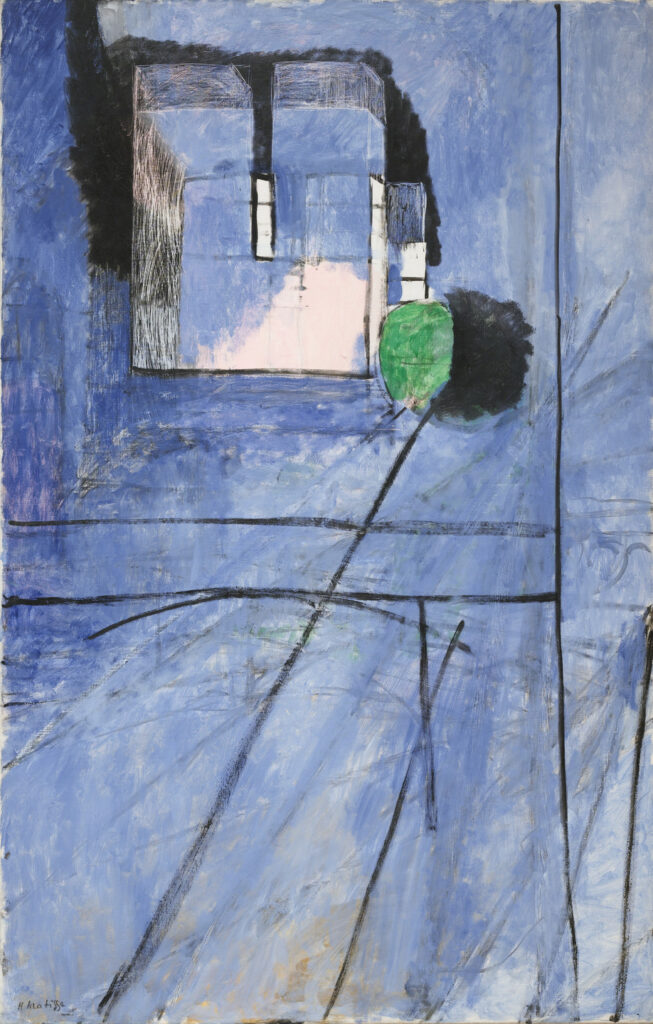
Henri Matisse, View of Notre Dame, 1914, oil on canvas, 58 x 37 ⅛ in, via Wikimedia Commons. Public domain.
The Ignorant Art Historian is a series by the art critic Hal Foster, in which he tries to “demystify the viewing of art a little, not to deskill it exactly, but to suggest that anyone can do it.” You can read his introduction to the series here. The next three installments will appear weekly throughout May.
As we approach this painting, we have little idea of what it depicts, or whether it depicts anything at all. A washy blue covers the entire surface unevenly, and its space is traversed by several black vectors. A vertical line stretches the length of the canvas on the far right, where it intersects with two horizontal lines that cut across the center of the picture. In the lower half of the painting, three diagonal lines run roughly parallel to one another, also toward the right.
The main motif floats in the top third of the painting. Outlined heavily in black, its interior is made up of the same blue as elsewhere except for one white blotch and a few black planes, scratched to reveal the white underneath. Three thin, white planes also appear in the interior, each crossed with a horizontal black stripe; the central plane divides the space in two.
All this is hard to sort out, and two more pieces on the right—a green blob beside a black one—only add to the puzzle. It is a complicated painting, but its complication is borne of simplicity. Completed in 1914, at the beginning of World War I, it is an austere work in an austere time.
The title offers a kind of lifeline: View of Notre Dame. But what kind of view and from where? And what are all the black lines? Neither abstract nor representational, the painting requires a shift in our way of looking: its elements are less images of things than signs for them.
We know that the Notre-Dame sits on the western end of the Île de la Cité in Paris. So the three diagonals might signify the quai along the Left Bank, the low path alongside the Seine, and the great river. The two horizontal lines then read as a bridge over the Seine, and the slight curve underneath them as its arched support. Finally, the long vertical line serves as the near edge of the quai, or perhaps of the very building from which the view is taken. The angles suggest that we look down on the scene from a Left Bank apartment several floors up. The overall blue signifies air and water where that seems appropriate, and anything else (or nothing at all) where it does not.
How does the squarish motif convey the famous cathedral? If the bisected shape suggests the two great towers, the white plane between them might evoke the rose window. Since we view the cathedral from the Left Bank, it appears turned away from us slightly, its south side more exposed. If the black areas register the sides of the building in deep shadow, the white ones might signify the play of light across the facade. And the blobs in green and black? The green could be a plant, and the black its shadow.
The pieces don’t add up completely or neatly. But then signification is about signaling-just-enough rather than representing-in-full. Here, seeing is guesswork. It often is elsewhere, too; we just don’t acknowledge it. Sometimes a sign doesn’t signify and sometimes it suggests more than one thing. The diagonals evoke both the quai and the river; the black areas convey a material thing here and an immaterial shadow there.
Around this time, Matisse kept a studio above the quai Saint-Michel. Might View of Notre Dame double as a view of the interior from which it was painted? In that case, the Paris cathedral is also a French window, with blue sky and white clouds seen in or through the glass; the green shrub is also a plant on the sill; the lines of the bridge are also the molding in the room; and—who knows?—the diagonals of the bank are also the easel on which this very painting was produced.
Hal Foster is an art critic and art historian. He teaches at Princeton University.