

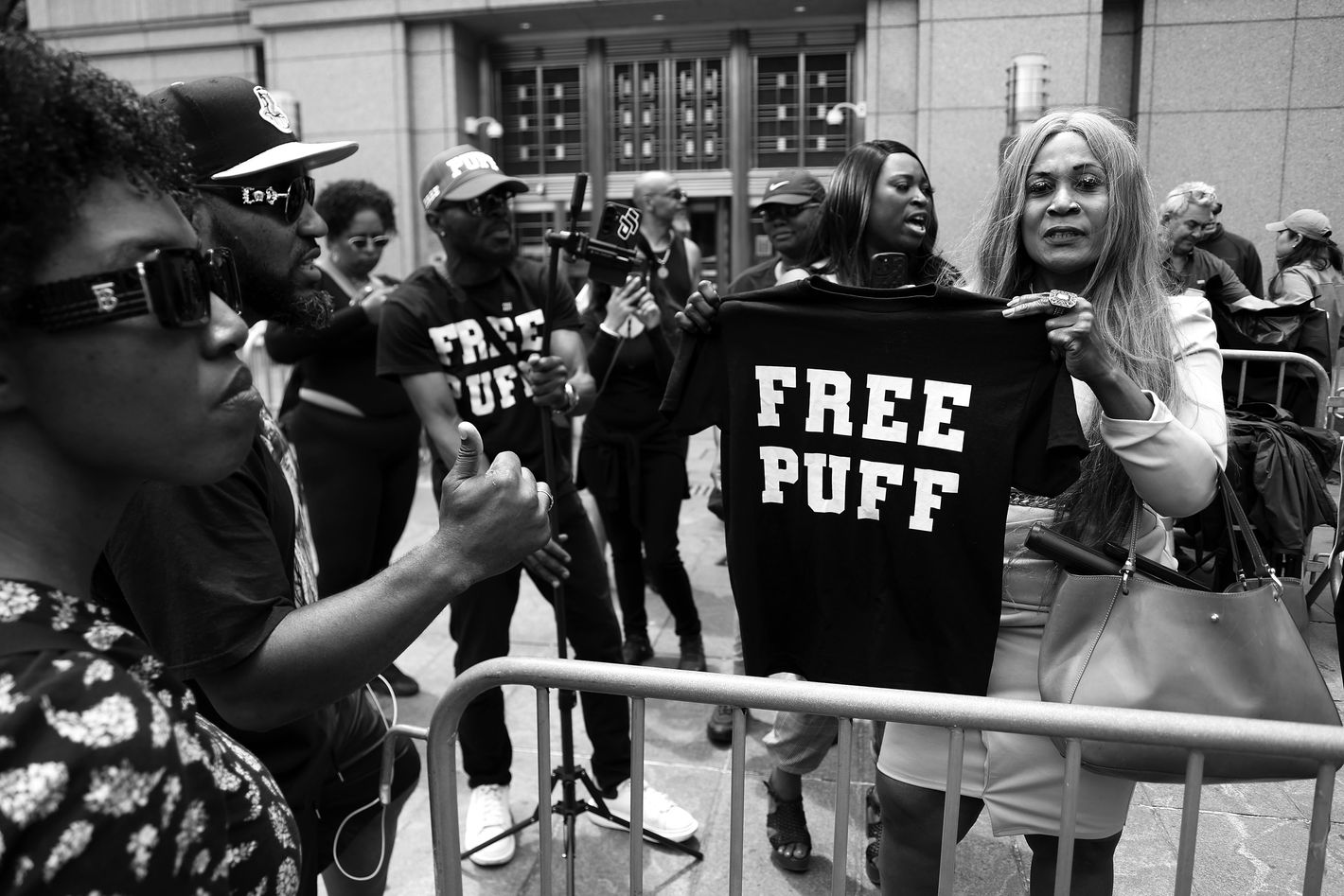
“It’s a baby oil summer 😂.” “Cassie was never a victim.” “The prostitutes need to be convicted too.” “Free Puff.”
This is a small sample of the comments that popped up on the Shade Room’s Instagram account within minutes of a jury finding Sean “Diddy” Combs not guilty of sex trafficking and racketeering conspiracy on Wednesday. The rapper was convicted on two other counts of transportation to engage in prostitution, pertaining to two of his ex-partners — the singer Casandra “Cassie” Ventura and “Jane,” an influencer who testified under a pseudonym.
For many of his defenders online, the fact that the jury found Combs guilty only on the lesser charges seemed to underscore his alleged innocence — even though, in addition to the criminal charges, he is also facing more than 70 civil lawsuits accusing him of wide-ranging abuse including rape, sexual harassment, sex trafficking, and the creation of nonconsensual pornography. Commenter after commenter among the Shade Room’s nearly 30 million Instagram followers called Ventura and Combs’s other accusers “304s” (slang for “hoes”), said the women needed to be prosecuted, or joked they’d like to attend one of the rapper’s infamous parties.
One could write off the despicable responses as the work of trolls, but outside the courthouse, Diddy’s supporters had gathered day after day during the trial. Some of them even sprayed baby oil into the crowd following the verdict, a callback to the allegations that Combs used it during his so-called “Freak Offs.” Online and in person, this giddy response to the end of a trial centered around sexual-violence allegations against a powerful, wealthy man exposes the terrible ways in which our culture is turning back the clock to more misogynistic times.
Maybe Me Too is really dead.
After all, as soon as the movement exploded in the fall of 2017, the backlash was swift. Increasingly, it has felt as though any cultural progress that women’s rights and well-being collectively made in the last decade have been steadily eroding and have been replaced with a throwback brand of women-hatred and rigid gender expectations.
Language that has proliferated in the manosphere — a.k.a. the constellation of online misogynistic communities that includes pick-up artists, incels, and the Men’s Rights movement, as well as, now, teenage boys and your worst uncles — has comfortably spilled into the mainstream. From there, think of classifications such as “alphas” and “betas,” the suffixes -maxxing and -pilled, plus TikTok-y signifiers like “masculine” and “feminine” energy that are now used regularly by people of all political stripes. As the language has infiltrated our culture, so have retrograde and hateful beliefs about women’s place in society — either pushed explicitly by people like the brother podcasters and accused rapists Andrew and Tristan Tate or in stealthier ways, as Republican-aligned influencers continuously do.
This shift has manifested in the gleeful cruelty and conspiratorial thinking surrounding Depp v. Heard, which is now being echoed in Lively v. Baldoni. It was shown by how Donald Trump, a man facing more than two dozen credible sexual-assault allegations and who was found liable for sexual abuse, is now back in the Oval Office surrounded by other alleged abusers. Trump’s reelection was met with the phrase “Your body, my choice” and other equally horrific sentiments, such as a call to repeal women’s right to vote.
According to the New York Times, researchers also found that between May 2022 and November 2024, the number of Republican men who said women should return to “traditional” roles went from 28 percent to 48 percent, a 20-point swing in just two years. Republican women haven’t been immune: Among them there was a 14-point shift, going from 23 percent to 37 percent who support the statement. The gap between women and men who support abortion rights — a key tenet of women’s rights that is deeply connected to their ability to have control over their lives — has rapidly widened, from 13 percent in 2022 to 20 percent in 2025, according to Gallup.
With these things in mind, the reaction to Diddy’s verdict is harder to swallow. We know the courtroom has rarely been the place where survivors can find justice; the law is simply not designed to fully contain gender-based violence and discrimination. But for a brief moment in time, it seemed, at least to me, as if, culturally, we could move past the constraints of the criminal legal system, rewiring our collective understanding of how abusers wield their power over their victims and reaffirming survivors’ humanity.
In those hopeful early days of Me Too, when victims — disproportionately women and members of other marginalized groups — bravely offered up their wounds for the world to see, I believed their example would lead and our institutions would follow. Was that naïve? Should I have resigned myself to the idea that the violence ingrained in our patriarchal structures would be much harder to vanquish? Did I have too much faith that our society would be able to show compassion rather than callousness? I am afraid the answer to all those questions is yes, yes, and yes.
Prosecutors lost on the sex-trafficking charges because they were not able to prove beyond reasonable doubt that Diddy forced his partners into having sex they did not want to have. I can’t help thinking about how the resurgence of unfettered misogyny may have influenced the perspective of the eight men and four women in the jury. Prosecutors called more than 30 people to the stand who spoke at length about Diddy’s behavior and alleged crimes, in addition to other types of evidence, such as the 2016 hotel footage that shows Combs brutally beating up Ventura. The defense, on the other hand, opted not to call any witnesses, instead choosing to cast Ventura in the closing arguments as a “winner” who was “sitting somewhere in the world with $30 million” and who wasn’t a victim — rather, she was “a woman who actually likes sex.”
Combs now awaits sentencing. Trump may even pardon him. All I can think about right now is Cassie on the stand, days away from giving birth to her third child, torturously recounting how, for years, the man she loved inflicted a level of physical, emotional, and sexual violence that is nearly impossible to fathom. Seven years ago, it seemed as if we were moving toward building a world in which she’d be believed. That we are not is almost too painful to accept.