

I recently went to visit a great exhibition of the work of the sculptor Stephen Cox at Houghton Hall in Norfolk. The truth is that the show (which placed Cox’s works around the house and in the parkland) officially ended some time ago, but I had missed it – so happily took up the offer of visiting before it was finally disassembled. I have always liked Cox’s work, and when he had a smaller show at Trinity Hall, Cambridge in 2022–3, we held a “conversation” together, which you can still watch online. But the version at Houghton was even bigger and better.
I confess that I do see some of Cox’s work (inappropriately maybe) through a classical lens. At Houghton, it was the title of the show, Myth, that first struck me. That was partly because Cox plays with very international mythic references (underpinned by living for some of the year in India and working a lot in Egypt). The piece at the top of this post is entitled “Gilgamesh and Enkidu”, the mythic figures at the centre of the Mesopotamian Epic of Gilgamesh. He also includes sculpted tributes to the yoginis of Hindu India and the immortal pharaohs. Beyond that, though, the sculpture in the parkland at Houghton nudges you towards that very ancient (classical) sense of “myth” and “mythic figures”: as forces unexpectedly intruding into the landscape, things you might bump into and stop you in your tracks. Myth, in other words, added another dimension to the “normal” world, and that’s what you experience at Houghton.
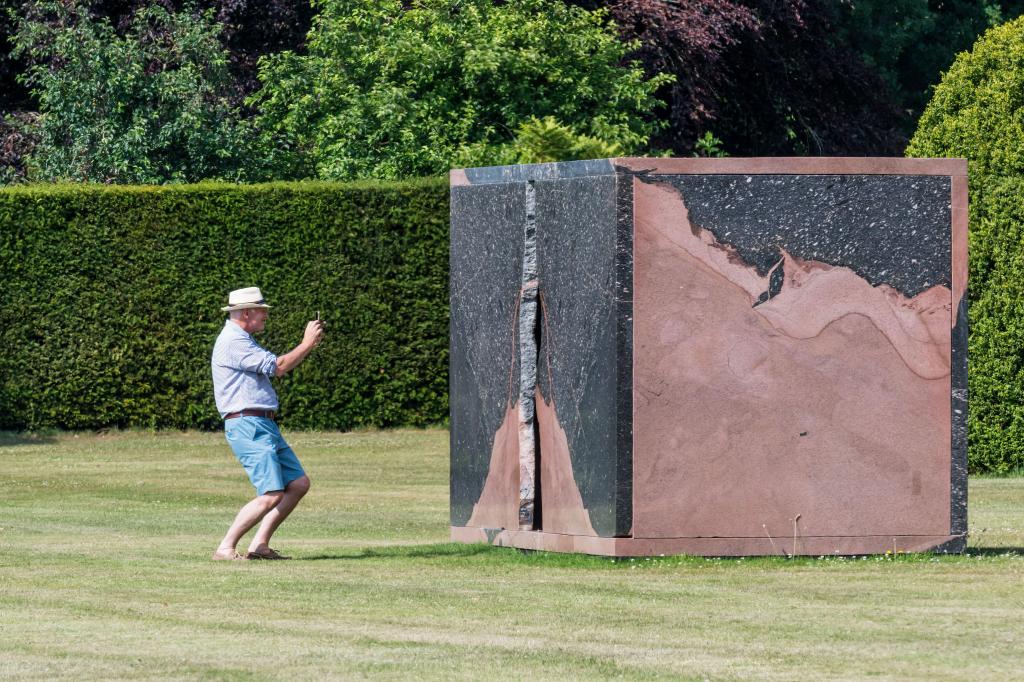
But there is the sheer craft of it too, which also looks back to antiquity. Cox is one of the few people in the world now who can (or takes the trouble to) sculpt very, very hard stone, and he has extracted his material from some of the ancient Roman quarries in Egypt (hardly exploited for centuries), as well as getting dark black basalt from the Clee Hill quarry in Shropshire. In some way his work feels like a conversation with these extraordinary difficult, reticent but ultimately glorious stones, bringing out all the patterns and colours that only become clearly visible when they have been worked and polished. Cox isn’t applying colour to these pieces, he is exposing it, or allowing us to see it.
Those colours are also part of the lesson for me. Over the last century or so, we have tended to restrict our vision of ancient sculpted stone to pure white marble, with all the awkward ideological issues that go along with that (and challenged only by the fact that much ancient white marble sculpture was originally painted). It’s true that there is a lot that is white (and the Italian white marble quarries at Carrara could churn it out by the ancient lorry load). But the pleasure of much ancient stone (marble and its relatives) was always its fantastic rainbow quality, cherished by the Romans as decoration for walls and floors, and much more: from the exquisite green stone from Sparta to luscious purple porphyry from Egypt (reserved by the Romans for statues of emperors). They even celebrated it in poetry. (There’s a great and very florid example in Statius, Silvae 1, 5).
Many Grand Tourists in the nineteenth century still cherished the colours of marble, as we know from all those dazzling “marble specimen tabletops”, constructed to display the different hues of the different stones in all their glory. We should try to recapture some of that excitement before dismissing it all as aggressively white – which is what Cox’s work helps us do.
The post The colour of stone appeared first on TLS.