

I love a novel that tells you why it was written, a novel that has a bit of backstage to it. It’s like sitting at the edge of a row of theater seats, in a cheap seat that reveals an actor standing in the wings, waiting to go on. I hate that in the theater, but I love it in a book.
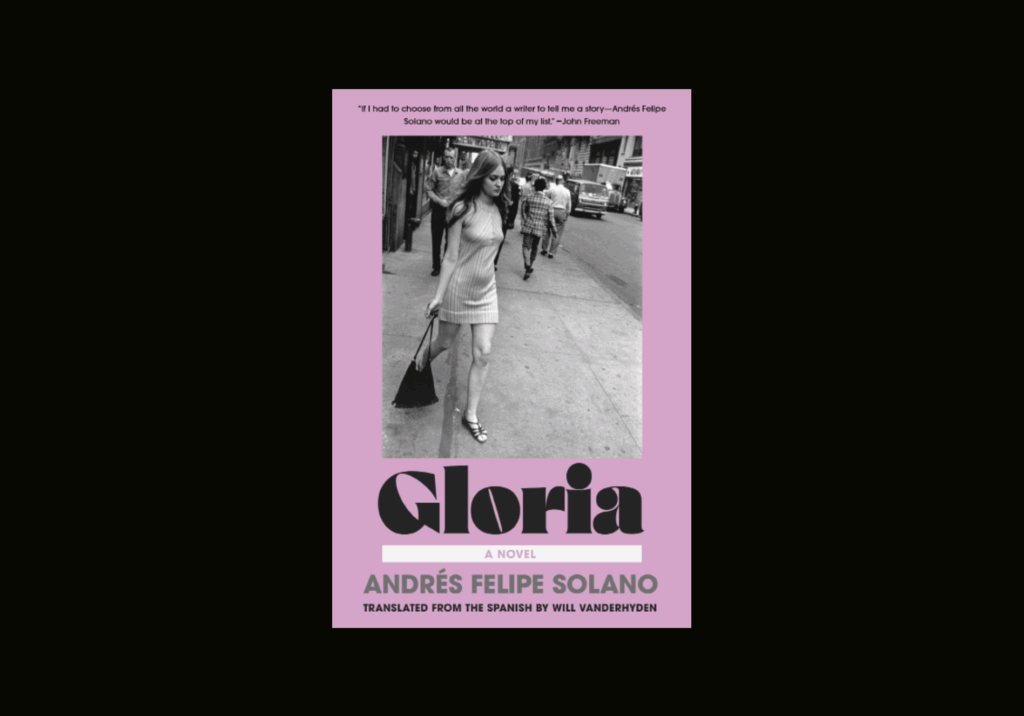
Gloria, written by the Colombian novelist and journalist Andrés Felipe Solano, and elegantly translated by Will Vanderhyden, is that kind of novel. It is the story of one long night in the seventies, during a brief spell when the author’s mother lived in New York. She was twenty. It was before her marriage to his father, and before Solano was born. But the story of a young woman (not yet a mother) becomes, through a series of very delicate, very sparingly placed interruptions in the telling, also the story of a son imagining the life of a mother he can never meet. He lingers in the shadows, brings her to life, withdraws, and then returns again in brief passages, or stray sentences, offering little hopes, a bit of wonder, tiny narrative gifts, as if from a god in the sky.
For instance, here, as Gloria stands in a sold-out Madison Square Garden, watching the famous Latin American singer Sandro, whom she adores:
His tousled head of hair, his long sideburns, his chest adorned with that heavy gold medallion. And his smile. And his eyes, with which he seems to look one by one, face by face, at the thousands who have come to worship him. From here, from my position in the shadows, I force the King to pause for a few extra seconds on Gloria, to make her feel his power in her knees, which shake uncontrollably.
The first part of the book tells the story of the long night of the concert: her waiting for her boyfriend, Tigre, who is late; the concert itself; snacks at a diner after; going to listen to records at an apartment later, and finally reaching her bed as the dawn breaks. Then we move forward into her future: a vacation with her two small boys (including the author); a motorcycle trip in early old age with a boyfriend; a last residency in New York as the son comes to help her, trying to persuade her to leave the States with him, thinking she must be lonely in New York. She is, but she likes it that way.
In every scene, one senses Solano trying to win happiness for his mother—and also freedom, and escape from something about her choices or fate that causes him pain. He doesn’t tell us what the pain is, or precisely what he’s trying to change with this tale. Perhaps sadly, as a novelist and journalist who is faithful to life, he cannot refigure her life sufficiently, cannot imagine into her past the kind of unencumbered lightness he most wishes her to feel. He can’t even avoid imagining the tiny oppressions of the boyfriend, the macho Tigre, who is, cuttingly, “good at detecting swings in her mood and tries to help when he thinks they’re justified or worth paying attention to.”
There is a particularly beautiful moment early on, in a book of beautiful moments, when Tigre and Gloria race from a diner before the concert, after he was late fetching her:
At last, they’re just steps away from the glowing entrance of the subway station. They go up the stairs and at the turnstiles insert one of those strange coins that I would find many years later in a drawer, rummaging around for hours to ward off the boredom of vacation afternoons, a coin that wasn’t big and was lighter than any I’d held before. It was stamped with NYC. The Y was actually a slot. One night, when she arrived home from the office enveloped in her typical blend of smog and Opium by Yves Saint Laurent, the perfume she wore for years, I showed her the coin and asked: What can you buy with this? She might have scolded me for having gone through her things. But no reprimand came. Seeing it, her eyes sparkled, she took the little piece of metal and held it in her open palm as if it were a baby bird. It’s a token. For the subway, I heard her say, and it might have been right then, in that moment, that I started writing all of this that I’m writing now.
His thought that this is the moment that he started writing the book comes again later, and again one more time. It’s true: with certain books, you feel like you started writing them when you were ten years old, and again at twenty-four when you had a certain dream, and again when you wrote the first sentence down. Such books feel like they were fated to be written, and also could have been written only at the time they were written, and not a moment before. It’s vanity to think you can start a book whenever you wish: the big orchestrator of art decides. Solano may have wanted to write this book five years before he started, but he needed to be with his mother in New York, in that laundromat, didn’t he? He couldn’t have known that, and might have become frustrated with himself. I’m so lazy. Why haven’t I started on the book about my mother working at the Agfa photo lab when she lived in Manhattan? But he hadn’t lived everything he had to live yet.
Solano is so close to his mother’s private struggles, so intimate with them. Gloria, having entered a friend’s boyfriend’s apartment for the first time, “bends down to pick up a button and sets it on the table, beside the Sandro albums. She can’t stand seeing things lying on the ground, she always has to pick them up and put them on top of something.” When you put something down—even on the floor—it’s always “on top of something.” So the phrase sounds a little like teasing. It’s sweetly funny: one imagines her looking for something she can put the button on top of. He continues, “Sometimes she struggles when she finds buckles, gloves, batteries in the street. Buttons.” This noticing—on the part of a son toward a mother he loves, which began with his birth and never ended—makes the book thick with a rare kind of feeling. It’s not nostalgic, or homesick, or romanticizing. It’s the feeling (how funny—this image just came to me) of putting on pants: that safe and enclosed feeling of being inside pants. Solano’s eye on Gloria is close, but not overly close, not constricting, not invasive, not a threat to her privacy, but rather a shield around it, somehow respecting it even as he imagines her innermost thoughts and feelings.
How does he manage to do this? I think it’s simple: love. Although love is not simple, in this book, it feels that way, as if the author’s love for his mother (or at least the character of the mother) is simple and straightforward. He wants what is good for her, which is the essence of any love: you want what is good for the other person, and you care about this deeply. So of course he hovers in the wings—he is reminding us that he is there. It’s a way of protecting her: You may think about my mother, but know that I am here watching. Because of this, his interjections don’t feel like a metafictional trick, but like more love. It’s quite a complicated thing he is doing, but he does it with such lightness and elegance.
Toward the end of the book, when he, now a grown man, suggests to his mother that she return to Colombia, fearing she is isolated, she communicates to him, wordlessly, something about her wish to stay in America; he reads in her eyes: “Where there’s freedom, there’s no abandonment, where there’s freedom, absolute loneliness doesn’t exist.” Perhaps what he always saw was a mother who carried some freedom within her—carried it as a corner of her being where even her own son couldn’t go. Maybe writing this book was his attempt to go near it, to stand in its wings. He steps onto the stage with her sometimes, just briefly. And then, like a funny little boy, he is off.
Sheila Heti’s next novel, The St. Alwynn Girls at Sea, will be published by Farrar, Straus and Giroux in April 2027. She is the author of eleven previous books, including Alphabetical Diaries, Pure Colour, Motherhood, and How Should a Person Be?