

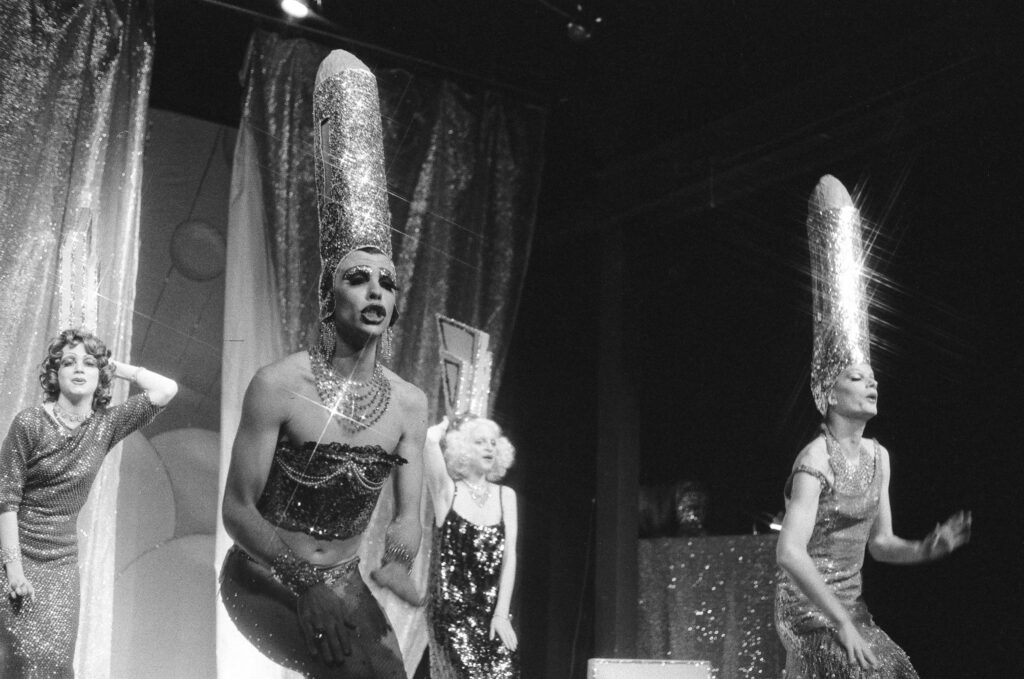
Bambi is in the back, to the right. Photograph by Dan Nicoletta.
Bambi Lake had come into my life like a specter or apparition, at first, faintly present, but something that would grow in intensity at every conversation had thereafter.
I was go-go dancing at this bar in San Francisco on Polk Street called Club Rendezvous for a bygone SF night called Club Macho. The party had spilled out of the club and onto the street up near the doughnut shop and I remember dancing naked in the street and in the background, I saw her looking at me, Bambi. Like, tall, EVOCATIVE blond bob, vintage mid-century baby doll dress and, like, a fur coat. I was wasted and dancing but I just remember her being burned into my retina, the way you could look at someone and just know they were somebody; the word is striking—every time I saw that woman she was well dressed and just visually striking. Her fashion sense alone could melt fucking lead.
San Francisco is a really peculiar place, it’s changed identities several times, but forever remains this fog-covered small town, where the lack of innumerable cultural options leaves us getting way too drunk at bars and meeting everyone you need to meet in this town in, like, the first two weeks; it was in this pressure cooker that I got to know and talk very often to Bambi.
I used to turn tricks in the back of the B.A.R. (Bay Area Reporter) and there was some article where a writer called me “slut princess” and FOR WHATEVER REASON Bambi read it and took it to mean that I was transitioning and accosted me on a street corner about it—“DON’T DO IT, BRONTEZ! ITS TRAAAAAAAAAGIC! SIMPLY TRAGIC!” she said as she was totally decked out in this maroon Edie Sedgwick look with a mod hat, looking FUCKING GORGEOUS—and I was like, “Ion know sis, you making it look kind of fab,” but I digress.
Someone had shown me a picture of Bambi in the seventies and it all clicked. She was wearing this black satin dress number with long gloves and heavy black eye makeup—she looked like a mix between a post-punk girl and a twenties film star. Like, stated bluntly, she was that unclockable trans girl in the seventies who hung out at night at all the rad punk haunts in town. West Coast punk rock was quite an institution unto itself, and Bambi was the scene girl when it all became new. For reference and scale, she was our Amanda Lepore, our Sophia Lamar, but Bambi didn’t really represent Downtown, club kids, or even modernity. There was a niche and nostalgic magic that she generated. She represented the older, elemental gods—her arrival in SF in 1970 from Redwood City, California, predates the punk explosion where she later seemed to ground herself.
She had been a member of the Angels of Light—an offshoot of the seminal, acid-taking, experimental SF drag troupe the Cockettes. She did a residency in Berlin for a bit and then returned to San Francisco.
In the eighties she had an all-girl band whilst haunting the hearts of a wild gaggle of boys in bands. Bambi knew her audience—“Gay guys don’t like tits. Straight boys do …” she quipped.
Bambi was kaleidoscopic—in the words of the famous singer Vivica Bond (who did a beautiful cover of Bambi’s poem/song “The Golden Age of Hustlers”), “She was a mood ring!” Besides being a prophet, Bambi also represented a lot of chaos (she was balanced like that). More often than not, you could see her on the street in various raw forms, definitely not present, and even full of rage—and in those moments, as a younger queer, I would say in my head, That woman can do whatever the FUCK she wants. At the time, few of us baby queers who were witnessing the Bambi of the aughts could begin to comprehend a woman who had seen the Vietnam War, the Hippie-Disco-Punk movements all rise and fall, the gay movement, the women’s movement, the AIDS epidemic, the crack epidemic, the eighties and nineties computer-tech takeovers of the Bay Area, and innumerable cultural shifts all happen in a lifetime. And she didn’t just witness them, she had to witness them from the margins—the rage was never lost on me and, goddammit, I think it was well earned.
“Although I had forgotten the white-hot pain of rejection, I feel pretty again.”
Bambi’s verse eels like her playing the role of punk rock dilettante, but we see behind the rouge a lifetime of experience. I daresay that there is something upbeat and vulnerable about Bambi’s memoir in verse, beckoning us with a wink to hear her heartache, wit, loss, and triumph.
I remember sitting outside the Eagle SF (a bar she had been permanently banned from—and that ten years later I would be banned from for causing similar behavior) with her when I was twenty-four and she taught me how to “tuck” my package in tight jeans and also gave me a copy of Frank O’Hara’s Lunch Poems that she had in her purse—a volume of poetry that sent me on a trajectory that has held me to this day. She would always say to me, “Brontez, you don’t have to worry, you are smarter than the rest of them,” and I didn’t know how to receive that at the time.
By the first party I saw her at, I had also released my first zine, Fag School. I can only imagine that she read it and recognized something similar to herself in me? But maybe she just liked other maniacs, and I was certainly that.
I remember I hung out at a punk house in the Mission that one of Bambi’s nieces lived at, and she related to me that at some point prior Bambi had been pushed out of a car going seventy-seven miles per hour on the highway and had somehow survived.
Some called Bambi chaotic (I mean, sure) but I just think she had what I like to call “a fully integrated shadow self”—indicative of the soul of a sensitive artist who has seen a bit too much, but still has the bravery to put on her goddamn eyeliner and get the hell on with it.
Bambi knew we weren’t all in the gutter looking at the stars but rather we were the stars living in the gutter—mirroring the literal fact that the actual stars in the sky were all housed (imprisoned?) in a void.
But, oh honey, that was not going to stop us.
I remember the last time I saw Bambi was at a Sick and Twisted Players reading. She no longer sported her iconic blond bob and had had a breast reduction and she seemed distant. I opted not to bother her, but then she came up behind me and whispered, “Is that Brontez?” And we talked for a second and I felt seen. She was a person that made me feel seen. When the baddest bitch in the room makes you feel seen, you never forget it.
From the introduction to Bambi Lake’s Devour Me, Again: Poems, to be published by Nightboat Books in June.