

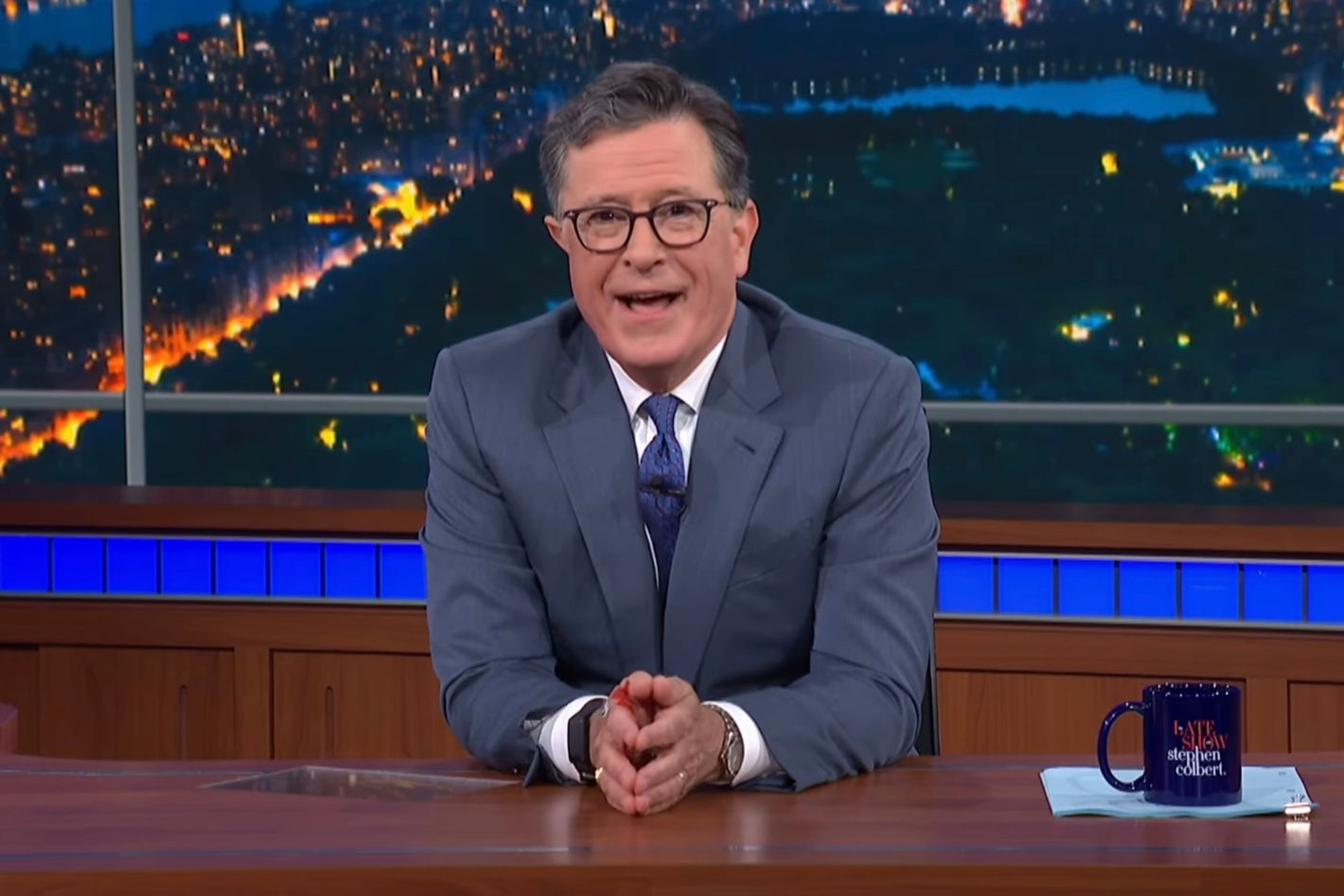
In a deeply disturbing sign for the future of late night, CBS is canceling Late Show — not just the version hosted by Stephen Colbert for the past ten years, which has ruled the Nielsen ratings for most of that time, but the entire franchise that began in 1993 with David Letterman. Colbert announced the news Thursday night during a taping of Late Show, telling his clearly stunned audience that he was told of the decision “just last night” and that it wasn’t the end of his run but the entire franchise. “This is all just going away,” Colbert said, prompting one of several choruses of boos and nos from the crowd.
CBS issued a press release announcing that Late Show would wrap next May and, in a bid to try to head off speculation that the decision was in any way prompted by parent company Paramount Global’s pending acquisition by Skydance — or the attempt to get said merger approved by Donald Trump’s FCC — the company insisted the call was all about money. “This is purely a financial decision against a challenging backdrop in late night,” three of the network’s top execs, including CEO George Cheeks, said via press release. “It is not related in any way to the show’s performance, content or other matters happening at Paramount.”
Unfortunately for CBS, while there is no doubt network TV in general, and late night in particular, is in a very tough place, Late Show also happens to dominate its time slot. During the just-completed second quarter, Colbert averaged 2.4 million total viewers (including those who watch via DVR replays), well ahead of ABC’s second-place Jimmy Kimmel Live! (1.8 million) and double the audience for NBC’s The Tonight Show Starring Jimmy Fallon (1.2 million) combined. The race is closer in demos, with Kimmel and Colbert trading leads throughout the year, but CBS has never sold much ad inventory based on demo ratings. That said, while Colbert is the clear king of late night, he rules over a much-diminished landscape: As recently as 2018, he was pulling in nearly 4 million viewers per night, and advertisers were still devoting a decent chunk of change to network TV. But nearly everything in linear TV is way down compared to 2018, and while scripted shows like NCIS or Matlock can amass millions more viewers via streaming and have value in syndication, late-night shows pretty much live or die on their linear numbers, with some added revenue (and buzz) coming from social channels such as YouTube.
So while CBS is not wrong to note the challenging landscape, and it’s not at all shocking to hear news of a network late-night show going away, most observers figured ABC would simply throw in the towel on the daypart first if and when Kimmel made good on threats to retire, or that NBC would walk away from the Fallon-hosted Tonight if and when exec producer Lorne Michaels retires. Colbert being first is gobsmacking — not only because of his show’s specific ratings position, but because CBS, in general, is doing incredibly well relative to its network rivals. It’s still making lots and lots of scripted dramas and comedies (more than any broadcast or basic-cable network), and even recently launched a new daytime soap (a daypart even more messed up than late-night).
It is because of this reality that there will be lots of speculation in coming days about how Cheeks’s decision was impacted by the looming merger. The least conspiratorial theories will likely revolve around the new regime’s mandate to cut costs and focus on the most profitable dayparts. More speculative conversation will try to draw a line between the push to get Trump and his administration to give the go-ahead and Colbert’s decade of brutal comedic takedowns on all things Trump. Indeed, Oliver Darcy and Status just last week pretty much predicted what would happen today, and CBS’s spin on the matter, by reporting that both Colbert and his Paramount colleague Jon Stewart were in danger because of the merger and that if both or either were canceled, “Paramount leadership could present these moves as cost-cutting measures for struggling linear television, while achieving the political benefit of silencing two of Trump’s loudest critics on the airwaves.” This isn’t a smoking gun proving what Darcy and others saw coming happened for the reasons they thought they would, but it’s certainly going to spark a ton of investigation and commentary. But whatever reasons end up most accurately representing the truth, this much is certain: Today will be remembered as an incredibly sad day in the history of network TV.
Watch Colbert’s announcement: