

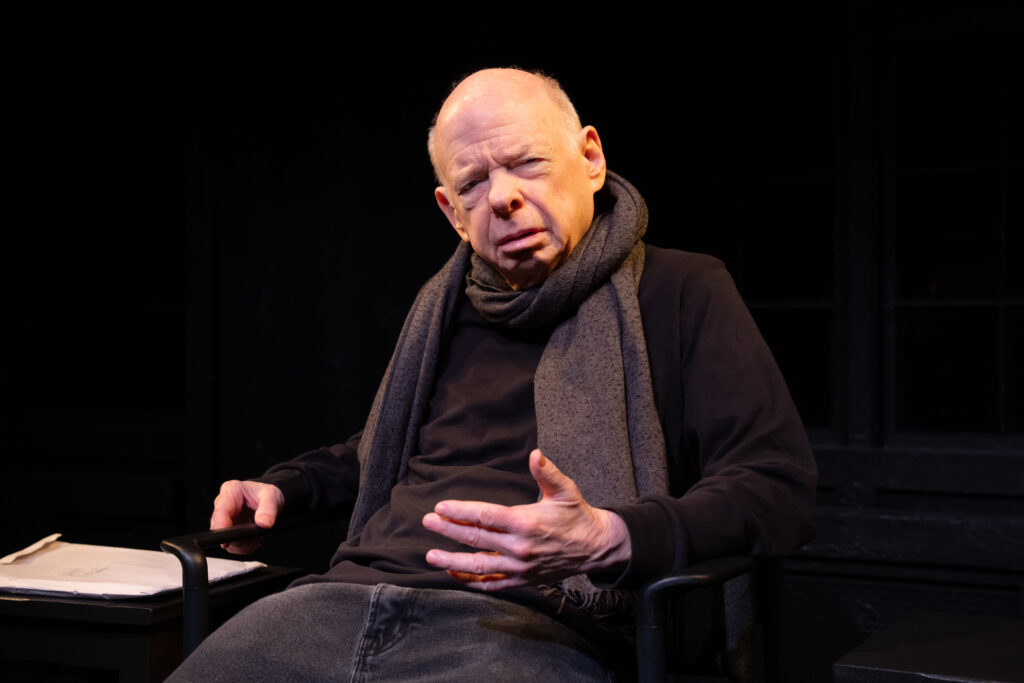
Wallace Shawn in The Fever. Photograph by Julieta Cervantes.
At an open rehearsal last fall of Wallace Shawn’s new play, What We Did Before Our Moth Days, the director, André Gregory, Shawn’s longtime collaborator and a genially uncompromising trailblazer in American avant-garde theater, turned to the audience from his front-row seat. He announced that while it might appear from the stage that the dramatic ensemble consisted of four characters—a mother, a son, a father, and his lover—there were actually five. At this point, Gregory gestured toward those watching, prompting some nervous chuckles.
The audience is always, to an extent, a part of any theatrical production. But in Moth Days, the cast is literally addressing the house. “If I look at someone’s face and they’re looking at me with an expression of utter revulsion, or if they’re smiling, that affects how I’m going to say the next line,” Josh Hamilton, who plays the father, Dick, told me. “It feels like I’m acting with the audience. And so that automatically keeps the speech from being a set thing, or having a set objective.” After I attended a preliminary run-through last October, two members of the audience told me that they’d had the strange feeling of “listening in on voices” rather than of watching a play.
Characters in Shawn’s later works often spend little or no time speaking to one another, instead directing their remarks to the onlookers. They talk in terms that suggest they are presenting not just their story, but also their case—shifting abruptly between emotional registers: one minute confessional and penitential, the next self-righteous and defiant. Shawn has talked about putting audience members in a position to adjudicate the scenes they’re watching, yet he also frequently implicates them in the unfolding moral dilemma. The audience might thus think of itself less as a judge than as an especially silent psychoanalyst—recalling, in particular, a practice pioneered by Freud’s acolyte Sándor Ferenczi, which he termed “mutual analysis.” In 1932, when both the world and his own personal sanity were unraveling, Ferenczi kept a clinical diary in which he delved deeply into the possibilities of a reciprocal dynamic between doctor and patient, at one point describing psychoanalysis as a “dialogue of unconsciouses”—a phrase evocative of the ecology that binds audience and cast in Moth Days, which might be said to transfer its audience back and forth between the chair and the couch.
But the metadialogue taking place during Shawn’s run at the Greenwich House Theater this spring went beyond house and cast. In an unusual feat of staging, two Shawn works began playing concurrently Off Broadway this March: Moth Days, a tightly contained four-person story of familial discord, and The Fever, an expansive one-man show from the nineties, whose speaker is overcome by visions of foreign suffering entangled with American interests. This contrapuntal double bill featured Shawn himself performing the latter twice weekly. Shawn told me, “Moth Days could be described—I hope it isn’t—but some people would say it’s my least political play. While The Fever certainly would be—well, it’s nothing but political.”
On the face of it, Moth Days is probably Shawn’s most straightforward domestic drama. In the three-hour play, a man and woman fall in love when they are young. By providing unstinting support over many years, the woman imbues the man with the confidence he needs to flourish as a writer. The couple have a child, who himself becomes an author of outlandish, erotic short stories. The woman works as a teacher in disadvantaged schools while the now-successful man increasingly gads about with a bohemian crowd; he eventually begins an affair with a fellow writer that destroys the family and blights all three of their lives. It’s a perfectly realistic setup, except that the characters are all speaking to us from beyond the grave. (“Moth day” is Dick’s euphemism for one’s deathday.)
Many aspects of the drama echo Shawn’s own family history. (“There’s only a very thin curtain between theater and life,” he wrote in the introduction to a 2022 essay collection, “if I may use the metaphor.”) His prominent-editor father had a multidecade affair with the writer Lillian Ross. Moth Days depicts a world in which books and authors still preside over the culture, as they did in William Shawn’s heyday at The New Yorker. Elle, the name of the mother in Moth Days, seems to nestle within the name of Shawn’s actual mother, Cecille, while the name of Dick’s mistress in the play, Elaine, bears a near-anagrammatic relation to Lillian. In Shawn’s play, the lover learns about the man’s death from his wife and then goes to their apartment. In Ross’s memoir, she states that Cecille phoned to tell her of William’s death, whereupon she rushed to their apartment, meeting at the door his son Wallace, who seemed frightened to admit her. In Moth Days, when Elaine reaches the apartment after calling Dick’s number and speaking with Elle on the phone, she describes being let in by Dick’s son, Tim, “a young man with a pale face.”
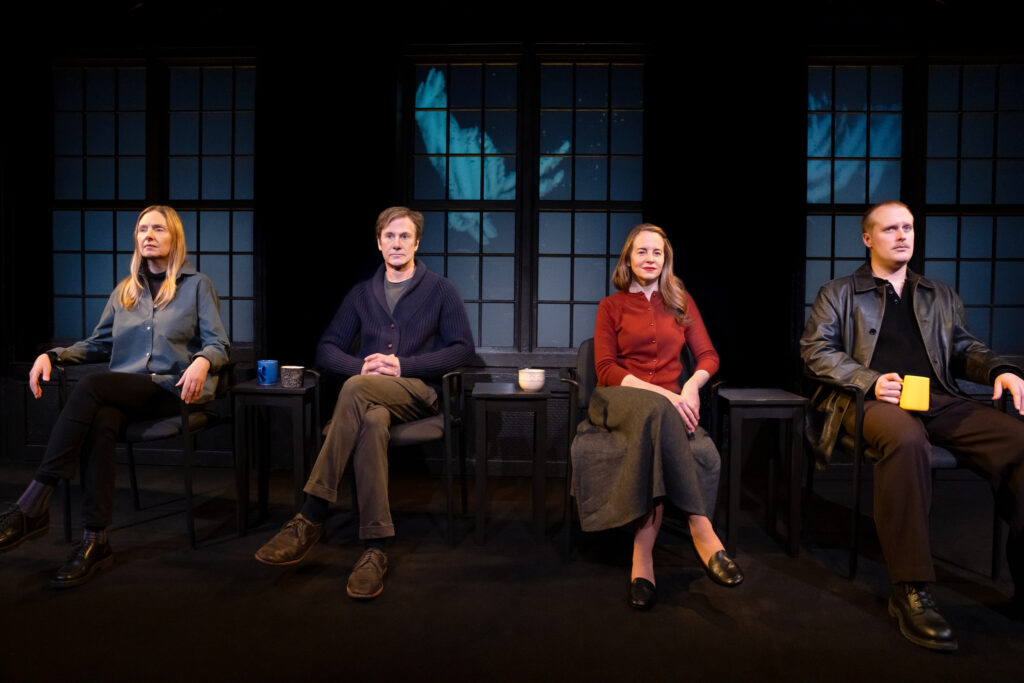
Hope Davis, Josh Hamilton, Maria Dizzia, and John Early in What We Did Before Our Moth Days. Photograph by Julieta Cervantes.
The play’s psychoanalytic dimensions are sometimes flagrantly manifest. At one point, Tim confesses to fantasizing about getting his mother away from his father and kissing her; at another, we learn that the short stories he labors over—in the spirit of, and in hopeless competition with, his father’s—feature a “satyr-like figure” with a penis so long he can tie it into a ring with his tail. The actor Maria Dizzia, who plays Elle, told me that the family in the play had always seemed very metaphorical to her. On one level, Moth Days is about “people living in an institution, an institution that they have built with conviction,” she said, but to whose violence they are “completely blind.” “The whole idea of this little family that Dick and Elle started with notions of love, of nurturing, and of growth, is just a fantasy. Instead, it’s a cesspool.”
She recalled that at one point, Shawn asked: “ ‘Do you think it’s okay that we’re doing this? A play about people just talking, and in the middle of that, the world is falling apart?’ And we all said, ‘Wally, that’s what this play is about. It’s about all the promises crumbling.’ ” At times, this larger scene of disintegration comes into view. When Elaine, the mistress, first lays eyes on the son after her lover’s death, something about his white clothes and sandals makes her flash “to blurry photographs of horror and violence in frightening corners of the world.”
There is a clear family resemblance between the young man of Moth Days, who evokes indistinct images of faraway brutality, and the narrator of The Fever—another avatar of Shawn. The latter play might be said to stage that scene’s inverse: the speaker’s dreamlike encounters with “horror and violence” in a distant country send him into a sickly reverie in his hotel bathroom, mixing flashes of political torture with reminiscences of an affluent upbringing. “We were the delicate, precious, breakable children, and we always knew it,” the narrator recalls. “We knew it because of the way we were wrapped—because of the soft underwear laid out on our beds, soft socks to protect our feet.”
The drama is effectively a conversion story, from solipsism to Marxism. The narrator discovers Das Kapital and begins to comprehend “commodity fetishism,” along with the invisible labor and bloodshed that went into his bourgeois wrapping. Like Moth Days, as Dizzia put it to me, The Fever concerns a confrontation with what it means to have chosen “to believe you are the life you live in your head, without any sense of responsibility for the life you live in the physical world.” Ultimately, the education that the narrator undergoes destroys his pleasure in the cosmopolitan comforts he had been raised to expect. Contemplating his return home, he wonders how he will continue to live. “I could change sides,” he reflects. “I could decide to fight on the other side. The life of a traitor? Betraying my own people? Walking into danger? Very difficult, but a possible choice.”
This earlier play draws on Shawn’s own encounters with eye-opening foreign realities. He wrote it following several trips to Latin America in the late eighties, where he and his partner, the writer Deborah Eisenberg, observed the results of the Sandinista revolution in Nicaragua. The Fever, Shawn told me, was an attempt to write something absolutely truthful to what he himself had undergone: a stark confrontation with the fact that his own comforts were inextricable from the suffering of others. The land he owned, as the protagonist reflects, had been allocated not “by chance, not by fate,” but had been “pieced together one by one, by thieves, by killers . . . until the beautiful Christmas morning we woke up, and our proud parents showed us the gorgeous, shining, blood-soaked fields which now were ours.”
Shawn meant for The Fever to provide an analogous shock to spectators. Initially, he performed it at parties in the apartments of friends and acquaintances, sometimes without the guests’ foreknowledge and to occasional outrage. “I don’t think I had the slightest consciousness of the arrogance and presumption involved in asking people to listen to me that way,” Shawn said. “I was just so upset, so concerned with getting people to pay attention.”
Shawn’s plays seem to suggest that domestic drama is not merely related to the political arena but can form, or even determine, its shape. “As all of our attitudes flow into action, flow into history, the bedroom and the battlefield soon seem to be one,” he wrote in an essay on morality from the mid-eighties. “Our political attitudes can only come out of what we are—what we were as children.” The son in Moth Days offers a far more rigidly prescriptive version of these ideas. In an early monologue, he describes a state of affairs in which our fates are fixed from before conception:
The book of your life was written many billions of years ago . . . The whole story, everything that will happen to you and everything that you’ll do—it’s all already written in the book, down to the smallest detail. And everything that happens in the world has a chain of causes leading back from it—this was caused by this, and that was caused by something-or-other, back and back to the original elements and the water and the wind and the ultraviolet light.
There is a totalizing pessimism to this outlook, Tim suggests, because it presupposes an “inevitable source of misery for human creatures.” Namely: the intractable human “need to inflict pain, to wound, to maim, to torment, to destroy, to trample, to kill . . .”—be it by blowing up a country or shattering one’s family. But Tim’s viewpoint also allows for a profound mercy—a belief that those who perpetuate harm could not have turned out any other way. Hence, on some level, all is forgiven.
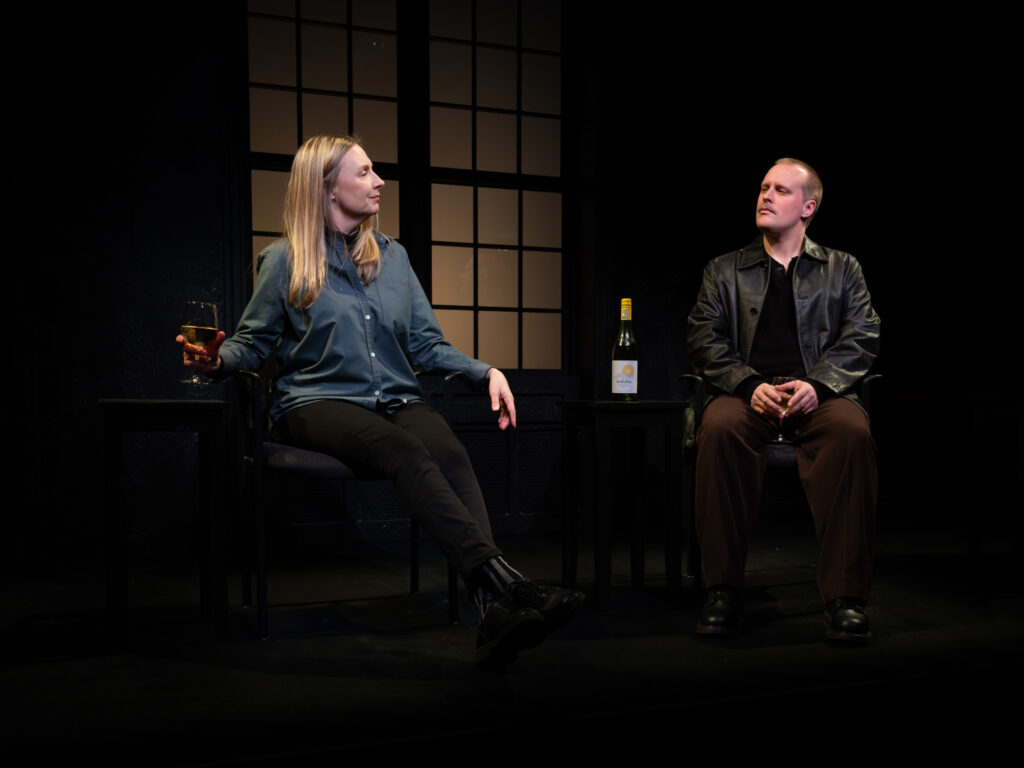
Hope Davis and John Early in What We Did Before Our Moth Days. Photograph by Luis Manuel Diaz.
And yet, the worlds of Shawn’s plays are spaces where people can act upon one another, as much for better as for worse; where fluid and multifarious influences might nudge us to make one choice over another; where the interdependence of even our small decisions—“what we’ve become today, what we’ve learned in school, at the playground, at the party, at the beach, at home, in bed,” as Shawn writes in the morality essay—can end up effecting change on a societal scale. “My political opinions fly out across the world and determine the course of political events,” Shawn continues. “What I say to you about my neighbor’s child affects what you feel about the nurse who sits by the side of your friend in the hospital room, and what you say about the nurse affects what your friend’s sister thinks about the government of China.”
Shawn also anatomizes the process by which, on a more mundane level, we can debase ourselves in ways that spread through our social circles, often by means of titillating sensationalism. He goes on to describe meeting a young woman at a dinner party who tells him that she sometimes likes to go out with gangsters. “She describes in detail the techniques they use in getting other people to do what they want—bribery, violence. I’m shocked and repelled by the stories she tells. A few months later I run into her again at another party and I hear more stories, and this time I don’t feel shocked. I’m no longer so aware of the sufferings of those whom the gangsters confront. I’m more impressed by the high style and shrewdness of the gangsters themselves.” By their third encounter, he’s become a “connoisseur of gangster techniques” and finds her stories comic. “And so every day,” Shawn writes, we confront the “numberless insidious intellectual ploys by which the principle of immorality makes a plausible case for itself.”
Shawn acknowledges the paradox of a form of determinism that doesn’t preclude an individual’s responsibility to help cultivate a more just society. “I don’t have the brain that could possibly defend what I believe,” he told me, “which is that other people are determined by the forces working on them, but I still have free will and could make better or worse choices.” And yet there is, throughout his body of work, a strain of hopefulness, however faint, that people might be shaken from their preconditioned paths, and that art, in enacting diverse dialogues of unconsciouses, might play a role in bringing that change about. “Wally’s plays,” Eisenberg told me, “make you aware that you are part of a system, that the way you live is a choice—that at least you should be conscious of this.”
But the manner of awakening this consciousness can be mysterious and subliminal—as is perhaps exemplified by Shawn’s collaborations with Gregory, whose rehearsal process famously stretches on for months or even years longer than the average production, and which more than one cast member likened to psychoanalysis. “He creates an environment that allows the unconscious to emerge at its own pace,” recalled John Early, who plays Tim. “He doesn’t coax it out.” The process of listening to the unconscious is enigmatic to Shawn himself. In one essay, he speculates that in the collaboration between his rational self and the unconscious, the latter manifests as “the voice that comes from outside the window.” He suggests that “if the unconscious has thoughts,” then they must come “from the people I’ve met, the people I’ve read about, the people I’ve happened to overhear on the street. So it’s not just a theory that society is speaking to itself through me.”
The actor Hope Davis, who plays Elaine in Moth Days, told me that when she and Shawn look at each other, sometimes “one of us will just start to cry. He’s just wide open. It’s his just wonder at being with another human being and looking them in the face.” Her description recalled Ferenczi’s note that a final, “not unimportant factor” in “mutual analysis” was “the humble admission, in front of the patient, of one’s own weaknesses and traumatic experiences and disillusionments.” The idea was to abolish the patient’s feelings of inferiority and unbreachable distance and create a simultaneous revelation of emotion in which “the tears of doctor and of patient mingle in a sublimated communion.” The intimacy itself served as a “healing agent, which, like a kind of glue, binds together permanently the intellectually assembled fragments,” endowing the sufferer “with a new aura of vitality and optimism.”
Ferenczi’s account seems consonant with the sort of exchange Shawn and Gregory seek to cultivate between actors and audience—a kind of visionary mutuality that might nurture our capacity to picture a better world, even if the sight is often blurred by our tears. The question of how art might facilitate a transformative encounter—probing the depths of our individual unconsciouses even while augmenting our social consciousness—haunts their plays. It was a subject that also came up repeatedly in a series of conversations I held with Shawn, Gregory, and the cast of the production of Moth Days in the fall and winter of 2025.
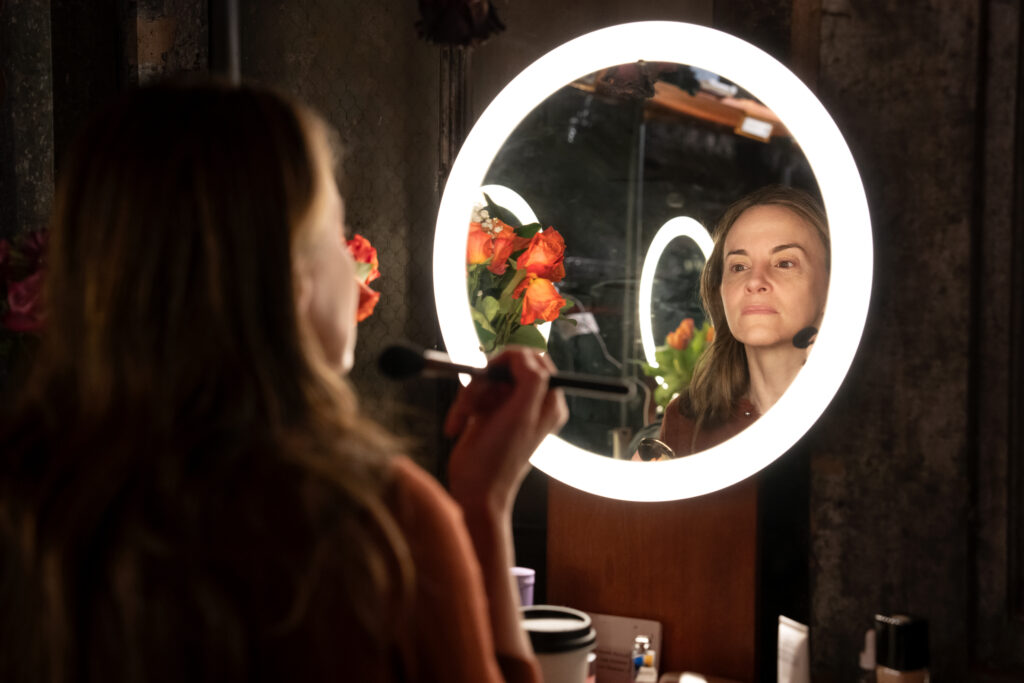
Maria Dizzia, backstage at What We Did Before Our Moth Days. Photograph by Julieta Cervantes.
I. On Beginnings
INTERVIEWER
What was the genesis of your involvement with this particular production?
ANDRÉ GREGORY
Wally asked me to do it.
INTERVIEWER
Was it something that you debated at all?
GREGORY
Well, I debated it a little bit. No more than I ever debated the other plays he’s asked me to do. Because what happens is, I read the play and totally don’t understand it. I have no idea what it’s about. I think, I’ll never be able to do this. And it was the same with this. I thought, I just don’t get it.
But it seemed unlike anything I’d read of his before, which was part of why it was so intriguing. The playwright and director David Hare put it quite well. He flew from London just for a day to see it, and we were talking about how different it was. And he said, “Yes, these are bad times. These are not times for fucking Cats.” And there’s something in that.
I don’t think Wally and I have ever had a conversation about what the play is about. But of course, one of the things that’s interesting about getting older is you realize you don’t know a goddamned thing.
JOHN EARLY
I became pen pals with Wally and Deborah during early COVID. We would write to each other. I suddenly felt terrified of them getting COVID. That’s how it started. Once things opened back up again, I started to have dinners with them. Wally emailed me out of the blue. I had no idea that he had a new play. I was completely shocked by how beautiful it was. Bursting into tears reading it. Screaming. Laughing. I swear to God, I was not thinking of myself in the young male role. I mean, I often think of myself as the woman, so I just wasn’t even thinking about it. But then a few weeks later, he was like, “I’ve never cared about age-appropriate casting. So would you want to read for this part?”
MARIA DIZZIA
When I was in college, my mom sent me the script of The Fever. For me, it was my introduction to socialism, to the very personal morality of how we contribute to and benefit from all those structures. I would read it aloud in my dorm. I mean, that’s really the actual story: she sent me the book, and I would read Wally’s words out loud by myself.
HOPE DAVIS
I was initially very daunted by the idea of doing a play. I felt like, Are people able to concentrate anymore? Is the attention span able to handle just sitting and listening? People like to say, “Oh, it’s only ninety minutes.” And we all feel that, right? You feel this kind of relief when someone says that. Like, Oh, great, soon I can be back in my bed. But is that all we can give at this point? You know, this isn’t the Mahabharata. It’s not nine hours and it’s not hard to follow. It just requires a little bit of people’s time.
***
II. On Rehearsal
GREGORY
I think there is something shamanic about what I do. I know nothing about shamanism, but I know enough to know that there’s some kind of magic going on. Even though I’m doing it, it’s a mystery. I’m just an antenna. The antenna goes up into space to receive messages. All I do is make sure the antenna is clean.
JOSH HAMILTON
What André does is: You come in. You read through the first half. You have some coffee or tea, and you sit. You have a nice little chat about any movies or plays or anything in the news for five or ten minutes. Then he goes, “Okay, let’s begin.” And he basically just beams his undivided love and attention at you. Every once in a while, he just says, “Good, good, good.” You don’t even really know what he means. Then you order some sandwiches and you read the second part.
HOPE DAVIS
The way André works is that he listens. That’s what he does. It’s extraordinary to be with any human being who can sit day after day and listen.
EARLY
I mean, it must be said, this is a ninety-one-year-old man who has never once fallen asleep. And this is a three-hour play.
DIZZIA
He doesn’t say anything. He just watches the whole time. It’s something that I was really craving as an actor—to feel supported in my own subconscious figuring-out of the text, rather than to be interrupted and rescued from it by someone.
DAVIS
With André just sitting and listening, the play shifts. There isn’t that sense that we’re trying to achieve a certain sound. There’s more of a sense that you’re on a river that’s flowing and this is life, and you’re just continuing to flow with it.
DIZZIA
There’s this great book, The Inner Game of Tennis, and it’s written by a tennis coach. He taught a lot of pros. He was saying that as he progressed in his coaching, he spoke less and less. And he realized that it was better—the less he spoke, the less he praised someone. When someone was really struggling, the best thing to do was to put them in front of a reflective surface and just have them hit the ball. I feel like André came to the same conclusion.
GREGORY
I don’t think of one single thing in the three hours that the play is taking place. I’m just watching. I love hearing that the actors liked what I was doing. Because I sometimes think, God, I don’t do anything.
***
III. On Art and Barbarism
EARLY
I kind of have a little mantra now before I go onstage. It’s: I am Tim. Tim is me. I have an enormous cock. “I have an astounding member”—those are his words. I’ve imagined Tim as a child, realizing he has an astounding member, and how terrifying that must be. It actually feels almost essential to Wally’s whole worldview. Like: With this thing, this mighty, terrifying thing, I could do really bad things. Or I could do really fun, pleasurable things. But I could do really evil things.
WALLACE SHAWN
I suppose it’s fate that my least aggressive play is coming out at this particular moment. In a way, I wish I were presenting an aggressive play against fascism or against Donald Trump. But the truth is that at this moment, to show any sensitivity, delicacy, gentle feeling at all is to take a radical stand against the thugs who are running our country, because their ideology is so opposed to any sort of delicate feeling. Their aesthetic is even opposed to any sort of charm at all.
INTERVIEWER
Maybe if we paid more attention to our capacity to savor beauty, we might defang our primate selves a bit?
SHAWN
That’s what The Fever keeps circling and circling around. I mean, the poor character keeps saying, “I love the violin.” And then his other side says, Well, who paid for your violin? Who had to die so that you could hear the violin, or so that someone could make a violin? Who had to be tortured so the concert hall could be built?
INTERVIEWER
It reminds me of the famous Walter Benjamin quote: “There is no document of civilization which is not at the same time a document of barbarism.” It’s usually taken to mean that every document of civilization is actually a document of barbarism. But I think he’s instead asking us to hold in mind two disjunctive truths: the genuine splendors and the horrors pertaining to their production.
SHAWN
I haven’t resolved that in my own mind. I do say to myself every day, Well, these crimes that have been committed in order for me to have this lovely fruit salad are inexcusable, but shouldn’t I at least enjoy the fruit salad? I mean, if I don’t enjoy it, I’m just going to throw it out. And that won’t erase the crimes that have been committed in order to bring it to me.
EARLY
I’m very compelled by restaurants. I often write characters for myself that are, like, upper-middle class, panicking at dinner parties. And there’s this kind of seductive pull of restaurants in so much of Wally’s work—I’m saying that in a funny way; it’s more than just restaurants—but that’s often one of the settings that stands in for our capacity to be seduced by amorality, to give in to it. Now, in this play, that impulse is placed into someone who is very loosely modeled after his father, and also into the son, who is very loosely modeled after Wally.
***
IV. On the Bourgeois
SHAWN
Well, in My Dinner with André, I am stubbornly defending a bourgeois approach to life. One hundred percent. I’m refusing to budge and basically saying I don’t care about anything except leading a comfortable bourgeois life. André is questioning that. He’s saying, You seem like an intelligent guy. Do you really think there’s nothing more—that’s all you want? And I’m sort of pigheadedly saying, Yes, that’s all I want.
Now, interestingly, when I was fifteen and I read Zen Buddhism, I also read Ulysses, and I put the two together. I sort of made my own fifteen-year-old synthesis of Suzuki and Joyce, basically to the effect that we should celebrate the joys of the most mundane aspects of daily life—you know, Bloom eating his kidneys (not his own kidneys, the kidneys that he buys) is where we should all be. And there’s an aspect of at least the fifteen-year-old’s understanding of Zen that says, If you can be alive and awake to the lunch that you’re eating, or to the small rock that you’re sitting on, that could be the highest form of enlightenment.
In My Dinner with André, I sort of merge that with the enjoyment of the bourgeois lifestyle. That seems to imply that D. T. Suzuki would have thought that sitting on a pleasant sofa and watching TV is what he was trying to get at, which I’m not sure is true. But in my own mind, I think I was counterpoising something like that to what André was saying. On one level, I was just saying, No André, forget all of that. The bourgeois lifestyle contains everything of value. But I think I was also defending my fifteen-year-old synthesis of Suzuki and Joyce, even as I was arguing against André’s spiritual quest. Which is possibly why I think you can see that by the end of the film, our points of view converge. I’m much more sympathetic to what he’s saying than I was at the beginning. We converge on the idea of experiencing the moment. And that’s what these four people in Moth Days are doing in front of your eyes. People are having an awareness of their own impulses and following them—living in the moment onstage.
HAMILTON
I did Wally’s last play, Evening at the Talk House, in London at the National Theatre. And it was such an interesting experience, because the whole cast had this wonderful time creating this production that we all were in love with. And then the subscription audience at the National started coming. It was the first year that the artistic director from the Royal Court had taken over from Nicholas Hytner, who’d been such a crowd-pleasing, popular, brilliant director. The audiences had had at least a decade of seeing things that were just pretty fun to watch. And then Wally—I just think they didn’t really know what they were coming to or why they were watching this, or even understood all of it. It was a very dispiriting experience because people would walk out. You’d hear these flaps of the chairs.
EARLY
I think there are some uncharitable interpretations of his work where people become defensive. They think that they’re being lacerated, eviscerated, like they’re being punished or called out.
SHAWN
You could say that people who are brought up in a privileged environment are stupider than people who are brought up in a more desperate environment. There’s an idiocy built into being a privileged person, and when you’re raised in that environment as a child and as a young person, you can’t see around it or through it.
EARLY
I was reading reviews of The Designated Mourner last night, and there were people who thought it was making fun of people who appreciate poetry and music. But I think that’s totally wrong. When the protagonist says at the end, No one is reading John Donne anymore, that’s not a joke. It’s okay if you find it funny—a lot of Wally’s work invites that specific kind of laughter. But to me, that sentiment is tragic. What Wally’s saying is that if the world were a more just place, and we didn’t insist on poverty, more people might like Beethoven. More people might like John Donne. And what a better world that would be.
HAMILTON
Wally doesn’t set out to write plays that he thinks people are not going to enjoy. But I think sometimes that has been the case, because often what he’s writing about is not what a lot of people go to the theater for. Sometimes people are like, What are we watching? Why is this person telling us that we need to look at ourselves in the deep, dark, truthful mirror?
EARLY
But for those people who think that he’s making fun of the bourgeoisie, what this play reveals is that the source of his moral fixation is entirely personal—not in a crass, confessional way, but this play includes this very personal thing where the father does give into amorality. It’s not just a random character this time, someone you could perceive as maybe a metaphor. It’s actually something that he experienced. In that way, it’s maybe his most accessible work.
***
V. On Art and Action
SHAWN
For a long time I went through a process of thinking, If only I could tell my audience what the world is like and show them their involvement in creating that world and sustaining that world—the world in which the oppressed are crushed in order to create a pleasant environment for the privileged—if I could show my audience how that world works and how they fit into it, they would be shocked and want to change the world.
There was a time when it really hadn’t occurred to me that people in my audience might not be shocked. At any rate, I thought that they might be a little bit surprised by what they saw. I didn’t realize that they would accept it. But their conclusion after seeing that they were not nice guys was to accept the fact that they were not nice.
GREGORY
I feel that we’re living in a world where there doesn’t seem to be any truth anymore. Maybe there is never any truth. But now lies are being propagated on purpose. Art itself, I think, has become one-dimensional, rather superficial. So work that is actually stripped of artifice and is telling the truth, talking about the way things are, has become quite radical and in a way political.
EARLY
I was really noticing this thing happening online, where I was just feeling the limits of the language we were all using to talk about progressive politics. There became such a uniformity in the language. There’s probably a more derogatory word than uniformity, like sludginess or assimilation. It was all very academia inflected, very social justice inflected. It’s really hard to not feel this total paralysis and self-consciousness every time you open your mouth. Especially my generation, I really do think the only thing we’re taught is to vamp, just to keep talking. It’s not about what you’re saying; it’s about holding the floor and just filling the silence.
In Wally’s writing, there’s an almost fairy-tale quality to the way he talks about the world. It’s generous. The way he tells you about power and politics is almost magical. And frankly, it’s more clear. It’s just easier to understand for someone like me, who feels alienated by the way people talk about politics, where everyone’s competing to outdazzle each other.
SHAWN
I don’t feel that people will see my plays and change. But awareness of something being wrong is nonetheless the first step for change to become possible. If people became aware en masse, then maybe change would take place.
EARLY
I love the Mark Strand interview that Wally did. He says that the point of a poem is actually to stage a kind of encounter. It’s like a painting; you stand in front of it in awe. But it’s not just creating awe; it is giving you a way to process death. Poems, paintings, plays can be a kind of safe way to encounter some sort of fundamental mystery—death—even if it’s not explicit.
SHAWN
I keep coming back to the question, Why isn’t Donald Trump more interested in painting? Why didn’t he devote his life to writing monographs about Munch or Vermeer? Instead, he was so interested in money, and now he’s interested in power. I realize that’s almost the definition of a stupid or shallow thought, but I keep coming back to it. I mean, Donald Trump keeps talking about America—America, it’s a great country, the greatest country. It should be great again. But I’m more interested in John Ashbery. How can you be interested in America more than in John Ashbery? That seems insane to me. And I don’t claim to understand Ashbery, or any poetry. I, in fact, claim to not understand it. But it’s so fascinating, so wonderful. I don’t care if America is great. Ashbery is great.
***
VI. On Laughter
EARLY
There’s this note Wally gave me that I always come back to. He said about Tim: “I think that he finds this all funny.” This was one of the first changes Wally made in the script. He was like, “I’ve made some changes.” And then I got the new pages, and it was one stage direction. It wasn’t even a line change. It was just one stage direction in parentheses after—sorry, I’m just going to have to say the first two lines: “Thoughts had occurred to me after we pulled into my garage, that simply by sitting there for a while and failing to turn off the car’s ignition, I could perhaps inspire a curious story on the local radio station, something along the lines of, you know, ‘Unfortunately, the police have still not uncovered the specific motivation that drove these two obviously desperate young people to end their lives in a sort of corner of Wood Street last night. But sadly, we fear that’”—and then this is what he added: “(He chuckles.)” They just added, “(He chuckles).”
HAMILTON
There’s maybe only one line that, no matter how I did it, always got a laugh. It’s in this section where I finally get a room of my own and I start writing on the weekends. My wife is working during the week, so on the weekends she wants to see me all the time. But that’s when I am writing. So Dick says, “I’m sorry, I can’t write if somebody else is in the room.”
And she says, “Somebody else? What do you mean? I thought I was a part of you, the way you’re a part of me.” And I say, “Yes, of course, that’s true, but somehow I can’t seem to write my stories if the part of me that’s you is sitting in the room.”
That line always gets a laugh. Wally notoriously does not like to change much in the script, but at the end of one rehearsal, he said, “I’m going to take away that line.” All the other actors said, “No, we love that line.” And I wrote to him that night. I said: “I’m sure you’re right, but I just have to understand. Why? Does it sound like I’m making fun of her?”
And he wrote back: “The cut line is undeniably a line that’s meant to be funny, so if the audience laughs, the whole story comes off as snarky. I don’t like snarkiness. The audience loves snarkiness. I don’t like having Dick and the audience sharing that, or Dick bringing out their less good selves. Without the line, the passage is still funny in a way, but Dick knows that it’s basically not very funny. My not-best self wrote the line, and I want to be my better self.”
EARLY
There’s a purity to Wally’s language, to the images—a frankness, to use his word. It’s created a standard for me for directness. André’s part in this, in my relationship to language, is only speaking when necessary. Allow things to emerge and say them. But don’t force them. Don’t wrest them from the earth—only if they bubble up. And if they’re not bubbling up, don’t say anything.