

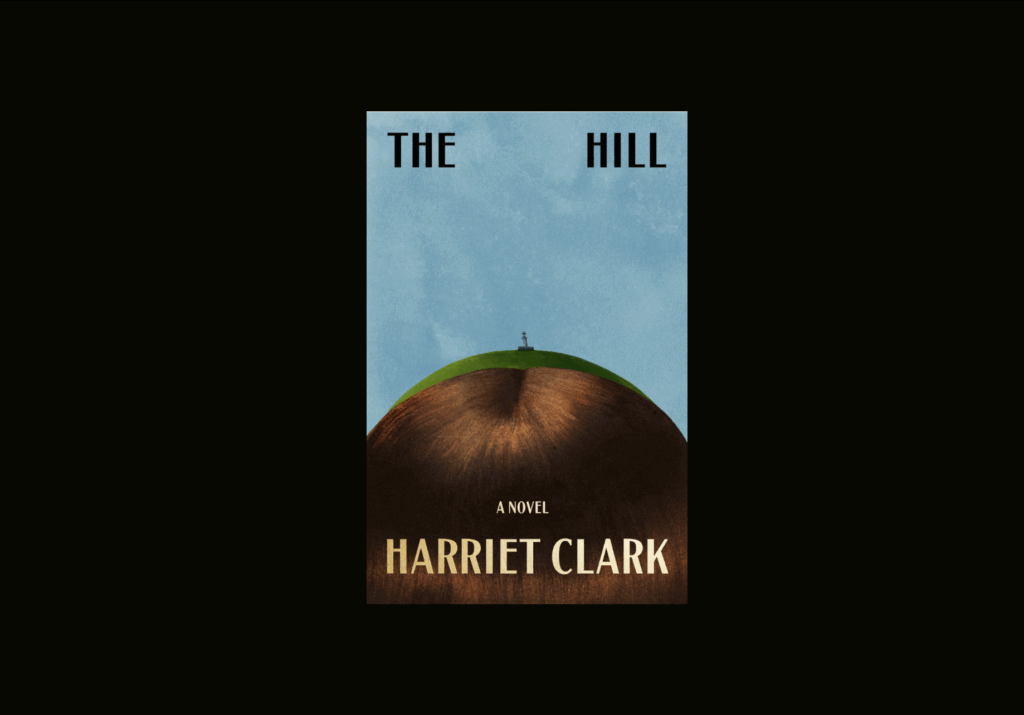
A gifted fiction writer who doesn’t publish must stand accused of genius or maladjustment (if we can distinguish those)—and Harriet Clark endured both during the twenty-plus years she spent refining her debut, The Hill. The work in progress, from which the Review eventually extracted a Plimpton Prize–winning short story in 2022, earned her several MacDowell residencies, fellowships from the Iowa Writers’ Workshop and Stanford University’s Wallace Stegner program, and a rare pitch of whispered literary envy and suspicion—amply justified, in the end, by the novel itself, which came out earlier this month. Clark described its slow, uncertain gestation over tea one Friday afternoon in May, in the sun-soaked attic study of the Bed-Stuy house she shares with her wife and son. Its striking premise draws on her early experience. During her infancy, her mother, Judith, a member of the Weather Underground and other radical organizations, was arrested, and later sentenced to life in prison for driving the getaway vehicle for an armed robbery, intended to fund revolutionary struggle, that went disastrously awry. (She was released on parole after nearly forty years in 2019.) Like her protagonist, Suzanna, Clark (whose father also spent years incarcerated in connection with his involvement in militant groups) was raised by her maternal grandparents, once prominent Communists; they apparently fostered and protected Clark’s intimacy with her mother against the best efforts of the state. Yet rather than some thinly veiled autobiography, the book is an eerie, dreamlike, funny, psychologically acute fable crossed with a nineteenth-century novel (unexpressed ardor, letters burned unread, train rides, consequences), a portrait of childhood to rival What Maisie Knew.
INTERVIEWER
This book took you a very long time. What was going on there?
HARRIET CLARK
A big part of the problem was that, obviously, I had a situation, but I did not have a story. And I had a character whose perspective I often wrote through, but I didn’t think she was a protagonist. She didn’t really do anything. She was just inside that situation. So how could there be a novel about her?
INTERVIEWER
It was hard for you to imagine her driving the action, having any agency.
CLARK
Exactly. It used to sadden me that there were so few novels about growing up with a parent inside. When you don’t see your life represented, it contributes to the sense that you’re living a degraded life, not worthy of art. And when you’re in these unlucky situations, people do sometimes act like you’re living a lesser version of a life, like if your mother is in prison, you have less of a mother. So part of what became important to me, once I began imagining it as a book for readers and not just a private writing experience, was to show that life as something dignified. There’s a real American obsession with freedom that shapes classic storylines. For a while I believed the book had to end with the girl finally leaving her mother and riding off into her own life. But that doesn’t take into account how, if you’re deprived of a home, deprived of access to your family, you learn that, actually, being bound to others is the significant thing. Certain forms of freedom are also forms of being unheld. Even though there’s no way for Suzanna to have the standard sense of progress, of moving toward the future, and even though no one else thinks she is doing anything heroic, she needed to have, from the beginning, the revelation it took me so long to have—that, in trying to be with her family, she was doing something meaningful.
Also, and this is a sloppy analogy, but if you work on a book for twenty years—whatever we mean by work—people really act like you’re very neurotic. Like there’s something wrong with you, or you’re doing something wrong—and it’s easy to internalize that. Mary Ruefle says that she used to think she kept writing because she hadn’t yet said what she wanted to say, “but I know now I continue to write because I have not yet heard what I have been listening to.” For some of us, it takes so long to hear what you’ve been listening to—and it’s meaningful to give yourself all the time you need.
INTERVIEWER
What do we mean by work? Were you writing some version of the same book all those years?
CLARK
Well, for the vast majority of the time, I had no aspiration for it to be a book. I wanted to be in writing programs because I like reading and being around writers, and because I was trying to sidestep the regular economy, the obligation to build a certain kind of life. As I say in my acknowledgments, it was a cover story for wanting time to myself. For years, I only wrote for deadlines, either for workshop or to apply for some grant or fellowship. And in that time, you know, I’d read some amazing panoramic novel from all these different perspectives, and then I’d spend three years imagining a book that had the perspectives of the nuns and the guards, and so on. I would do all that writing, and then three years later I’d throw it all away.
INTERVIEWER
What made you feel you had to trash so much?
CLARK
The first book I read that got me to throw out a whole collection of stuff I’d been working on was E. L. Doctorow’s The Book of Daniel. It’s a fictionalized story of the Rosenbergs, who were accused of being spies and executed. That family was very meaningful to my family, and as I was reading the book I felt conflicted, because his prose is so playful. He’ll be doing a three-page-long sentence moving between first and third person, and he’s so funny. It has this incredible mania. One part of me was enjoying that so much, and another felt, “Are you allowed to take this actual tragedy and make it about your prose?” And then, very far into the book, he has this scene of the children coming to the death house to say goodbye to their parents before they’re executed. It is wrenching, written in an entirely different style. You realize that everything he’s been doing has been making you complicit in mis-seeing what a tragedy it is that the American government is about to murder these two kids’ parents. Doctorow always knew he was eventually trying to bring the reader to the point of being able to look the tragedy in the face. When I finished reading that, I knew that everything I’d been writing in the preceding years, trying to play around with the material and the language and the different perspectives, had been an act of evasion.
But then I spent the next three years writing the worst Sebaldian version of this book—my God, just terrible Sebald karaoke. If you could set computer files on fire, I would have.
INTERVIEWER
When did you start to take it more seriously as a novel?
CLARK
Most of what’s there was written in my forties—there’s really only one scene that existed twenty years before, which is in a slightly different style. It was around 2017 that I began to really think for the first time about publishing. Trump began his family separation policy at the border, and I saw how outraged people were to see kids being taken out of their parents’ arms. And I shared that outrage, but it also registered to me that many people didn’t quite understand that that’s exactly what happens every day at the end of visiting hours in jails and prisons all over this country—that all detention is family separation, and that we were already doing this on a massive scale. You had five million children in the U.S. who’d had a parent in prison at some point in their upbringing—one in fourteen American children, one in four Black children. If you’re inside that community, you know how ubiquitous it is. If your parent is in prison, you can never think it’s just happening to you, because you never see your parent without seeing other kids visiting theirs. So I began to think about whether there was something I wanted to say in a more public way.
And then right around that time there were the caravans of migrants coming up from Central America, which were being vilified in some corners of the press and portrayed as tragic in others. When I would see the footage, night after night, of parents carrying their children hundreds of miles in their arms and on their backs—I can barely carry my son the five blocks from school!—I was moved by how heroic it was, these people making such efforts to keep their families together. All those years I’d been saying that my narrator didn’t do anything, but actually, I love Joseph Campbell, and I could start to see how to write the story as a hero’s journey.
INTERVIEWER
What strikes me, hearing about this political, real-world impulse animating the novel, is how restrained you are in representing the prison itself. It’s not the darkest portrait.
CLARK
The places that shape us in our youth, especially when we’re looking back on them later, are mythic places. We don’t experience them in the style of realism. The idea that your mother is shut away on a hill she can never leave produces a mythic atmosphere that determines how you would describe it.
INTERVIEWER
It makes it feel almost like a thought experiment—imagine if we did this, locked people away for life, what would that mean? There’s this quite moving sense, too, of the mother shielding the child from her experience, until much later when she starts to say, Perhaps I should have let you know more that it’s not so nice in here.
CLARK
Yes, which is also me talking to the reader—it’s true that the mother would protect the child from this, and I have been protecting you, and now we’re going to get into it. There are a thousand reasons why I would never write nonfiction, and one is that nonfiction can have this ethical mandate that says, You must care about this because it’s really happening to real people.
INTERVIEWER
And let me show you in excruciating detail just how horrific it is …
CLARK
Exactly. I’m a very emotionally defended, shut-down person, and I have done most of my feeling through novels. Because they have no mandates. You don’t have to care about the characters in novels. You owe them nothing. The great gift of fiction is that you’re released from the burden of obligation. Those are the conditions that allow me to think in a different way, and to feel a lot more.
We have certain cultural scripts around prison that are triggered by set images and tones. Some of that is meant to provoke horror or pity. Appropriate responses, but I don’t like being coerced, and I didn’t want to write a book that felt coercive. One of the primary ways prisons legitimate themselves is by becoming familiar to us, becoming ordinary. When, actually, it is an extraordinary thing to do to people, to take away their basic rights, to gather them up in a place and trap them there forever. And an extraordinary reality to impose on children. I wanted to remove everything we were used to about prisons, so that when the gate closes and Suzanna’s mother is gone, stuck on the top of the hill, we can be almost re-awed by what family separation is—for me, it is the original and ongoing sin of our nation. We’ve done that since the residential schools for the indigenous, through the horrors of slavery, and now with escalating deportations—it’s remarkable that the state is allowed to continue this assault on families. I didn’t want to call upon any of those familiar images and tones, anything that would bring the usual emotional baggage. I wanted a new terrain in which the reader could be free to discover what they felt.
That’s why, the one time that shackles appear in the book, I knew I wanted to have a strange, unexpected animal there too. It’s also my homage to a very weird Bruno Schulz story I love called “Father’s Last Escape,” where he imagines that his father has become a scorpion. By that point, I wanted just a little more of the horrors to be coming through, and I still needed to keep space for emotions I hadn’t overly determined, so I put a parrot in there. Reader, feel whatever you’d like to feel about this parrot.
INTERVIEWER
Like a dream.
CLARK
Yes, because in dreams, you’re in the presence of meaning, but you can’t reduce it. I don’t really believe you can interpret it. I didn’t want to have digested everything for the reader. That’s why I had to write it sideways, at the corner of my eye. The book is a dream for me. I want you to feel inside the murk of the unconscious, where the mind has certain images it keeps returning to, but it doesn’t quite know what they mean.
I forget who describes the process of writing a poem as stumbling upon some amazing fruit and then having to build the tree that would drop that fruit. It’s very fragile, trying to figure out how not to let the conscious mind in too much. I had to do that by reading, because the only time I can really allow my unconscious to enter is in my reading life. I’m always reading and I have my notebook. Someone would use a word or conjure a tone, or I’d reread this poem by David Ferry, “Resemblance,” where he thinks he sees his dead father in a diner, and it has so many lines that resonate with me, like, “Unable to know is a condition I’ve lived in / All my life”—and then I would write something.
It helped to have scenes that felt kind of one-off—meaningful but somewhat absurd and liberated from having to be plot points. I did not want the book to have the heaviness of my obligation to plot.
INTERVIEWER
The sense of time and movement in the book do feel unusual. There’s an intensity and stasis, and then these other forms of momentum emerge.
CLARK
That was the technical challenge, how to honor that she’s inside an experience where she has been denied certain forms of change when, fundamentally, a book must have movement for the reader to enjoy it. Obviously, from early on, my own life involved a lot of repetition, a pretty nonprogressive, suspended experience of time without any real notion of release on the horizon. What Suzanna is doing is ritualizing her life. Every week she performs these steps where she climbs a hill, she empties her pockets, she walks down this aisle, and she’s returned to her mother. That’s sacrament. That is the repetition of action that allows meaning to emerge. It doesn’t require change, and it doesn’t require futurity. That interests me and moves me. How do you say that this moment in time is meaningful without needing to have that meaning proven by some trajectory of improvement or redemption?
INTERVIEWER
You had your child during the period you were writing this, too, and I wondered if that informed that sense that ordinary time and repetition could itself be redemptive. I’ve felt that, after having a child, caring for them, seeing them change every day, the passage of time is not traumatic in the same way. Do you feel that?
CLARK
No, not really. I mean, having a child makes one hungrier for that sensation of time that’s off the clock—it becomes all the more vital to read something you have no reason to read, to assert that time is for you, not just something you’re dutifully distributing to everyone else.
Having a young child has made me understand more than I ever did how vulnerable young children are, and that has profoundly changed my sense of the world. When I hear about children being starved, or bombed, I am one hundred percent carrying inside me the fact that my son becomes an asshole if he has dinner half an hour late. I’m thinking, How are these mothers putting their kids to sleep in war zones? But I almost couldn’t bear to bring that awareness of my child’s vulnerability into my actual writing.
INTERVIEWER
That’s interesting, because in reading the book I had such a keen sense of the pain of the mother in prison, deprived of the child, and of the child having this enforced, precocious knowledge of that pain—these games where Suzanna allows the mother to play at mothering her, where she pretends to be asleep and the mother gets to wake her, as she would if they could live together.
CLARK
It was important that the book capture a particular atmosphere of childhood, what it feels like to be both constantly watched and ignored, and the combination of vigilance and dissociation that many children have. They’re at the mercy of an adult world they cannot understand, so they have to simultaneously pay close attention to the environment and shut themselves off from it. So much of childhood is the experience of being in a room with people talking around you. There’s all this speech that you’re estranged from—it’s not directed at you, you can’t exactly follow it—but that is formative and is probably shaping the whole of the rest of your life. A child’s fundamental vulnerability is their permeability, the fact that they haven’t emotionally individuated yet, so the emotions that belong to other people are entering their bodies. I wanted to capture the tone of what that feels like—but it didn’t come in any way from observing my son. It came from reading the books that changed my life in the way they captured that tone—Marilynne Robinson’s Housekeeping, Kazuo Ishiguro’s Never Let Me Go. I got far more guidance from identifying with those British clones than with my own son!
I’ll be honest—my feeling is that, if the book is a memoir, it’s a memoir of the books I love. Absolutely everything in it is a tribute to those books. It opens with a cat attack, as a tribute to Paula Fox’s Desperate Characters, and ends with Suzanna on the bench, as my nod to Ishiguro’s The Remains of the Day. Then the dialogue—almost everything about the way the grandmother and her friends talk comes from Grace Paley and Leonard Michaels, all those writers who captured a much wittier and more Yiddish-inflected version of that generation of politically committed Jewish women than was my reality.
There were so many things inside me that I never knew I felt until I read those books, or until those books read me. I spent a very long time reading about radicals in the thirties, forties and fifties, the sixties and seventies, but then, to all of a sudden have that profound experience of that’s me, inside books that describe totally different conditions—it frees you from thinking that your own history, your identity, constricts you. Those writers brought me into the human fold. They revealed me to myself. They made this call, and then it took twenty years for me to write my response.
Lidija Haas, formerly the Review’s deputy editor, is a writer and candidate in psychoanalytic training in New York City.
Harriet Clark is the winner of The Paris Review’s Plimpton Prize for her short story, “Descent,” and has received fellowships from the Iowa Writers’ Workshop and the Wallace Stegner Program. The Hill is her debut novel.