

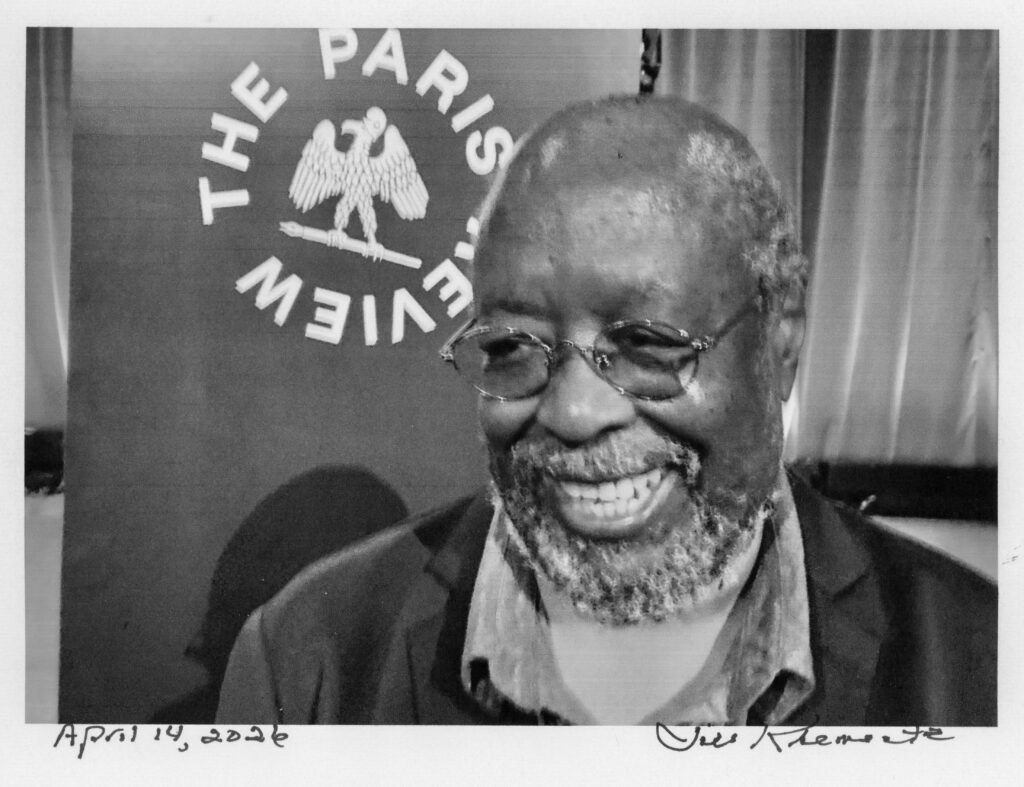
Edward P. Jones photographed by Jill Krementz at the Paris Review Revel on April 14, 2026.
Last week, at The Paris Review’s 2026 Revel, the writer Edward P. Jones accepted the Hadada Award, a prize presented each year to “a distinguished member of the writing community who has made a strong and unique contribution to literature.” Jones, whose 2004 novel The Known World won that year’s Pulitzer Prize for Fiction, has been a beloved contributor to the Review since 1992, when his short story “Marie” appeared in the Spring issue. Among the editors’ initial reactions to that story, we found a handwritten note (whose chicken scratch strongly resembles that of George Plimpton) which reads: “a formidable character … well-plotted … very well controlled … Hooray!” The note accompanies a letter from Jones, dated October 1991, in which he told the former editor James Linville that “it seems that I have been creating the people in the stories all my adult life.” This speech, however, takes us back to before that adult life, to when Jones was first falling in love with, as he puts it, “this fiction stuff.” We hope you’ll enjoy it as much as we did.
Doing nonfiction stuff is not something I like very much, so I will not be standing here for very long, sparing you and sparing me. For some months—since I was told about this award—I have been trying to find the point in my life when this fiction stuff and I became friends. I cannot find it. It perhaps has something to do with a poor boy with a mother who could not read or write, who cleaned restaurant floors and made hotel beds to feed her babies—maybe it has to do with a boy who had no desire to write but who looked up one day from enjoying some book and began to understand that words matter, that words have magic and power and that with each word, each paragraph, each book, he was—without even knowing it—becoming a piece of that word-world. Admittance was possible because his mother could afford for him the price of Signet paperbacks. And because libraries were free.
My friend Steve Mears and his family managed a few years ago to find the first book I ever read as a boy, a book that had no pictures. I was thirteen years old and I, with my sister, was visiting family in South Boston, Virginia. I was used to reading funny books. The rest of the world calls them “comics’’ but in Washington, D.C., they were “funny books.” From Marvel superheroes to Archie and the gang to Little Lulu and Hot Stuff and Casper the Friendly Ghost, I had known only funny books, with all their colorful pictures. And books of folktales and fairy tales—all of them giving me picture after picture so that my brain did not have to do much work.
There were no funny books in 1964 in South Boston, Virginia, but my oldest cousin was married to a man who made part of his living by selling salvageable stuff he would find in a junkyard. One day he found in the junkyard a box of books, and one of those books was Who Killed Stella Pomeroy? It was a British mystery published decades before 1964. From my Superman funny books, I knew words like invulnerable, but I did not know bungalow, which occurred a lot in that book. I thought it some kind of special house and I just kept reading, because it was all about the people and the good and bad things they did to each other, not about the house where they did it. I saw the people in the book, saw them rise up off the pages of mostly plain words and go about their lives. And they did that without pages of pictures.
When I returned to Washington that summer, there was not any kind of big decision to never go back to funny books. I just did it, with no more thought than going from one room into another. I can’t remember reading much of anything after South Boston, Virginia. But the next year, the first of high school, my English teacher, Miss Crawford, gave us copies of Black Boy, a treasure populated with people I knew because, though I was a child of the city, I was the product of country people who had been born and hammered into being in the South. And so I began a life of reading Black authors and then white Southern authors because they, too, wrote of a land I felt I knew. That was it for a while and then I discovered other writing folks who opened their doors and said I was welcome.
One wondrously vivid memory is of a scene in James Jones’s From Here to Eternity, a book I read long before I saw the movie. Early on, James Jones has the army man, Prewitt, go up a plain old hill, not a mountain, and lose himself in playing his horn. I do not know many musical instruments—I know a piano and a violin when I hear them, but beyond a saxophone, I am lost when it comes to the horn. But that day, when I read what Jones did with his Prewitt and that horn and that hill, I could see him and I could hear him. Of the millions of pages I have read in my life, that scene lives as one of my most lasting word experiences. It might have something to do with the kind of man Prewitt was portrayed as, even in the first pages of the novel. In the movie, Prewitt is played by Montgomery Clift, a man with a perpetually sad face.
A free writing course was offered on Saturday mornings when I was in high school, a course taught by white men who were professional journalists working in Washington, D.C. My school did not offer such courses and I do not know why I took the course. I had no real interest in writing—nothing at that time spoke to me. I might have taken it because an English teacher told me it would be a good idea. One thing I wrote for that course was about a boy who got on a Trailways bus in D.C., going I don’t recall where. [It was a] Trailways bus because my mother told me Greyhound bus did not treat Black people very well. The boy went to sleep on the bus and when he woke, he was in East Berlin. For no other reason then that I did not know any better.
As I tried to find the point where fiction-writing and I became friends, I worked hard to recall an Isaac Singer quote about when writers decide to become writers, when you walk around one particular corner of your life and cease being just a reader. I used to know Singer’s quote by heart, but time has done something to memory. I want to say that the quote might have something to do with emulation, but I don’t think Singer would have limited it to that. I can say that I have never emulated any writer, never wanted to write any way someone else has done it. It might simply be my own individual need to express what flows in the blood, what lives in imagination. And to do that, you don’t need to look to the fellow to the right or to the left. You don’t sculpt, you don’t dance, you don’t grow splendid roses, but you have discovered words and you decide you may want to try stringing them together. Humble because that’s the way you were raised. And the words are free to use, with only a pencil and the back of some used pieces of paper found in the trash. And the words–on your better days—make you happy as you use them. And on your worse days, when the words do not obey, you try to remember a mother who did not have that many good days. You simply get up the next day and start again. “Once upon a time, there was this and then there was that …”
So there may never be any knowing where this writing stuff and I became friends. In the end, though, it may not matter. It is all just about the lovely surrender to words—yours and everyone else’s—this lovely surrender to words and what they give you.