
Yesteryear

Slash With His Girlfriend Melissa Fisher in 1978

Slash With His Girlfriend Melissa Fisher in 1978

A rare photo of a very young Slash with his first girlfriend, 12-year-old Melissa Fisher Fink, at Bancroft Junior High School, 1978:

The words of Slash:

“My first girlfriend was named Melissa. She was half chubby, gorgeous. She was 12 and I was 13 when we were together. Today that isn’t something so rare. Today it’s common to see guys do big things but in 1978 we were two “bold” guys, people would turn to watch us if we kissed in public.
“People looked at us closely. ‘Don’t ruin good times,’ that was our first law. We didn’t waste the relationship we had, which was good.
“The first time we were together was in her house. We started in the laundry room and ended up in the room (the apartment had a single one shared with her mother, Carolyn). Unfortunately Carolyn came home ahead of schedule so I had to slip out the window with my pants down my ankles. Luckily, I was able to hide in the bushes.
“When her mom wasn’t home, we used her bed and when she was home, we used the couch after Carolyn fell asleep due to the Valium. Eventually Melissa and Carolyn moved to the upstairs apartment that had two rooms: one for her and another for her daughter. Carolyn thought it would be better if we were in the house than anywhere else. To us, Carolyn was a divine!”
read more
Sandra Milo: Icon of Italian Cinema’s Golden Age

Sandra Milo: Icon of Italian Cinema’s Golden Age

Known for her distinctive voice, charm, and vibrant screen presence, Italian actress and television personality Sandra Milo rose to fame in the 1950s and 1960s, becoming a muse of legendary director Federico Fellini. Her most iconic roles include performances in Fellini’s (1963) and Juliet of the Spirits (1965), where she portrayed complex, sensual characters with emotional depth. These roles helped cement her status as a symbol of Italian cinema’s golden era.

Though she took a break from acting in the 1970s, Sandra later returned to the spotlight through television, theater, and public appearances. Her candid personality and unique charisma kept her beloved by generations of Italians.
Sandra Milo was also known for her outspokenness and advocacy, especially later in life, becoming a symbol of resilience and vitality. She remained active in the public eye well into her 80s, embodying a timeless spirit of creativity and passion. Step back in time with these captivating photos of Sandra Milo at the height of her youth and fame.

See more »

read more
The Enduring Love Story of Alice B. Toklas and Gertrude Stein

The Enduring Love Story of Alice B. Toklas and Gertrude Stein

The love story of Alice B. Toklas and Gertrude Stein is one of the most enduring and influential partnerships in literary and artistic history. Their relationship spanned nearly four decades, from their meeting in Paris in 1907 until Stein’s death in 1946.

Alice B. Toklas arrived in Paris on September 8, 1907, and on her very first day, she met Gertrude Stein. The connection was immediate and profound. Toklas later described Stein as a “golden brown presence,” her voice “deep, full, velvety like a great contralto’s, like two voices.” They fell instantly in love and remained inseparable.
Their home at 27 rue de Fleurus became the legendary salon of the Parisian avant-garde. It was a hub where leading figures of modernism in literature and art, such as Pablo Picasso, Henri Matisse, Ernest Hemingway, F. Scott Fitzgerald, and many others, gathered for conversation, intellectual exchange, and to view Stein and her brother Leo’s impressive art collection.
While Gertrude Stein was the renowned writer and public figure, Alice B. Toklas was the indispensable partner behind the scenes. Toklas acted as Stein’s confidante, lover, cook, secretary, typist, editor, and muse. She meticulously managed their household, typed Stein’s manuscripts, and provided the domestic tranquility that allowed Stein to focus on her groundbreaking work. Their affection was evident in the notes they left for each other around the house, signed “DD” (Darling Darling) and “YD” (Your Darling), and their nicknames “Lovey” and “Baby.”
In 1933, Stein published her most commercially successful work, The Autobiography of Alice B. Toklas. This unique book was written by Stein but narrated in Toklas’s voice, offering a witty and insightful account of their shared life and the vibrant artistic circles they inhabited. The book brought international recognition to both women.
Their bond remained strong through significant historical events, including both World Wars. During World War I, they volunteered to deliver hospital supplies for the American Fund for French Wounded, driving across France in a Ford they affectionately named “Auntie.” They also survived the German occupation of Paris during World War II, a testament to their resilience and the protection afforded by their connections.
Their nearly four-decade-long partnership ended with Gertrude Stein’s death in 1946 from stomach cancer. According to Toklas, Stein’s final words were, “What is the answer?” and then, when no reply came, “In that case, what is the question?” After Stein’s death, Toklas continued to live in their shared home and dedicated herself to preserving and promoting Stein’s literary legacy. Toklas also became a published author in her own right, most famously with The Alice B. Toklas Cook Book (1954), which notably included a recipe for hashish fudge.
In the 1980s, a cabinet in the Yale University Beinecke Library, which had been locked for an indeterminate number of years, was opened and found to contain some 300 love letters written by Stein and Toklas. They were made public for the first time, revealing intimate details of their relationship. Stein’s endearment for Toklas was “Baby Precious,” in turn Stein was for Toklas, “Mr. Cuddle-Wuddle.”

See more »

read more
Beautiful Photos of the 1961 Oldsmobile Dynamic 88 ‘Bubble Top’ Coupe

Beautiful Photos of the 1961 Oldsmobile Dynamic 88 ‘Bubble Top’ Coupe

General Motors embraced futuristic design language for 1961, with Oldsmobile introducing a completely new 88 that was shorter, lower, and narrower than its predecessor while maintaining the same 123-inch wheelbase.

Styling drew inspiration from the burgeoning “Space Race,” with GM’s “Rocket” division creating a car that appeared ballistically fast even while stationary. The distinctive “bubble top” designation came from its curved front and rear glass, creating an enormous greenhouse that made the substantial automobile appear lighter and more elegant than conventional designs.
Oldsmobile enhanced the space-age appearance by adding “skegs” to the lower rear quarter panels, reflecting the nation’s fascination with rockets and potential space travel. The design represented a one-year-only configuration for the coupe body style, making these vehicles particularly distinctive among early 1960s automobiles.
Under the hood, the previous 371-cubic-inch V8 was replaced by the 98 model’s 394-cubic-inch unit, with the Dynamic 88 receiving a two-barrel, 250-horsepower version that used regular gasoline. A new three-speed “Roto” Hydra-matic transmission that was smaller and lighter than the previous four-speed unit was introduced as an option. Popular equipment included power steering, power brakes, and AM radio systems.

See more »

read more
The Disappearance of “Scarface” Actress Tammy Lynn Leppert in 1983

The Disappearance of “Scarface” Actress Tammy Lynn Leppert in 1983

Tammy Lynn Leppert, an aspiring actress, model, and beauty queen, disappeared under mysterious circumstances on July 6, 1983, at the age of 18 from Cocoa Beach, Florida. Her case remains unsolved.

Leppert was born in Rockledge, Florida, on February 5, 1965. She began participating in beauty contests when she was four years old, competing in nearly 300 beauty pageants and taking home about 280 crowns. Leppert was employed primarily as a model throughout her adolescent and teenage years, appearing on the cover of CoverGirl magazine in October 1978.

Just before her disappearance, Leppert appeared in the film Scarface (1983) as the girl who distracts the lookout car during the bloody chainsaw scene. Before that, among other minor roles, she played a party girl in Little Darlings (1980) and a participant in a boxing match in Spring Break (1983). Reportedly, Leppert’s legs, hips and torso were used in the main poster for the latter movie. It is also claimed she had plans to go to Hollywood in 1983. Leppert had a lead role playing herself in a film called Cover Girl Behind the Scenes.
After the Spring Break shoot was finished, Leppert went unaccompanied to a party one weekend. According to her close friend, Wing Flannagan, she came home from the party “a different person.” After performing her role in Scarface, Leppert suddenly returned home after the fourth day of filming. Her mother assumed that Leppert had been afraid of being murdered by someone, and that she had become overtaken by this delusion. Her mother felt obliged to have her examined by a doctor, but after 72 hours in a medical center, Leppert was released and there seemed to be no signs of drug or alcohol use according to doctor statements.
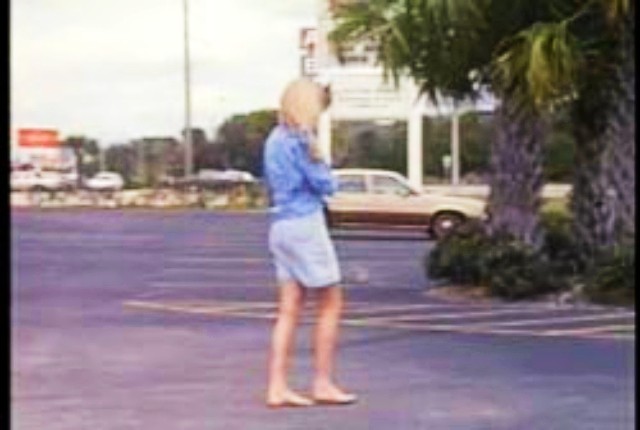
Leppert was last seen in Cocoa Beach, Florida, on July 6, 1983. She was reported to have worn a blue denim shirt decorated with flowers, along with a matching skirt, a gray purse and sandals. Some agencies have stated that Leppert left without shoes or money.
Tammy Lynn Leppert was last seen in Cocoa Beach, FL.

A male friend told authorities that he had an argument with her while driving her from her home in Rockledge and had later “left her […] in a parking lot.” Although he is the last person believed to have seen her, he is not considered a suspect. However, Leppert’s mother has claimed that her daughter was “afraid” of him.
After Leppert’s disappearance, Cocoa Beach Detective Harold Lewis received two telephone calls from a woman claiming that she was still alive. In the first call, the woman said that Leppert would make contact when the time was right. During the second call, she said that Leppert was doing what she always wanted: going to school to become a nurse.
Two prominent serial killers active in Florida at the time were considered persons of interest: Christopher Wilder and John Crutchley. Wilder was known for luring women with promises of modeling opportunities, and Leppert’s family even sued him, though the suit was later halted due to doubts about his involvement. Crutchley was a convicted kidnapper and rapist. Neither has been definitively linked to Leppert’s disappearance.

See more »

read more
16 Rare Photos of George Michael as a Young Boy From Between the Late 1960s and Early 1970s

16 Rare Photos of George Michael as a Young Boy From Between the Late 1960s and Early 1970s

George Michael, born Georgios Kyriacos Panayiotou on June 25, 1963, in East Finchley, London, had a childhood shaped by his family background and an early interest in music.

His father, Kyriacos “Jack” Panayiotou, was a Greek Cypriot restaurateur who had emigrated to England in the 1950s. His mother, Lesley Angold (née Harrison), was an English dancer. George was the youngest of three children, with two older sisters, Yioda and Melanie.
The family spent most of his childhood in Kingsbury, London, in a home his parents bought soon after his birth. He attended Roe Green Junior School and Kingsbury High School. While his mother was generally supportive of his artistic inclinations, his father was reportedly more distant and initially disapproved of music as a career choice, even telling George he didn’t think he could sing.
Despite this, George’s musical interests began at a very young age. He reportedly wrote his first song at age six after finding a gramophone in his parents’’garage. By the age of eight, he knew he wanted to pursue music as a career, though he kept this secret from his parents for a while.
In his early teens, the family moved to Radlett. It was there, at Bushey Meads School, that he met and became close friends with Andrew Ridgeley, his future Wham! partner. They shared a common ambition to become musicians, bonding over their love of music and similar “outsider” backgrounds. George even busked on the London Underground, performing songs by artists like Queen.
While his childhood saw the nurturing of his immense musical talent, it was also marked by a somewhat complicated relationship with his father and a deep, though at times complicated, bond with his mother. His early life laid the foundation for the global superstardom he would later achieve.
In the early hours of Christmas Day 2016, Michael died in bed at his home in Goring-on-Thames, at the age of 53.

See more »

read more
Prague in 1995 Through Fascinating Photos

Prague in 1995 Through Fascinating Photos

Prague in the 1990s was a city in transition, reborn from decades of communist rule into a vibrant center of culture, tourism, and democracy. After the Velvet Revolution in 1989 and the peaceful split of Czechoslovakia in 1993, Prague emerged as the capital of the newly independent Czech Republic.

The city’s rich architectural heritage—Gothic spires, Baroque churches, and Art Nouveau facades—drew growing numbers of international visitors. At the same time, a youthful energy transformed its streets: cafés, clubs, and galleries flourished, while local artists and entrepreneurs began shaping a new cultural identity.
The decade marked a blending of old-world charm and post-communist renewal, making Prague one of Europe’s most captivating capitals of the era. These fascinating photos, uncovered by David Pirmann, offer a glimpse into the streets of Prague in 1995.

See more »

read more
The Amazing Story Behind the Only Two Portraits of Poet Emily Dickinson

The Amazing Story Behind the Only Two Portraits of Poet Emily Dickinson

There’s only one officially authenticated photograph of reclusive poet Emily Dickinson. It’s a daguerreotype taken in 1847 when she was 16 years old, years before she wrote the poems that would make her famous when they were published after her death.

Amherst College, founded by Samuel Dickinson, Emily’s grandfather, received it from a donor along with other Dickinson papers in 1956, and the ownership record is clear and unbroken back to Emily’s sister Lavinia.
Other alleged pictures have cropped up over the years, but none of them have ultimately proven authentic. This was not unexpected since Emily herself declared in July of 1862 to have no photographs of herself. In a well-known correspondence with abolitionist, Unitarian minister and Atlantic Monthly columnist Thomas Wentworth Higginson, Emily responded to his request that she send him a picture as follows:
“Could you believe me–without? I had no portrait, now, but am small, like the Wren, and my Hair is bold, like the Chestnut Bur–and my eyes, like the Sherry in the Glass, that the Guest leaves–Would this do just as well?
“It often alarms father. He says death might occur, and he has moulds of all the rest, but has no mould of me; but I noticed the quick wore off those things, in a few days, and forestall the dishonor. You will think no caprice of me.”
She means “quick” in the sense of vitality, the essence of life, which she thinks drains out of photographs after a few days, hence her refusal to sit for a portrait even at her beloved father’s behest.
But in 2012, there’s a new contender for the title of only picture of Emily Dickinson as an adult poet, and the Amherst College Archives and Special Collections thinks it may just be the real deal. The image is a daguerreotype taken around 1859 of two women sitting next to each other, one with her arm around the other. It belongs to a daguerreotype collector who bought it in a group of items from a Springfield junk dealer in 1995. The collector noticed the woman on the left bore a strong resemblance to the sole picture of Dickinson, so he began to research the subject, starting with an attempt to identify the woman on the right.
After years of study, he was able to confirm thanks to two moles on her chin under either side of her mouth that the sitter on the right was Mrs. Kate Scott Turner Anthon, a school friend of Sue Gilbert Dickinson, wife of Emily’s brother Austin. Austin and Sue lived in the house next door to Emily, and Kate stayed with them several times starting in January of 1859. She struck up a close friendship with Emily, as their extant correspondence attests to, until they had a falling out about a year later.
A book published in 1951 contended that their relationship was romantic, that the falling out was a break-up. It was not well-received by reviewers at the time, to say the least, but if this picture does prove to be incontestably authentic, the book might be seen in a different light. After all, Emily wouldn’t have a picture taken for her father, so there would have had to be a powerful impetus to persuade her to sit for a picture with her arm around her friend.
Emily Dickinson 1847-1859 comparisonIn 2007, the collector showed the daguerreotype to Amherst College Archives and Special Collections staff. Their Dickinson experts have been researching it ever since. High resolution scans of both the 1847 picture and the 1859 were compared, and the physical features of the potential Emily match the confirmed Emily. Dartmouth Hitchcock Medical Center ophthalmologist Dr. Susan Pepin, who has made a study of Emily’s eye problems, examined the eyes on both images and declared them a match. From Dr. Pepin’s report:
“The two women have the same eye opening size with the right eye opening being slightly larger than the left. The left lower lid in both women sits lower than the right lower lid. The right upper lid from the crease in the lid has more length than the left upper lid. Also, the left upper lid margin height sits lower that the right upper lid margin height (0.1 mm ptosis OS).
“Other similar facial features are evident between the women in the daguerreotypes. The right earlobe is higher on both women. The inferonasal corneal light reflex suggests corneal curvature similarity, allowing us to speculate about similar astigmatism in the two women. Both women have a central hair cowlick. Finally, both women have a more prominent left nasolabial fold.
“After a thorough examination of both of these women’s facial features as viewed from the 1847 and 1859 daguerreotypes, I believe strongly that these are the same people.”
Another argument in favor of authenticity is, oddly, an anachronism. Potential Emily’s dress is at least 10 years out of date. In fact, it has several significant elements in common with the dress worn by the teenage Emily 12 years earlier. This suits the adult Emily just fine, since she was determinedly unfashionable. She told her friend Abiah Root in 1854: “I’m so old fashioned, Darling, that all your friends would stare.”
Amherst experts together with the Emily Dickinson Museum’s experts went through their textile collection to see if there was a potential match for the blue check fabric of the potential Emily’s dress, and as long a shot as this was, they actually found a sample that fits in pattern and sheen. The picture is too small to make it a definite match to the swatch, but future research with specialized tools will hopefully be able to magnify the garment in the picture so that a match can be confirmed or denied.
Kate is wearing a black dress whose style is from the mid-1850s. She was widowed for the first time in 1857, so that fits.
The authentication search is ongoing. The picture is available for viewing upon request at the Amherst College Archives and Special Collections. Researchers are asking the public to come forward with any relevant information that might be squirreled away in their attics.
(This original article was published on The History Blog)
read more
Gilbert Orcel: A Parisian Milliner of Mid-Century Elegance

Gilbert Orcel: A Parisian Milliner of Mid-Century Elegance

Gilbert Orcel was a distinguished French milliner whose elegant and refined hat designs became a hallmark of mid-20th century Parisian fashion. Active from the 1940s through the 1960s, he was a celebrated figure in the world of haute couture, with his creations featured in leading fashion magazines such as Vogue and L’Officiel. Known for his impeccable craftsmanship and artistic flair, he designed hats that complemented the silhouettes and sophistication of the postwar fashion elite.

Orcel’s signature style included straw toques, veiled caps, and silk-trimmed pieces that reflected the grace and glamour of the era. His work was often photographed by iconic fashion photographers like Henry Clarke, and his hats were worn by top models and actresses, including Simone d’Aillencourt and Gene Tierney. These images helped cement his reputation as a master of millinery.
Gilbert Orcel remains a shining name in the golden age of French couture, remembered for transforming the simple hat into a statement of style, femininity, and luxury.
Model in pale pink straw hat covered in pearls by Gilbert Orcel, photo by Philippe Pottier, 1950

Bettina Graziani wearing a small white satin cap decorated by pale pink rose and sheer black voilette covering the face and tied in the back, by Gilbert Orcel, photo by Georges Saad, 1951

Carmen Dell’ Orefice wearing a hat with a high, wavy shape in natural Milan straw, above the brim, navy-blue wings, under it is red velvet, by Gilbert Orcel, photo by Cecil Beaton, Vogue, February 15, 1951

Gigi Terwalgne in elegant two-piece ottoman adorned with roses by Worth, white straw hat with long sheer white veil by Gilbert Orcel, photo by Georges Saad, 1951

Model in natural Baku straw hat adorned with striped organdy ribbon by Gilbert Orcel, 1951

See more »

read more
40 Scary Photos From the Set of 1988 Horror Film “Child’s Play” That Will Haunt You

40 Scary Photos From the Set of 1988 Horror Film “Child’s Play” That Will Haunt You

Child’s Play is a 1988 American slasher film directed by Tom Holland, from a screenplay he co-wrote with Don Mancini and John Lafia based on a story by Mancini. The film stars Catherine Hicks and Chris Sarandon with Brad Dourif as Chucky. Its plot follows a widowed mother who gives a new doll to her son, unaware that it is possessed by the soul of a serial killer.

Child’s Play received a generally positive response from critics upon its release. It was praised for its unique premise, the suspense it built, and Brad Dourif’s chilling voice performance as Chucky, which helped establish the doll as a horror icon. While some found elements of the film to be “brainless and entertaining,” many appreciated its blend of horror and dark comedy. It’s often seen as a well-paced film that builds tension in its first half before leaning into outright terror.
The film was released in the United States on November 9, 1988. It received generally positive reviews from critics and grossed more than $44 million against a production budget of $9 million. Along with the film gaining a 1980s cult following, the box office success also spawned a media franchise that includes a series of six sequels, a television series, merchandise, comic books, and a reboot.

See more »

read more