
Yesteryear

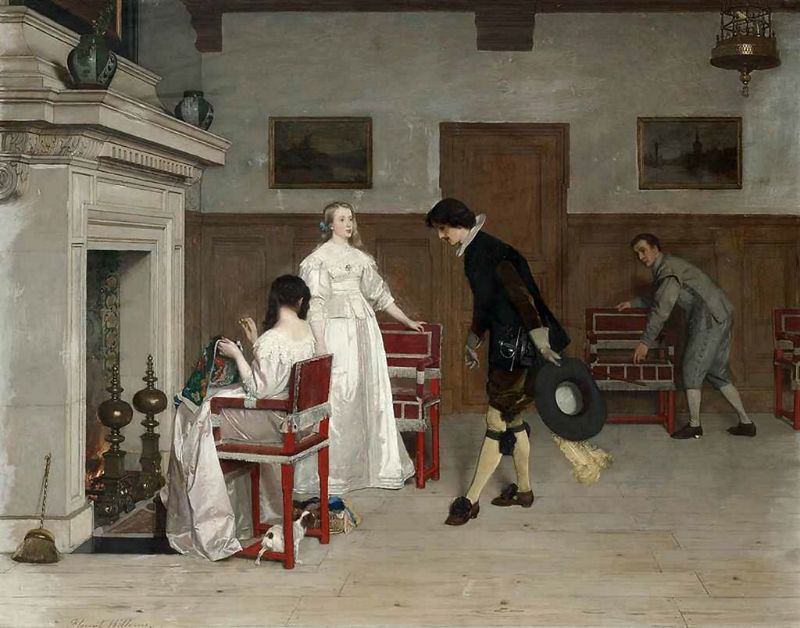
40 Beautiful Paintings by Florent Willems From the 19th Century

40 Beautiful Paintings by Florent Willems From the 19th Century

Florent Willems (1823–1905) was a Belgian painter and art restorer. He was successful with his genre scenes depicting a few figures in an interior executed in the style of the 17th century Flemish and Dutch Baroque.

Willems was particularly praised for his ability to render realistically the materials of the clothes of his figures which earned him the nickname of the ‘modern Ter Borch’. Below is a collection of beautiful paintings by Florent Willems from the 19th century.

The New Mother

The Introduction

Maid Offering Flowers

A Beauty in White

A Fair Reflection

See more »

read more
The New Sepulveda Boulevard Tunnel Following Opening Ceremonies, Los Angeles, 1930

The New Sepulveda Boulevard Tunnel Following Opening Ceremonies, Los Angeles, 1930

Sept. 27, 1930: Following opening ceremonies, a procession of cars, horses, and wagons proceeds south through the new Sepulveda Boulevard tunnel. After eight years of construction, the new tunnel connected the San Fernando Valley with West Los Angeles.

In an article the next day, the Los Angeles Times reported, “Leading a three-mile procession of Indians, Mexicans, Spaniards and other pioneers of the Southwest, who came by thousands in ox carts, covered wagons and on gaily caparisoned horses, Mayor [John] Porter yesterday turned a golden key and opened wide the gates of Sepulveda Boulevard tunnel, the new thoroughfare through the Santa Monica Mountains which links San Fernando Valley with the beaches and West Los Angeles.”
read more
Victorian Trade Cards: The Art of Advertising in the 19th Century

Victorian Trade Cards: The Art of Advertising in the 19th Century

Victorian trade cards were one of the most popular forms of advertising during the late 19th century, especially in the United States and Europe. These small, colorful cards were distributed by businesses to promote everything from soap and sewing machines to candy, medicine, and department stores.

Trade cards flourished during the Victorian era (roughly 1837–1901), coinciding with advancements in color lithography that allowed for mass production of richly illustrated prints. Many featured charming or humorous images—children, animals, flowers, and whimsical scenes—paired with the name and address of the business being promoted.
This is a collection of Victorian trade cards from the late 19th century.
Liebig Company’s Fleisch-Extract, Trade Card, Enthüllte Zauberkünste, Die Geister, circa 1880s

Liebig Company’s Fleisch-Extract, Trade Card, Miezchens erste Schlittenfahrt, circa 1880s

Queen Regent of Spain, from World’s Sovereigns series (Num. 34) for Allen & Ginter’s Cigarettes, circa 1880s

Liebig’s Beef Extract, “Italian Masques I”, “Arlecchino”, French issue, 1883

Véritable Extrait de Viande Liebig, “Italian Masques I” French issue, 1883

See more »

read more
25 Wonderful Color Photos of a Very Young Eva Marie Saint in the 1950s

25 Wonderful Color Photos of a Very Young Eva Marie Saint in the 1950s

Eva Marie Saint (born July 4, 1924) is an American retired actress. In a career that spanned nearly 80 years, she won an Academy Award, a Primetime Emmy Award, in addition to nominations for a Golden Globe Award and two British Academy Film Awards. Saint is the oldest living and earliest surviving Academy Award winner, and one of the last living stars from the Golden Age of Hollywood.

Saint attended Bowling Green State University and began her career as a television and radio actress in the late 1940s. She played the role of Thelma in Horton Foote’s The Trip to Bountiful (1953). She made her film debut in Elia Kazan’s On the Waterfront (1954), opposite Marlon Brando. The film won eight Academy Awards, including Best Picture, and earned her the Academy Award for Best Supporting Actress along with a BAFTA nomination for Most Promising Newcomer.
In a 2000 interview in Premiere magazine, Saint recalled making the film, which has been highly influential, saying, “[Elia] Kazan put me in a room with Marlon Brando. He said ‘Brando is the boyfriend of your sister. You’re not used to being with a young man. Don’t let him in the door under any circumstances.’ I don’t know what he told Marlon; you’ll have to ask him—good luck! [Brando] came in and started teasing me. He put me off balance. And I remained off balance for the whole shoot.” She repeated the anecdote in a 2010 interview.
Saint appeared alongside Bob Hope in That Certain Feeling (1956) for which she received $50,000. She was then offered $100,000 to star in the Civil War drama Raintree County (1957) with Elizabeth Taylor and Montgomery Clift. After that, she starred with Don Murray in A Hatful of Rain, the pioneering drug-addiction drama, which although made later than Raintree County was released earlier in 1957. She received a nomination for the “Best Foreign Actress” award from the British Academy of Film and Television for her performance.
Director Alfred Hitchcock surprised many by choosing Saint over dozens of other candidates for the femme fatale role in what was to become a suspense classic North by Northwest (1959) with Cary Grant and James Mason.
In 2000, recalling her experience making the picture with Cary Grant and Hitchcock, Saint said, “[Grant] would say, ‘See, Eva Marie, you don’t have to cry in a movie to have a good time. Just kick up your heels and have fun.’ Hitchcock said, ‘I don’t want you to do a sink-to-sink movie again, ever. You’ve done these black-and-white movies like On the Waterfront. It’s drab in that tenement house. Women go to the movies, and they’ve just left the sink at home. They don’t want to see you at the sink.’” In a 2010 interview she stated: “I said, ‘I can’t promise you that, Hitch, because I love those dramas.’”
Eva Marie Saint’s 1950s career was characterized by her versatility and ability to hold her own opposite major leading men and under the direction of esteemed filmmakers. Her success in this decade laid the foundation for a long and distinguished career.

See more »

read more
Stars and Stripes: 20 Stunning Vintage Photos of American Beauties Wearing Flag Inspired Fashion

Stars and Stripes: 20 Stunning Vintage Photos of American Beauties Wearing Flag Inspired Fashion

Long before Lynda Carter donned her Wonder Woman uniform complete with patriotic cape, starlets wore the stars and stripes to sell War Bonds and promote movie studios. The flag inspired fashion theme has since continued with celebrities, entertainers, musicians and models.

Whether they are wrapped in flags for magazine covers, wearing various versions of patriotism onstage, or donning red, white and blue bathing suits – here’s a collection of 20 stunning vintage photos of celebs, models and musicians in stars and stripes from the past decades.

Susan Hayward

Ann Miller

Ann Sheridan

Anne Gwynne

Barbara Bates

See more »

read more
30 Vintage Photos of a Young and Beautiful Gina Lollobrigida in Barefoot in the 1950s and 1960s

30 Vintage Photos of a Young and Beautiful Gina Lollobrigida in Barefoot in the 1950s and 1960s

Luigia “Gina” Lollobrigida (1927–2023) was an Italian actress, model, photojournalist, and sculptor. She was one of the highest-profile European actresses of the 1950s and 1960s, a period in which she was an international sex symbol. Dubbed “the most beautiful woman in the world,” at the time of her death she was among the last surviving high-profile international actors from the Golden Age of Hollywood cinema.

Born on July 4, 1927, in Subiaco, Italy, Lollobrigida initially pursued studies in painting and sculpture at the Academy of Fine Arts in Rome. She began her career in minor film roles in 1946 and gained wider recognition after placing third in the 1947 Miss Italy contest.
Her captivating screen presence led to significant roles in both Italian and French cinema, including Fanfan la Tulipe (1952) and Bread, Love and Dreams (1953). She made her English-language film debut in Beat the Devil (1953) alongside Humphrey Bogart. Her career flourished with notable performances in films like The World’s Most Beautiful Woman (1955), Trapeze (1956), and The Hunchback of Notre Dame (1956), where she played Esmeralda.
By the 1970s, Lollobrigida transitioned into a successful second career as a photojournalist, photographing notable figures such as Salvador Dalí and Paul Newman. She also dedicated herself to sculpture, a passion she had pursued since her youth.
Gina Lollobrigida passed away on January 16, 2023, in Rome, at the age of 95. She received numerous accolades throughout her career, including three David di Donatello awards, two Nastro d’Argento awards, and a Golden Globe for World Film Favorite – Female.

See more »

read more
Paula Raymond: Elegant Star of 1950s Hollywood

Paula Raymond: Elegant Star of 1950s Hollywood

Paula Raymond (1924–2003) was an American film and television actress best known for her work in 1950s Hollywood. With her refined features and poised screen presence, she became a familiar face in both film noir and science fiction genres during the postwar era.

Raymond began her career as a model and stage actress before transitioning to films in the late 1940s. She gained attention for her role in the film noir classic Crisis (1950) alongside Cary Grant, and later starred in the cult sci-fi favorite The Beast from 20,000 Fathoms (1953), which helped define the era’s monster-movie craze.
In addition to her film work, Raymond appeared frequently on television throughout the 1950s and 1960s, with guest roles on popular shows such as Perry Mason, 77 Sunset Strip, and Dragnet. Despite a car accident in the 1960s that briefly halted her career, she continued acting well into the 1980s. Take a look at these gorgeous portraits of Paula Raymond from the late 1940s and 1950s.

See more »

read more
July 4, 1884: The Statue of Liberty Was Presented to the United States

July 4, 1884: The Statue of Liberty Was Presented to the United States

In a ceremony held in Paris on July 4, 1884, the completed Statue of Liberty is formally presented to the U.S. ambassador as a commemoration of the friendship between France and the United States.

Head of the Statue of Liberty on display in a park in Paris, 1883.

Statue of Liberty, formally Liberty Enlightening the World, colossal statue on Liberty Island in the Upper New York Bay, U.S., commemorating the friendship of the peoples of the United States and France. Standing 305 feet (93 meters) high including its pedestal, it represents a woman holding a torch in her raised right hand and a tablet bearing the adoption date of the Declaration of Independence (July 4, 1776) in her left. The torch, which measures 29 feet (8.8 meters) from the flame tip to the bottom of the handle, is accessible via a 42-foot (12.8-meter) service ladder inside the arm (this ascent was open to the public from 1886 to 1916).
A plaque at the pedestal’s entrance is inscribed with a sonnet, “The New Colossus” (1883) by Emma Lazarus. It was written to help raise money for the pedestal, and it reads:
Not like the brazen giant of Greek fame,
With conquering limbs astride from land to land;
Here at our sea-washed, sunset gates shall stand
A mighty woman with a torch, whose flame
Is the imprisoned lightning, and her name
Mother of Exiles. From her beacon-hand
Glows world-wide welcome; her mild eyes command
The air-bridged harbor that twin cities frame.
“Keep, ancient lands, your storied pomp!” cries she
With silent lips. “Give me your tired, your poor,
Your huddled masses yearning to breathe free,
The wretched refuse of your teeming shore.
Send these, the homeless, tempest-tost to me,
I lift my lamp beside the golden door!”
A French historian, Edouard de Laboulaye, made the proposal for the statue. Funds were contributed by the French people, and work began in France in 1875 under sculptor Frédéric-Auguste Bartholdi. The statue was constructed of copper sheets, hammered into shape by hand and assembled over a framework of four gigantic steel supports, designed by Eugène-Emmanuel Viollet-le-Duc and Alexandre-Gustave Eiffel.
The colossus was presented to the American minister to France Levi Morton (later vice president) in a ceremony in Paris on July 4, 1884. In 1885 the completed statue, 151 feet 1 inch (46 meters) high and weighing 225 tons, was disassembled and shipped to New York City. The pedestal, designed by American architect Richard Morris Hunt and built within the walls of Fort Wood on Bedloe’s Island, was completed later. The statue, mounted on its pedestal, was dedicated by President Grover Cleveland on October 28, 1886. Over the years the torch underwent several modifications, including its conversion to electric power in 1916 and its redesign (with repoussé copper sheathed in gold leaf) in the mid-1980s, when the statue was repaired and restored by both American and French workers for a centennial celebration held in July 1986. The site was added to UNESCO’s World Heritage List in 1984.
read more
Captain Future (Magazine): Classic Space Adventure in the Pulp Era

Captain Future (Magazine): Classic Space Adventure in the Pulp Era

Captain Future was a science fiction pulp magazine published in the United States by Better Publications from 1940 to 1944. Created by editor Mort Weisinger, the magazine featured the thrilling exploits of Curt Newton, a brilliant scientist-adventurer known as Captain Future, who defended the solar system against cosmic threats.

Most of the stories were written by Edmond Hamilton, with only two exceptions. Captain Future was accompanied by his colorful team known as the Futuremen: the robot Grag, the shape-shifting android Otho, and Simon Wright, a human brain housed in a mechanical box.
The magazine stood out for its fast-paced “space opera” storytelling and its vivid, often flamboyant cover art, primarily illustrated by Earle K. Bergey. Seventeen issues were released quarterly until paper shortages during World War II ended the run in 1944. However, the adventures continued in Startling Stories until 1951.
In later years, Captain Future gained new life through reprints and adaptations, including a popular Japanese anime series in 1978 that found success in Europe and beyond. Take a look at these nostalgic covers from Captain Future magazine’s short-lived era.
Captain Future, First Issue, Winter 1940

Captain Future Vol. 1, No. 2, Spring 1940

Captain Future Vol. 1, No. 3, Summer 1940

Captain Future Vol. 2, No. 1, Fall 1940

Captain Future Vol. 2, No. 2, Winter 1941

See more »

read more
Promotional Photoshoots of a Young Tom Cruise as Steve Randle for “The Outsiders” (1983)

Promotional Photoshoots of a Young Tom Cruise as Steve Randle for “The Outsiders” (1983)

In 1983’s The Outsiders, a young Tom Cruise portrayed Steve Randle, the cocky and energetic best friend of Sodapop Curtis (played by Rob Lowe). At just 20 years old, Cruise was still early in his career, and The Outsiders marked one of his first major ensemble roles before his breakout in Risky Business later that same year.

As part of the promotional efforts for the movie, various publicity stills and photos were taken of the young cast members, including Cruise. These promotional photoshoots for The Outsiders captured Cruise’s youthful intensity and physicality. As Steve, he sported a tough “greaser” look — slicked-back dark hair, sleeveless denim or flannel shirts, tight jeans, and a brash attitude. In these images, Cruise often showed off his athletic build and high-energy personality, grinning or striking defiant poses reflective of Steve’s cocky nature.
The Outsiders is a 1983 American coming-of-age crime drama film directed by Francis Ford Coppola. The film is an adaptation of the 1967 novel of the same name by S. E. Hinton and was released on March 25, 1983, in the United States.
The film received mostly positive reviews from critics, particularly for its performances, and performed well at the box office, grossing $25.7 million on a $10 million budget. Over the years, the film has earned a cult following and has spawned a 1990 sequel television series and a successful 2023 stage musical.

See more »

read more