
Yesteryear

Amazing Photos of the 1929 Bugatti Type 37 Grand Prix

Amazing Photos of the 1929 Bugatti Type 37 Grand Prix

The 1929 Bugatti Type 37 Grand Prix is a standout model in the history of racing cars, blending engineering precision with elegant design. Produced by Bugatti under the leadership of Ettore Bugatti, the Type 37 was a true racing machine of its era, renowned for its speed, handling, and performance.
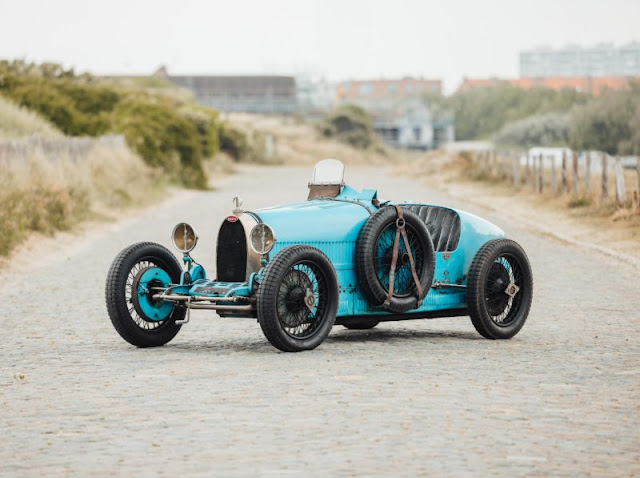
The Type 37 was powered by a 1.5-liter inline-four engine, capable of producing around 90 horsepower, which gave it the ability to reach speeds of 120 km/h (75 mph). Its lightweight, aerodynamic body was crafted from aluminum, contributing to its nimble handling on tight, twisty race tracks. The car also featured a 4-speed manual transmission, providing a smooth and responsive driving experience.
Designed primarily for Grand Prix and Formula racing, the Type 37 quickly became a force on European racing circuits, including events like the Targa Florio and Grand Prix de Monaco. With its powerful yet efficient engine, the Type 37 proved successful in a variety of racing conditions and built a reputation for reliability and performance.
Even today, the Type 37 is considered one of Bugatti’s most iconic and beloved models, a symbol of early 20th-century automotive excellence. Here is a collection of amazing photos of the 1929 Bugatti Type 37 Grand Prix.

See more »

read more
Amazing Photographs of Madonna Performing at Live Aid at the JFK Stadium in Philadelphia, 1985

Amazing Photographs of Madonna Performing at Live Aid at the JFK Stadium in Philadelphia, 1985

Live Aid was a benefit event on July 13, 1985, organised by Bob Geldof and Midge Ure to raise money to fight famine in Ethiopia. It consisted of two concerts, which were held simultaneously at Wembley Stadium, London and at the JFK Stadium in Philadelphia.

The shows were attended by respectively 72,000 and 100,000 people, while the TV broadcast reached a massive 1,9 billion global audience. It was the largest benefit event of its time.

The star-studded line-up was unprecedented and included performances from practically every icon of the 1980s: Queen, David Bowie, U2, Sting, Phil Collins, Elton John, Rolling Stones, Bob Dylan, Eric Clapton, Paul McCartney, The Who and many more.

Madonna, who was one of the new revelations at that time, was part of the afternoon schedule in Philadelphia, starting her half hour set at 16:27. She was introduced by Bette Midler at the concert: “I want you to know I have no idea why I was asked to introduce this next act — because you all know, I am the soul of good taste and decorum.  However we are thrilled to be able to introduce to you today a woman whose name has been on everyone’s lips for the last six months. A woman who pulled herself up by her bra straps and has been known to let them down occasionally.”
Madonna performed “Holiday” and her most recent single “Into the Groove,” before premiering “Love Makes the World Go Round,” from her upcoming album True Blue, which would be released only a year after Live Aid. For this final performance, Madonna was joined on stage by Thompson Twins and Nile Rodgers. In return, Madonna made an appearance during Thomson Twins’ set.

See more »

read more
Tina Turner Photographed by Richard Avedon for Vogue Magazine, 1971

Tina Turner Photographed by Richard Avedon for Vogue Magazine, 1971

Tina Turner in 1971 was at the peak of her dynamic career, captivating audiences worldwide with her electrifying performances and unique voice. At that time, she was performing as part of the Ike & Tina Turner Revue, a powerhouse duo that combined rock, soul, and rhythm and blues. Their hits included “Proud Mary,” which became one of their signature songs after its release in 1971.

Tina favored glamorous, bold outfits that highlighted her legs and matched her high-octane performances. In 1971, she often wore sequined or fringed mini dresses that shimmered under stage lights, paired with high heels. These outfits allowed her to move freely while accentuating her energetic dance moves.
Here, Tina Turner photographed by Richard Avedon in New York for Vogue magazine on June 13, 1971. These photographs of Tina capture the visual truth that every one of Avedon’s photographs does, with no exceptions. He saw right through to the truth of anyone and everyone. Tina’s ferocity tells her truth.

read more
Rarely Seen Photos of Teenage Linda Ronstadt Before Her Popular Rise to Fame

Rarely Seen Photos of Teenage Linda Ronstadt Before Her Popular Rise to Fame

Linda Ronstadt, born on July 15, 1946, in Tucson, Arizona, spent her childhood and early teenage years in the 1950s and early 1960s surrounded by music. Her family was very musical, with her mother playing the ukulele and her father singing Mexican songs and playing guitar. By the age of six, Linda was already singing harmony with her family. She recalled to People magazine, she thought, “Well, I won’t have to add, because I am going to sing.”

She grew up listening to a wide range of genres, including her father’s Spanish-language albums, country and western, top 40, blues, and gospel. She has stated that she doesn’t record any type of music she didn’t hear in her family’s living room by the time she was 10, highlighting the profound influence of her early musical environment.
In her early teens, around age 14, Linda began performing in local clubs and pizza parlors with her older brother Pete and sister Suzie. They formed a folk trio, sometimes billing themselves as “the Union City Ramblers” or “the Three Ronstadts,” and even recorded themselves as “the New Union Ramblers.” Their repertoire included folk, country, bluegrass, and Mexican music.
By 1964, at the age of 18, Ronstadt decided to pursue music professionally. She briefly attended the University of Arizona but left after a couple of months to move to Los Angeles. There, she teamed up with Tucson native Bob Kimmel and Kenny Edwards to form the folk-rock band The Stone Poneys in 1964. This marked the true beginning of her professional career, leading to their signing with Capitol Records in 1966 and their breakthrough hit “Different Drum” in 1967.
Below are some photographs of Ronstadt from the 1950s and early 1960s, as she wasn’t famous yet:

See more »

read more
Glamorous Fashion Photography by Bob Stone in the Early 1970s

Glamorous Fashion Photography by Bob Stone in the Early 1970s

Bob Stone was an American fashion and editorial photographer active primarily during the 1960s and 1970s. Born in Los Angeles, he studied art at UCLA before beginning his photography career in Hollywood. He later moved to New York City, where he became a prominent figure in the fashion industry, known for his sleek, glamorous style and sharply composed images.

Throughout his career, Bob Stone worked with major fashion publications including Vogue, Harper’s Bazaar, Cosmopolitan, and GQ. His editorial photography often featured prominent models of the time such as Anjelica Huston and Apollonia van Ravenstein, capturing the spirit of high fashion with a refined and modern aesthetic. His work was characterized by clean compositions, sophisticated styling, and a strong sense of elegance that defined the visual culture of the era.
In addition to his editorial success, Stone was also a sought-after commercial photographer. He created advertising campaigns for major brands like Revlon, Clairol, Elizabeth Arden, Saks Fifth Avenue, American Airlines, Pepsi, and MCA. His images balanced artistry with commercial appeal, making his work both visually striking and widely accessible.

Anjelica Huston, make-up by Charles Revson, photo by Bob Stone, Vogue, October 1, 1972

Anjelica Huston in white mink coat by Pierre Cardin, photo by Bob Stone, Vogue, October 1, 1972

Anjelica Huston wearing fur coat, photo by Bob Stone, 1972

Apollonia van Ravenstein standing on the sidewalk in front of a grey wall wearing grey wrap skirt, grey wool jersey cardigan jacket, ribbed black cashmere pull, and ivory silk shirt by Halston, photo by Bob Stone, Vogue, August 15, 1972

Apollonia van Ravenstein wearing a cream ribbed sweater by Valerie Louthan, handcraft tan cashmere scarf, and Mr. Martin multicolor houndstooth hat, photo by Bob Stone, Vogue, August 15, 1972

See more »

read more
Stunning Fashion Designs by Joset Walker in the 1940s and Early ’50s

Stunning Fashion Designs by Joset Walker in the 1940s and Early ’50s

Joset Walker (1902–1999) was a French-born American fashion designer best known for her elegant and practical ready-to-wear clothing. Born Josette Georgette Legouy in France, she moved to the United States at age 14 and later studied at the New York School of Fine and Applied Art (now Parsons School of Design), graduating in 1928. Among her classmates was the renowned designer Claire McCardell.

In the 1930s and ’40s, Walker became known for her colorful sportswear and her use of international influences, including Mexican and Guatemalan textile patterns. Her designs were sold at major department stores such as Bloomingdale’s and Saks, and she eventually founded her own successful label, Joset Walker Designs.
Her work was featured in prominent fashion magazines like Vogue, Harper’s Bazaar, and Life, and she was recognized for her ability to blend high style with wearability. Walker retired from fashion in the 1970s and spent her later years restoring an 18th-century home in Flemington, New Jersey. Take a look below at some of Joset Walker’s most captivating fashion designs from the 1940s and early ’50s.
Models in beautiful Everfast fabric dresses by Joset Walker, photo by Jerry Plucer, Harper’s Bazaar, May 1945

Bijou Barrington in draped Enka rayon jersey knit dress in heather by Joset Walker, hat by John Frederics, Harper’s Bazaar, August 1945

Model in Jamaican print Dan River cotton fabric dress by Joset Walker, Vogue, January 1, 1947

Evelyn Tripp in Cohama wool dress shot through with silver Lurex by Joset Walker, worn with with small velveteen cap and chinchilla muff, photo By Louise Dahl-Wolfe, Harper’s Bazaar, November 1948

Model in agate-colored piqué sleeveless dress squared off with a giant bertha, by Joset Walker, photo by Louise Dahl-Wolfe, Harper’s Bazaar, June 1948

See more »

read more
The Battered and Bruised Face of Elvis Presley Should Shock Some of His Fans!

The Battered and Bruised Face of Elvis Presley Should Shock Some of His Fans!

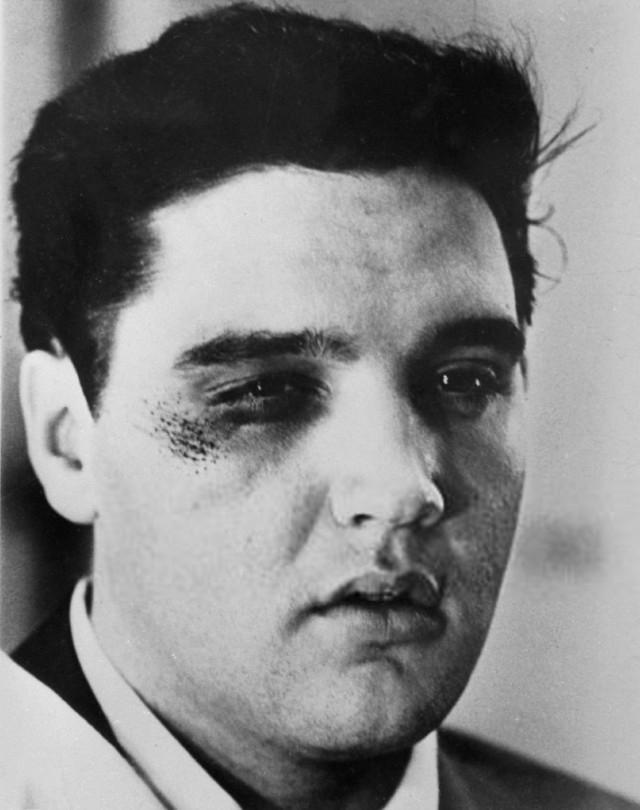
The battered and bruised face of Elvis Presley should shock some of his fans who expect to see him all prettied up in his movie roles. Elvis shows what he looks like after he gets slammed around in a remake of an old boxing picture, Kid Galahad (1962). Just to keep the record straight and avoid any unnecessary tears, the bumps and bruises are the product of the makeup department and not the result of a beating.

In the film, Presley’s makeup was used to make him look like a believable boxer, particularly after fights. Makeup artists created the appearance of cuts, bruises, and swelling to convey the physicality of his character. Specifically, makeup was used to create a gash across his cheek and swollen lips to depict the results of his boxing matches in the film.
“He looks like an electric mixer had been working on his face,” columnist Dorothy Manners reported. “One eye is puffed and closed, there’s an ugly gash across his cheek, and his lips are swollen out of shape. From the looks of him, Kid Presley must lose every fight in the script.”
Makeup could make Presley’s face look the part, but to make the rest of his physique fit would take a lot of work. Producer David Weisbart brought in former junior welterweight champion Mushy Callahan as a technical adviser to get Presley in shape for his role and teach him how to box. For 25 years Callahan had taught actors, including Wayne Morris in the original Kid Galahad film in 1937, how to handle themselves in the ring. The 56-year-old Callahan put Elvis on a rigorous training schedule to get him ready for his fight scenes. After the film was released, Elvis claimed he lost 12 pounds under Callahan’s regimen. Every morning he ran miles along the roads near Idyllwild in Southern California, where much of Kid Galahad was filmed. Every afternoon he worked the light and heavy bags and boxed with his trainer.
While Elvis was sheltered from the press, Mushy made himself available to anyone who cared to listen. Outgoing by nature, he always had something to say about his special pupil. “I try to break a script down and train him according to what the story calls for,” he explained to UPI writer Joseph Finnigan. “We work out routines that Elvis has to do in the ring and he catches on pretty good. He’s not afraid to get hit. Of course, he doesn’t want to get his teeth knocked out.”
As the training progressed, Mushy revealed that coaching Elvis was difficult for an unusual reason. “I’m having an awful time with Elvis because he looks too GOOD. He’s supposed to be a clumsy fighter in the film, but he looks and moves like a champ. So my job is to destroy his natural coordination and teach him to look bad. It’s a little like being a jockey and having to rein in ‘Man of War.’ It’s kind of hard to do.”
Two professional fighters who squared off with Elvis in Kid Galahad were also impressed. Welterweight Orlando de la Fuente indicated, “He is very, very strong. He was very interested. He watched me very carefully so he could learn the body movements.” Orlando’s brother, Ramon, a light heavyweight agreed. “Elvis hit me pretty hard. There was one scene there where we kept on fighting after the bell rang. He caught me a good right hand on the jaw. It wasn’t in the script but they left it in, it was such a good scene.”

See more »

read more
Camille Clifford: Perfect Body and Iconic Gibson Girl

Camille Clifford: Perfect Body and Iconic Gibson Girl

Camille Clifford (June 29, 1885 – June 28, 1971) was a Belgian-born actress and model, best known as the quintessential “Gibson Girl,” a feminine ideal popularized in the late 19th and early 20th centuries through the illustrations of artist Charles Dana Gibson.

With her hourglass figure, high-piled hair, and elegant demeanor, Clifford became the living embodiment of Gibson’s illustrations, symbolizing sophistication and Edwardian beauty.
Though she pursued a short career on stage, Camille Clifford’s fame primarily stemmed from her iconic look, which captured the imagination of the public and cemented her legacy as a fashion and cultural icon of her time. After marrying Captain the Hon. Henry Lyndhurst Bruce, heir to the title of Lord Aberdare, she gradually retired from the spotlight.
Take a look at these fabulous photos to see the beauty of a young Camille Clifford from the early 1900s.

See more »

read more
Louis Wain and His Psychedelic Cat Paintings

Louis Wain and His Psychedelic Cat Paintings

Louis Wain (August 5, 1860 – July 4, 1939) was a British artist best known for his whimsical and often psychedelic paintings and illustrations of cats. His work played a major role in changing the public perception of cats in Victorian and Edwardian England—from being seen primarily as utilitarian mousers to beloved household pets.

Wain began his career as an illustrator, contributing to publications like The Illustrated London News. In 1886, he created his first famous cat drawing for a Christmas issue of The Illustrated London News, titled “A Kittens’ Christmas Party,” which featured anthropomorphized cats in festive human-like scenarios. This illustration launched his reputation as a cat artist.
Wain’s early cat drawings were naturalistic but quickly evolved into anthropomorphic depictions—cats wearing clothes, playing instruments, attending parties, and acting like humans. These images were charming and humorous, and they appealed to a wide audience.

As his career progressed, his style became increasingly colorful, complex, and abstract. Some of his later works featured kaleidoscopic patterns, vibrant colors, and heavily stylized cats that bordered on the psychedelic. These later pieces have fascinated art historians and psychologists due to their potential reflection of Wain’s deteriorating mental health.
Wain was diagnosed with schizophrenia later in life, and he spent his final years in mental institutions. His later cat paintings—often cited as visual reflections of his mental state—have been studied in psychology and art circles for how they appear to represent the progression of his illness.

See more »

read more