

New York subscribers got exclusive early access to this story in our Brooding newsletter. Sign up here to get it in your inbox.
We attended a family wedding last weekend, and my kids were tasked with helping direct cars into a field for parking. They really didn’t have to do much more than wave and smile and point, but their enthusiasm for the task — perhaps combined with my younger son’s choosing to wear a bow tie — made people happy. Later on at the reception, the kids chatted with the adults sitting at their table. They were polite, made eye contact with everyone, and weren’t shy. People came up to my husband and me to say, “Wow, what nice kids you have.” Did I tell them my kids agreed to help park cars only after we’d agreed to pay them $20 each? Of course not.
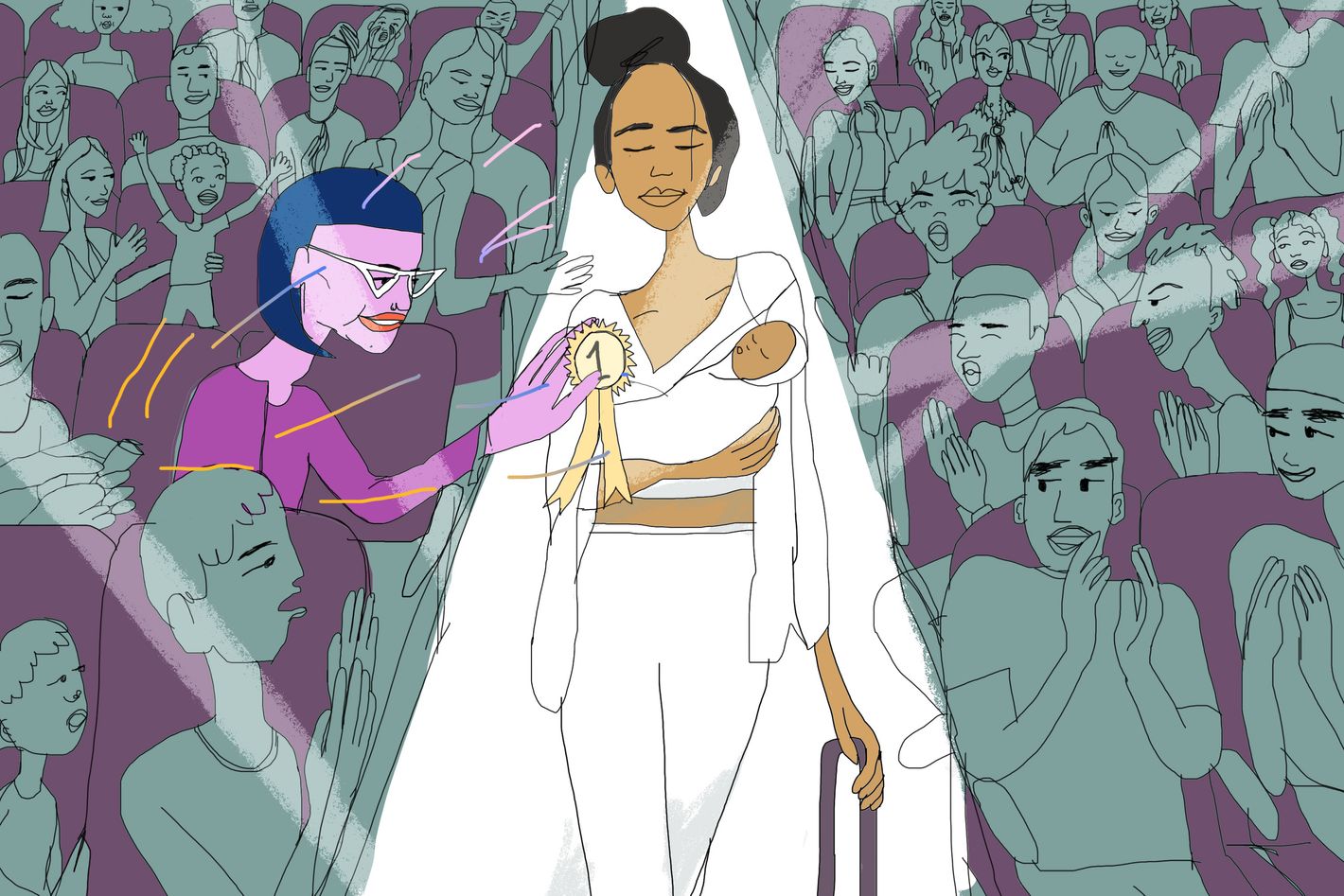
There are few things more satisfying than hearing praise for your kids. Mostly, it’s just nice to see them getting along well in the world, but a part of that praise reflects a flattering light back onto the parents, too. When a child is polite and personable, people tend to extrapolate that their parents must be good people — trustworthy and competent, people worthy of respect and deserving of inclusion, upstanding members of the community, even. When your child’s behavior casts you in this golden spotlight, it feels amazing. But is it fair?
Anyone who has taken a baby on an airplane knows there’s nothing at all fair about being judged by your kids’ behavior. I remember making our way off the plane after one flight my son slept blissfully through, and it felt like being a minor celeb. Everyone smiled at us as we passed, the beatified parents of a baby who hadn’t bothered anyone. “He did so great!” an older woman whispered to me.
A year later, my son was 2 and wailed inconsolably for the last hour of a flight. This time, our walk to the exit was met with weary looks, but mostly people just averted their eyes. Did I do anything differently from one flight to another? Not really — I didn’t deserve the praise or the scorn. Both flights had been a roll of the dice.
This kind of judgment is a fact of life. Even when we know it’s unwarranted, we let ourselves indulge. But when we judge parents by their kids’ behavior, we are on some very embedded monkey-brain shit, reverting to our most uncritical way of thinking, the kind that seeks out what feels good rather than what feels true. After all, it’s only parents of kids who are well behaved who truly believe they deserve this kind of credit.
No one feels the effects of this more acutely than parents of neurodivergent kids who struggle with social situations. We’ve come a long way from the days when doctors believed autism was caused by mothers who withheld affection, but even today the world is really not predisposed to empathize with a kid who doesn’t make eye contact. We all share the boomerly urge to coo over a responsive child, and when a child fails to respond, or responds with hostility, the momentary frustration or shame we feel is a glimpse at some of our deepest-held biases and fears, about our children and ourselves. One subtle way parents of neurotypical kids can extend solidarity to parents of kids who are neurodivergent is to remember that our own kids’ behavior is not a channel of our strength or weakness of character.
We all possess the lazy compulsion to find a link between what we can clearly observe — like a child’s bad behavior — and some moral substance deep within. Maybe it’s just the easiest way we have of ordering the chaos of our surroundings, but it leads to a lot of boneheaded thinking. It’s the same habit Susan Sontag wrote about in Illness As Metaphor back in 1978. The book critiqued the connection people made in the 1970s between cancer and psychology. At the time, cancer was widely considered to affect people who repressed their emotions, an idea that seems insane today. It wasn’t uncommon for cancer treatments to include visits to a psychotherapist, not as a way of learning to cope with the diagnosis but as a means of treating the cancer itself through the release of repressed emotions.
Sontag’s larger point was that people have a tendency to think of illness as a metaphor for our inner states, a kind of manifestation of what’s hidden. No one really believes this anymore (though RFK Jr. is definitely the type to buy this sort of BS), and it goes to show you how linked science is to culture. But we still make the same sorts of unscientific linkages between what we can observe and what we suspect to be the underlying cause, and there’s no more frequent application of this faulty reasoning than when we associate children’s behavior with the strength of their parents’ character.
If anything, I’ve observed the opposite to be true: Kids often seem to complement their parents, for better and worse. Some of the most scattered and dissociative parents I know have some of the most conscientious children (I believe we lately use the word parentified for kids like this), while some of the sweetest, most tenderhearted parents are tasked with handling the toughest, most uncooperative kids. The only real through-line I can see is that kids’ characters are their own, and parents are powerless to change them except by encouraging certain habits and discouraging others.
This is not at all to say that parenting doesn’t matter. But our influence manifests imperfectly and unexpectedly and in different ways over time. Sometimes, parenting is just a matter of teaching kids to fake good behavior in the hope that it will lead to something deeper developing on its own. My husband began teaching my kids about eye contact when they were in kindergarten. I recall finding it a bit old-fashioned and severe, the way he’d insist that they look at him when speaking to him. He really drilled it into them — I had nothing to do with it, it’s not how I was raised. And today I reap the benefits; my kids are trained up in making the kind of polite eye contact adults love. It’s true, my husband deserves credit for teaching our kids that. That was good parenting on his part. But is the habit of making eye contact a true sign of inner goodness? Absolutely not. My kids’ inner goodness has nothing to do with the adult-management training they received at a young age, but no one can tell the difference.
We want to take credit for our kids’ best moments and deflect responsibility from their worst — which is all the evidence we need that this is all just storytelling meant to make us feel better about ourselves.