

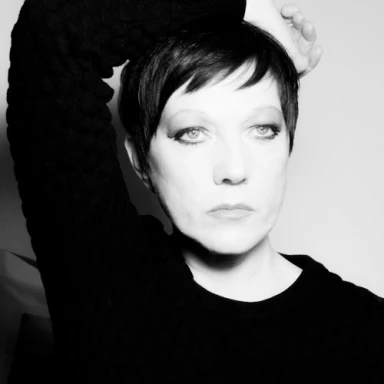
By Sprite Gravier
 In the flickering light of clubland, where synths pulse like marquee bulbs and heartbreak is always in soft focus, Billie Ray Martin first emerged as a screen siren for the electronic age. Her voice—smoky, defiant, and drenched in longing—doesn’t just sing; it performs. And her songs? They’re not tracks. They’re scenes.
Take Deadline for My Memories. The album cover alone channels Greta Garbo in exile—Billie posed like a silent film star caught mid-confession. It’s not nostalgia; it’s resurrection. She’s Garbo on the dance floor, mascara smudged with meaning.
Her Imitation of Life was written while watching the 1934 film of the same name. The result is a torch song in technicolor, where shadows of smiles linger like cigarette smoke. It’s Billie as both narrator and ingénue, watching the screen and stepping into it.
In True Moments of My World, she scripts a backstage drama worthy of Bette Davis. A director demands method acting; the actress resists, craving privacy in a world that wants her soul on cue. “I’ll follow your smile up to the moon,” she sings—a line so poetic it could’ve been whispered on a Paramount soundstage.
Then there’s Big Tears and Make-Up, a breakup ballad dressed in acting metaphors. “You paid me ten cents imagination / for a million-dollar part” is pure Crawford—devastated, defiant, and ready for her close-up.
Even her club hits shimmer with cinematic subtext. Your Loving Arms isn’t just a dance anthem—it’s a shelter scene, a moment of emotional refuge framed in yearning. “Inside your arms I’m burning” could be a line from a noir monologue, delivered in silhouette.
From her Electribe 101 days, Tell Me When the Fever Ended is a fever dream of lost love and lingering obsession. Another one penned by Billie herself, it’s a monologue of emotional possession: “I’m gonna use you like a tool / And I’ll be long gone in love.” The song plays like a scene from a psychological thriller—love as spell, heartbreak as haunting.
Talking with Myself, meanwhile, is the ultimate soliloquy. Billie’s voice drifts through the track like a ghost in a velvet booth, reflecting on isolation and inner dialogue. It’s Garbo in Queen Christina, whispering to no one. The song became a club classic, but its emotional architecture is pure arthouse: introspective, hypnotic, and timeless.
Her 18 Carat Garbage album, recorded in great part in Memphis with members of Aretha Franklin’s band, is a cinematic soul opera. Captain Drag tells the story of a transgender sailor whose identity is rejected by society—a tale of transformation and exile. Where Fools Rush In is a torch song for the romantically reckless, and I’ve Never Been to Memphis is a meta-ballad about fame, longing, and the myth of Elvis Presley Boulevard.
In Je Regrette Everything, her collaboration with DJ Hell, Billie channels Edith Piaf by way of Diamanda Galás. It’s electro-noir meets Shirley Bassey—a hand-wringing dramafest that turns regret into high art.
Honey, a club hit remixed by Chicane and Deep Dish, is deceptively tender. Beneath the shimmering beats lies a story of emotional disillusionment: “I don’t wanna be your honey this time / I just wanna feel your heart on my side.” It’s the sound of someone reclaiming their worth.
And Mystic Motion, her collaboration with Datura, is pure Italo-house mysticism. Billie’s vocals glide over trance textures like a diva lost in a dream, writing her own myth in motion.
Her work with The Opiates on Hollywood Under the Knife takes the metaphor further. Songs like Anatomy of a Plastic Girl and Rainy Days and Saturdays explore identity, fame, and transformation—divas, transvestites, and starlets caught between the mirror and the myth. It’s Sunset Boulevard reimagined in synths and scars.
Billie Ray Martin doesn’t just evoke Old Hollywood—she directs it. Her lyrics are scripts, her voice a camera, her albums a series of emotional films scored in soul and sequins. She is the diva who danced through the machines, and every song is a scene you’ll want to rewind.
Billie Ray Martin’s Cinematic Soundtrack
Essential Scenes from the Soundtrack of a Diva’s Inner World
| Track Title | Cinematic Lyric | Imagined Scene |
| Deadline for My Memories | “I’ve been sitting like a toy staring restlessly” | A Garbo-inspired diva walks alone through Soho |
| Imitation of Life | “Shadows of your smile will be all I can recall” | Black-and-white montage of love lost and remembered |
| True Moments of My World | “I’ll follow your smile up to the moon” | A director calls “Cut!” as emotions spill on cue |
| Big Tears and Make-Up | “You paid me ten cents imagination for a million dollar part” | A Crawford-esque starlet storms out of the studio |
| Your Loving Arms | “Inside your arms I’m burning” | Lovers reunite beneath flickering marquee lights |
| Rainy Days and Saturdays | “And I wish that life could be a Hollywood album like a book of perfect memories” | A starlet cries glitter tears on a rainy red carpet |
| Anatomy of a Plastic Girl | “But what you see is what you get when I parade my silhouette down Rodeo Drive” | A mirror-ball shatters as identity slips into myth |
| Tell Me When the Fever Ended | “Tell me when the fever ended / I’ll make it right again” | A femme fatale casts a final spell in a smoky club |
| Talking with Myself | “I’m talking with myself again” | A solitary figure dances alone in a velvet booth |
| Captain Drag | “Now he’s a woman… but they don’t like the dress that he wears” | A sailor in exile walks the harbor in heels |
| Where Fools Rush In | “I wanna lay my soul bare knowing it leads to nowhere” | A romantic fool returns to the scene of heartbreak |
| I’ve Never Been to Memphis | “I’ve never dragged the train of my dress down Elvis Presley Boulevard” | A dreamer rewrites her origin story in neon |
| Je Regrette Everything | “I was burning bridges while you burned your last cigarette” | A diva sings her regrets in a velvet-draped cabaret |
| Honey | “I don’t wanna be your honey this time” | A woman walks away from sweet nothings and empty arms |
🎬