

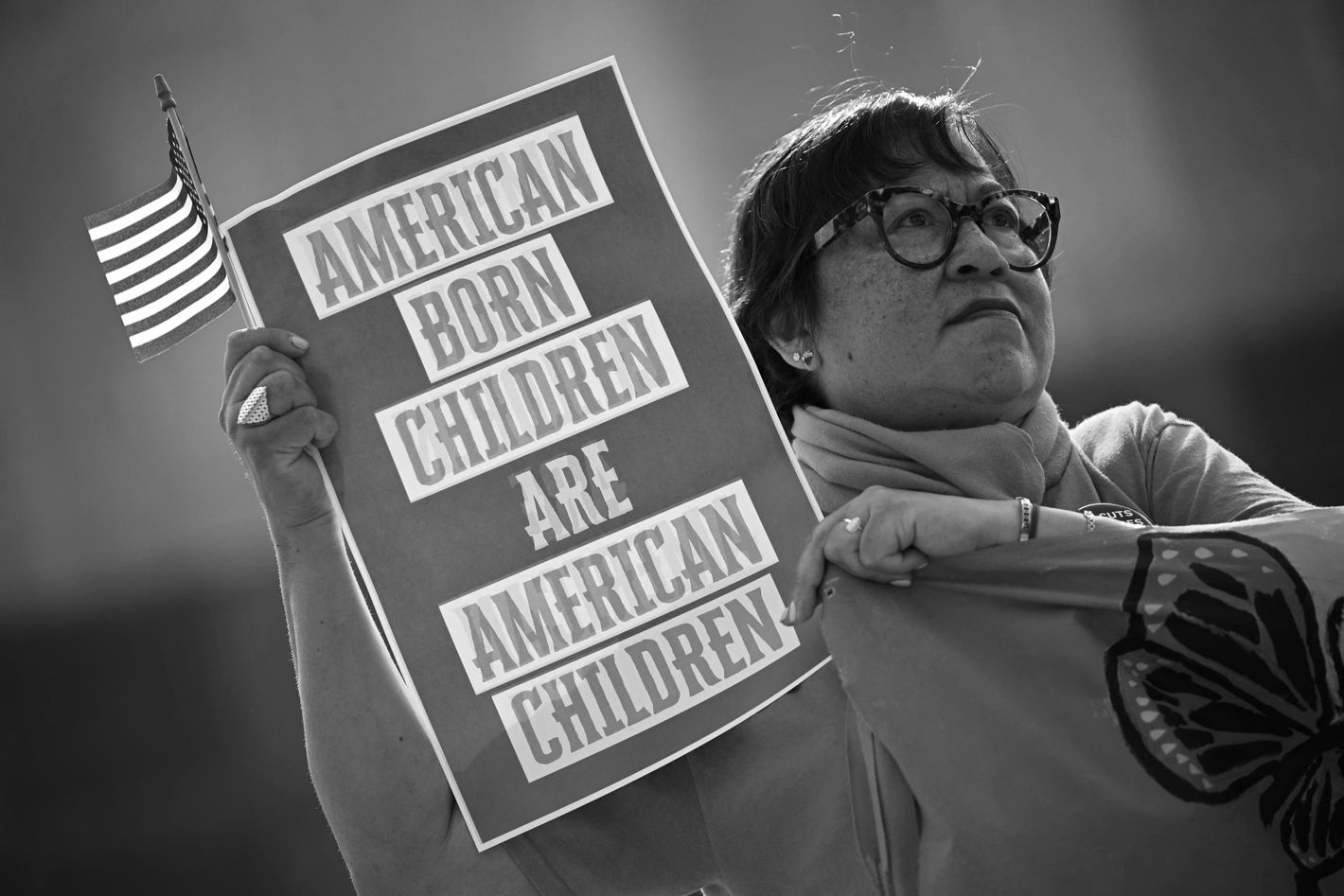
On his first day back in office for his second term, President Donald Trump signed an executive order to revoke birthright citizenship for children born in the United States whose parents are without legal status. This was meant to roll back the immigration rights that define this country. The order was a direct attack on the 14th Amendment, which, for more than 160 years, has guaranteed that anyone born on U.S. soil automatically receives citizenship, whether or not their parents are American citizens themselves. Citizen status offers full legal protections to people in the U.S., allowing them to vote, work, and live anywhere in the country; travel freely with a passport; access federal benefits; and enjoy many other rights some may take for granted.
The executive order was quickly challenged in federal court, and several judges issued nationwide injunctions to prevent it from going into effect. But at the end of the Supreme Court’s term on Friday, the conservative supermajority ruled in favor of the administration in Trump v. CASA. The case did not address birthright citizenship on merits — meaning the Court was not weighing in on whether Trump’s attempt to end it is constitutional. Instead, the justices ruled that the nationwide injunctions blocking the executive order were not legal and paved the way for the order to be implemented in the 28 states that did not sue the administration.
I spoke with Olivia Sedwick, a counsel at the nonprofit Lawyers’ Committee for Civil Rights Under Law, about what the decision means in practical terms — and why the legal fight over birthright citizenship is far from over.
Can you start by reminding us what Trump’s executive order said about birthright citizenship and what the Supreme Court case was about?
In January, Trump signed an executive order that essentially said that the children born to individuals who were not legal United States citizens — meaning here either as an undocumented immigrant or as someone on a lawful visa — would not be considered a citizen by birth. Several lawsuits were filed that challenged the executive order. The first case that was decided was in the Ninth District court out of Seattle, and the court there said that the executive order likely violated the Constitution. They instituted a nationwide injunction prohibiting the enforcement of the executive order not just on the parties that sued but on the entire country. Shortly thereafter, the other cases were also decided and judges essentially ruled the same thing in different district courts. They also implemented nationwide injunctions. Shortly after those district court decisions came out, the Trump administration appealed. It filed what are called “emergency applications” for stays of judgment in the various district courts. They did that on the question of whether or not a nationwide injunction — also called a universal injunction — was proper in this case.
They filed a petition to the Supreme Court to change the scope of the underlying injunction. By limiting the relief — meaning the universal injunctions — that the district courts already granted, the Court could open the door for the Trump administration to at the very least enforce the executive order in the states that did not sue while the challenge against it is considered on its merits.
What did the majority opinion say in this case, then?
The Supreme Court sided with the Trump administration in declaring that a universal injunction is not lawful and it’s not found in the Constitution. The impact goes beyond this decision, but the core question of whether or not birthright citizenship is constitutional has still not yet been answered. That particular question is still pending in four cases in three lower-circuit courts.
Given this decision, as of today, are children born everywhere in the United States entitled to citizenship?
There’s a 30-day delay before the restrictions go into effect in the 28 states that did not sue the administration. You now also have a situation of piecemeal enforcement. On a very general high level, it’s going to cause mass confusion. States will have to shift their infrastructure to be able to implement the executive order. That was one of the main arguments that the groups of states in State of Washington v. Trump and in New Jersey v. Trump articulated. The plaintiffs said there’s a host of ills that would be associated with them even just trying to get systems in place in order to enforce the executive order.
At its fundamental core, you’re going to have this question of, Who deserves to be considered a citizen? Under what circumstances are people going to be determined to be citizens? This executive order cannot be analyzed outside of the historical context of birthright citizenship. Birthright citizenship was Congress’s way of responding to the Supreme Court’s Dred Scott v. Sandford decision in 1857 — one of the most, if not the most, abhorrent Supreme Court decisions to ever be penned. Congress’s response to that decision was to codify birthright citizenship in the Civil Rights Act of 1866. Two years later, the 14th Amendment was enacted and ratified, and you see birthright citizenship become a constitutional principle. Fast-forward to today, where various judges of all political leanings have declared that the executive order banning birthright citizenship is likely unlawful and unconstitutional. Yet you have a Supreme Court saying, “That might be the case, but you can prevent the executive order from being enforced only on the people that filed the lawsuit.”
What they’re essentially saying is everybody now has to sue in order to get relief from this executive order being enforced against them. Logistically, that’s statistically impossible. The federal judiciary only accepts a small percentage of cases. It’s going to create a logjam of cases — which could have been prevented by maintaining the efficacy and strength of a universal injunction.
If this decision does go into effect in 30 days, what will that mean for children born to non-U.S. citizens? What about children born to green-card holders or people who are in the U.S. on work or student visas?
It depends on what state they’re in. If they’re in a state that sued to block the enforcement of the executive order, then in those states, they should be fine. Their children should be born under the cover of the citizenship clause — at least for the time being, that means they would be considered to be lawfully born United States citizens and they would be issued a birth certificate indicating that.
In the states that are not under the cover of the injunctions, they’re going to have to figure out what type of documentation or process they’re going to require people to go under in order to either establish their status here and, in turn, determine the status of their child. If you’re in my home state of Indiana, injunctions don’t apply to you. It’s very complicated. This is the mess that is created when a device as helpful as an universal injunction is taken away.
What happens if you are a person without legal status and you give birth in, let’s say, Indiana, since there’s no injunction that’s applicable there. Does that mean your child is stateless?
From my understanding, it appears that the child is considered to take on the nationality of the parent — so if both parents were from Nicaragua, the child would likely be considered to be from Nicaragua. What happens after that is so up in the air. Unfortunately, it’s such a parade of horribleness that I’m afraid to even postulate about what could happen, because I don’t want to give anybody any ideas. It’s a scary time, and I pray that these questions can be resolved quickly — particularly the merit-based question about whether or not birthright citizenship is constitutional.
What will happen if a child is born to a noncitizen in a state that grants birthright citizenship, then that family travels to or moves to a state that does not? Could they stop recognizing that you’re a U.S. citizen?
No. We acknowledge that states have their own level of sovereignty. Issuing birth certificates is governed by the states. It would likely very much be treated as a driver’s license. Every state sets their own requirements about what documentation you need to produce. If you’re able to get your driver’s license in one state, there’s no reason for another to not acknowledge that driver’s license. I think it’s going to operate the same way with birth certificates.
Since the Court was not weighing on the constitutionality of birthright citizenship, this means the legal battles around this are not over. What can we expect to happen next?
Once the merit-based question is decided in the district courts, you can almost guarantee that it’s going to get appealed to the Supreme Court, and it’s going to have the final word on the general constitutionality of birthright citizenship. That decision could be years away.
Congress can fix this situation, in the meantime, by passing a law addressing when nationwide injunctions would be proper and creating an exception for civil-rights violations. With respect to birthright citizenship — and other cases in the civil-rights arena — nationwide injunctions are probably the most impactful device when it comes to protecting and enforcing civil and constitutional rights. Everyone should call on Congress to allow courts to limit governmental practices, especially government overreach. This is a classic case: You can’t outlaw a constitutional provision with an executive order. You can’t outlaw a federal law with an executive order. That’s just not how the hierarchy of legal authority works.
Related