

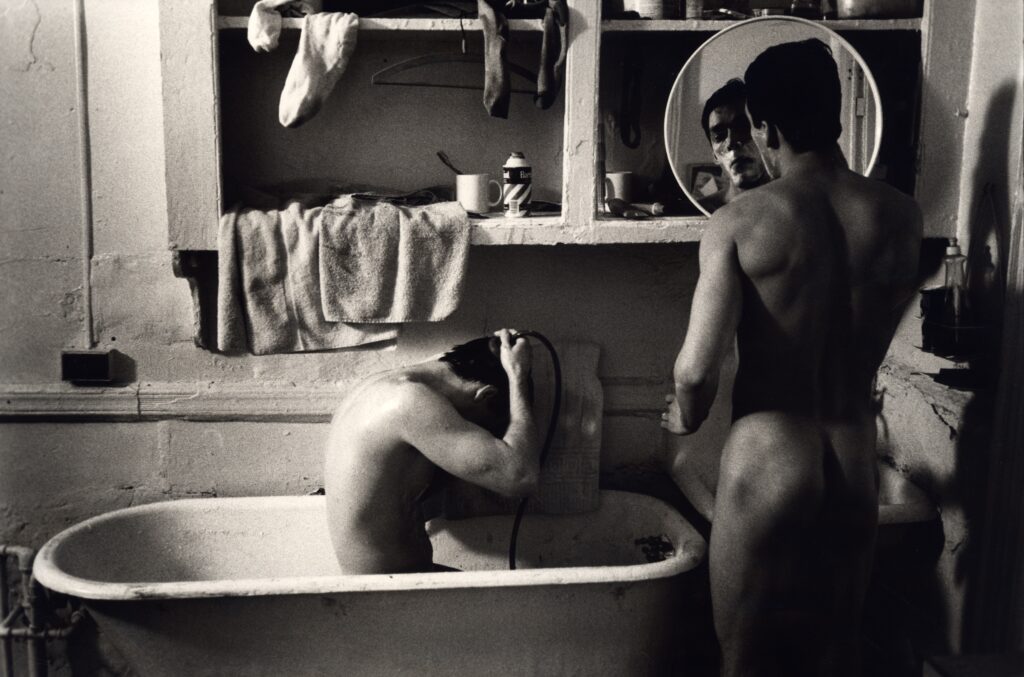
Bill Costa, The Bath (Homage to Paul Cadmus), 1985. Courtesy of the Leslie-Lohman Museum of Art (2001.1134.0008). Bequest of Douglass Roby.
Our bathtub was born in a sturdier, more brutal age. It’s a deep and oblong cauldron—perfect for cooking a human being—which stands in the center of our kitchen. Perched between the cheapo stove and the sink, the tub’s claw-feet are plantar flexed, as if they’re wearing high heels or pointe shoes, topped with swollen ankles and muscled calves. Time and use have abraded the inner porcelain. Only Bar Keeper’s Friend, a powder from the nineteenth century packaged in a retro canister (the plastic squeeze bottle just won’t cut it), keeps grime at bay.
The rest of the apartment is hopelessly sullied: Dirt fills the gaps between the red-painted wood floors. The fire escape is covered in hundreds of cigarette butts flicked over by a neighbor who lost his mind during the pandemic. My spouse, the writer Jeff Weinstein, and I are not allowed to forget the past in this house. Sometimes you turn the faucet and the tub lets loose a frail, industrial moan, like a crust punk approximating a Gregorian chant. We put an enamel board over the tub when we cook and divert the water from our dish rack into its milky depths. This system, perfected by Jeff and his late husband, the artist and writer John Perreault, works quite well. The tub has held party drinks and drained acrylic paints; I have written a chapbook’s worth of verse in its suds. We split the monthly rent. I pay $339.26.
Bathtubs were once common in Lower East Side kitchens, relics of the New York State Tenement House Act of 1901, which required landlords to provide, among other amenities, running water. Because the kitchen was usually the largest room in these shoebox dwellings for immigrant families, the tub was installed there. For Saul Bellow, who landed in New York in the forties, such an arrangement was a symbol of scrappy bohemia. He wrote of how the “tub became the kitchen table” when “covered with a heavy, smooth board,” in his short story “Zetland: By a Character Witness”—about a striving Chicagoan who heads east to attend Columbia, only to ditch his studies for downtown and its avant-garde. From my vantage in the twenty-first century, there is something so luxurious and, dare I say it, extremely gay about having a bath in the middle of your kitchen. Leisure and function are always butting up against each other. The cramped dimensions create their own kind of intimacy.
There remains a mere smattering of apartments like the one Jeff and I share on Seventh Street in the East Village. We occupy the last unrenovated unit at our address; bohemia left the building long ago. The other apartments lease for at least five times our total rent (which is $678.52), and they’re sterile, with brand-new fixtures, among them showers located in the bathrooms (boring!) and doors separating rooms—ours were ripped from their hinges before Jeff arrived in 1977, when he was twenty-nine. Some of our neighbors receive four to six Amazon deliveries per day; others leave their trash beside the garbage bins or, less frequently, within them. Jeff begrudges them, but when I lived in a studio on 149th and Broadway a number of years ago, I was also just passing through. Most of our neighbors stick around for a year while they white-knuckle demanding finance or corporate consulting jobs and subsequently move to the suburbs. The conclusion of their stay always seems foregone, but then again, so is mine: I will, barring any changes in the law, live here until I die.
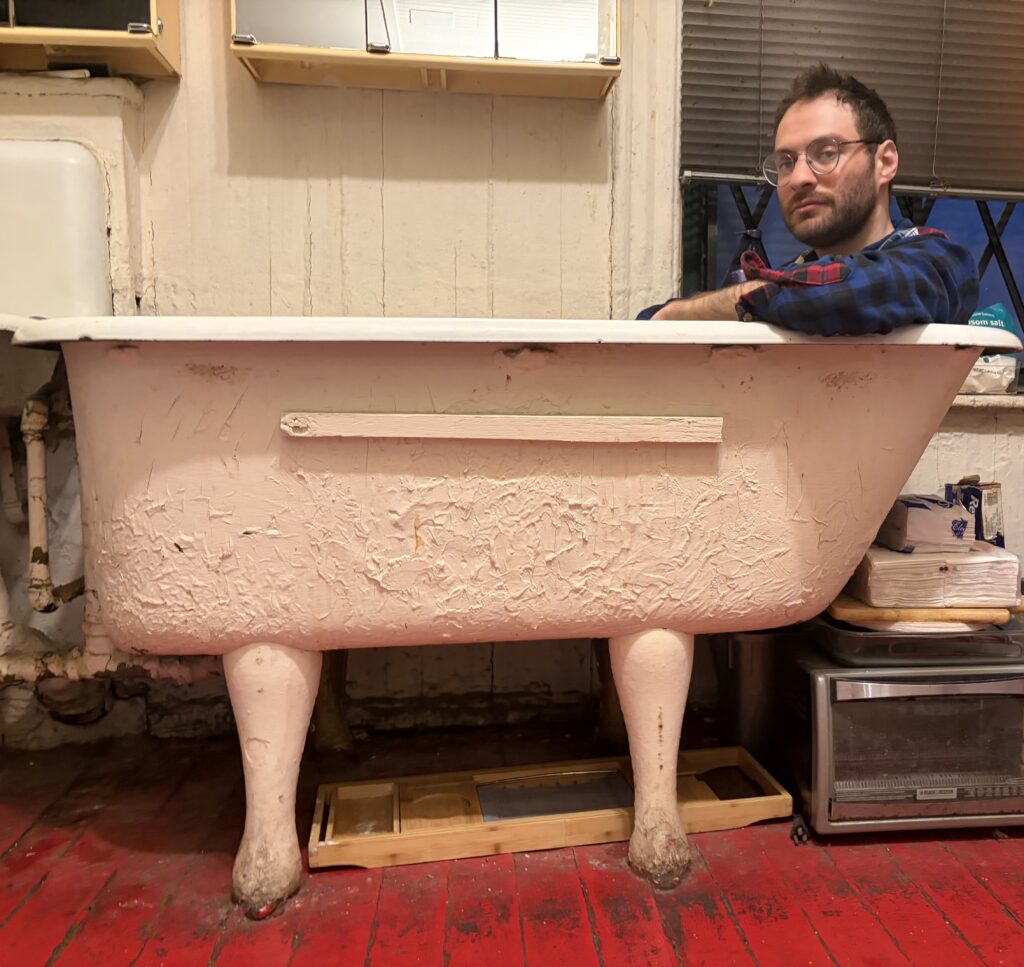
The author in the bathtub. Photograph by Jeff Weinstein.
I met Jeff when I was twenty-five and frustrated, a self-serious writer lusting after older men. The age gap between us is forty-four years, but back then, we were each trying to be younger for different reasons: Jeff was a widower, single for the first time after four decades of monogamy; I was trying to loosen up after a post-M.F.A. period of monkish devotion to a novel that I would never complete. Both of our lives progressed in waves that oscillated, at various frequencies, between CAREFREE and CONCERNED ABOUT TIME’S PASSAGE, and we laid eyes on each other at the right peak or trough. This made us, in a sense, contemporaries.
Soon after we met, Jeff introduced me to Paul Cadmus’s The Bath, a 1951 tempera painting by the queer New York artist that depicts two sculpted young men, the type that every gay guy but myself seems to find attractive. Portraits of youth, they perform ordinary ablutions in a flat cramped by a bathtub. The orientation of the room is identical to that of our kitchen. One of them bathes in the basin—scrubs his ass crack with a green sponge—while the other runs a comb through a head of brilliantined hair. Both are naked, baring their derrieres to the painter’s gaze. Early in my relationship with Jeff, when I first saw this painting, I felt a kinship with these hardscrabble young men engaged in their gritty dance, the ballet of a small apartment: the frankness of their eroticism and how it gave a charge, a mysticism, to close quarters. Like Cadmus’s bathers, Jeff and I were grasping how to fit around each other—how to entwine or detach as we slept, where to keep our shampoo and conditioner (in the broken oven, for years). Cadmus turned the give-and-take of daily life into a grand ritual: cohabiting in our charming and awkward abode, we enact a domestic ceremony that has been passed down through generations.
Another work that Jeff put in my hands was by his late husband, a gut punch of short fiction called “The Previous Tenant.” Published in John’s underknown 1989 collection, Hotel Death and Other Tales, this grunged-out ghost story centers on a man who moves into an apartment exactly like ours—John found the apartment via a Village Voice ad in 1976, a few months before Jeff moved from California to join him. In the story, the speaker obsesses over the previous tenant, a guy named William Haynes: “I know apartments absorb something from their inhabitants, which is not necessarily sinister, perhaps vibrations of some kind.” Haynes may have left behind vibrations, but he also left a coat. The narrator watches as “a friend, my current lover, tries it on.” How many times have Jeff and I worn each other’s clothes? Though I am more than half a foot taller than he is, we fit into everything that either of us owns—aside from shoes. Garments know that we’re a couple and form themselves to our bodies. Can anyone with a walk-in closet claim the same?
Ghosts reside in every property. I used the toothpaste that one of them abandoned behind the bathroom mirror of my old place uptown. I found a folding table, too, which Jeff and I lugged on the subway when we moved in together. The ghosts of just-past Manhattans haunt me, those whose art and activism were enabled in part by bargain rent. Maybe these specters see me as an interloper, if not as a welcome continuation of their lineage. More common, these days, is the other kind of ghosts, the absent plutocrats with their vacant pieds-à-terre. They remind me of how transience pervades every social stratum in New York, enabling investors to buy and sell with no regard for the communities where they own real estate. I am lucky to live where I do, to be bolted as tightly to my apartment as the claw feet of my tub. Yet this city has saddled me with its mindset: We are all closer than we think to being kicked out. I wonder how long Cadmus’s bathers held on to their lease.
In 1982, Jeff wrote an illustrated essay for the Village Voice about closets, which in Manhattan, he joked, are “primarily metaphors.” (A couple of years later, he wrote about baths—as in gay bathhouses.) Rooting around in our built-in armoire for a hanger, Jeff uncovered a photograph of a woman wearing a babushka. He suspects, perhaps wishfully, that this woman was a previous tenant—our ancestor—who he imagines lived here in the thirties. Occasionally, I open a drawer and come across other family photos, images of ghosts who predated me. Sometimes the ghost is John, and other times his presence hangs over a composition he must have captured. Once, sifting through a stack of books, I found a Polaroid of Jeff taking a bath in our kitchen, staring with surprise and affection over the tub’s rim. He and John had obviously had sex not long before the shutter clicked. The reminder is both claustrophobic and strangely homey: Jeff and I share space not only with each other but with vibrations of the dead.
If tragedy or a landlord eventually forces us from Seventh Street, whoever replaces us will have to share, too. Sometimes I imagine this future occupant unearthing the snapshot of Jeff in the depths of a cupboard. The moment of discovery will be unsettling, like when a water bug scuttles across the floor, evidence of other lives hiding behind furniture. Maybe our successor will toss the picture in the trash. It wouldn’t be the first time ancient Manhattan had intruded into their freshly renovated spot with its bathroom—replete with shower, sink, and toilet—so glimmering and modern that it was still being installed when the broker showed the listing. Those shoddy appliances look nice, but they never last long. My bathing husband will haunt our tenement forever.
Daniel Felsenthal is a writer and poet whose work has appeared in The New Yorker, The Atlantic, and New York Magazine, among other publications. He teaches creative writing at Columbia and journalism at CUNY’s Craig Newmark Graduate School of Journalism.