

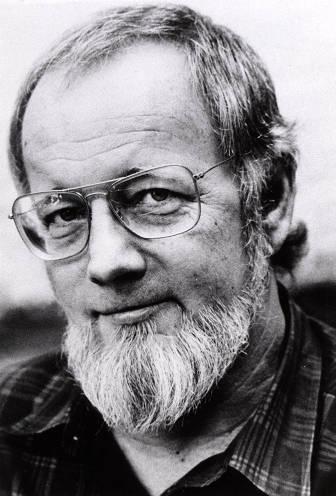
Donald Barthelme, via Wikimedia Commons. Courtesy of Special Collections, University of Houston Libraries. Public domain.
Barthelme was a Houstonian. To me this is the single most salient fact about him, though the competitors for that distinction are many: that he was a contemporary-art-museum director; that his childhood was spent riding in an open-top car through the undeveloped Texas prairie; that his friend and neighbor in New York City was Grace Paley; that his students called him Don B. and associated with him the powers of a mystic or shaman, if one prone to sarcasm. Barthelme was a genre unto himself, the rare writer who never wrote toward or against any previously recognized form but simply, somehow, took his own form, which is always instantly recognizable as its inept imitations are also instantly recognizable. All these qualities attest to his home city, at least for me, who shared the city with him for a while in the mid-eighties. Houston is a city of unexpected adjacencies. Because it has no zoning regulations, it has no zones. Instead, things are put places—a church, an ice house, some houses for living in, a place for strippers, a place to buy your fishing boat, a place to eat chilaquiles—in whatever way they happen to go, as if the city has said, collectively, Let’s not get too hung up on formalities, we’ve got enough room not to worry about it. Even now, Houston is a city like a prairie, its urbanity thin as a threadbare quilt tossed onto the grass, a playful indication of the urban. And this is also very Barthelme, this playing with category rather than dutifully seeking to conform, this ignoring of the very many conventions—of living, thinking, and certainly of writing—with which the rest of the world seems to unquestioningly preoccupy itself.
Barthelme did not write numerous stories, and the occasional longer work, so much as he expressed his genius through the medium of language. A major aspect of his genius was concision. His exemplary works are all short and as sui generis as the fables of Aesop. Their publication, in his time, in such mainstream literary venues as The New Yorker attests to an age of American publishing that is long past. In contrast to Barthelme’s emblematic short form, Hiding Man, the biography of Barthelme by his former student and fellow writer Tracy Daugherty, is a Tolstoyesque tome at 592 pages, but this is exactly appropriate, because it is necessary to illustrate that Barthelme’s genius for concision or compression was also demonstrated by his life, into which he fit a wild variety of living while still managing to die far too young.
Donald Barthelme Jr. was born in 1931 into a family of exceptional brilliance and creativity. His father, Don Sr., was an architect of renown who concerned himself with what constituted the modern, building a house for his family of which Barthelme later said, “On Sundays people used to park their cars out on the street and stare.” Barthelme’s mother, Helen, was the sort of woman who could make a house full of Aalto and Saarinen furniture feel warm. She loved the theater, music, and literature, and her five children were such creative overachievers as to prompt comparisons to the James family, if the Jameses had lived in a stark modern box with a spiral staircase like half a DNA helix punching from one floor to the next. Barthelme enjoyed the sort of youth in which he and his friends—“poor little pale little white boys,” as he put it in his interview for The Paris Review—were tolerated by the regulars to bring their dorky enthusiasm to jazz clubs that were otherwise, audience and musicians, all Black. When Barthelme ran away from home to Mexico by hitchhiking with truckers and musicians, he was rescued by his father and grandfather, who seemed to enjoy the excursion. While still a teen, he wrote about jazz for the Houston Post. In college, he was the youngest-ever editor in chief of the college paper. A combat-free tour of duty in Korea delivered him back to Houston in time to find the August 1956 issue of Theatre Arts at Guy’s Newsstand, within which was the entire text of Waiting for Godot, as well as production photos. Standing at the newsstand, Barthelme read the whole play, then took it home to his then wife, Helen. “I found it exciting but did not foresee the implications for Don,” she recalls in her biography of Barthelme, published in 2001. “It seemed that from the day he discovered Godot, Don believed he could write the fiction he imagined.”
Sixty Stories was first published in 1981 and comprises selections from Barthelme’s first eight books, which cover his output from 1961 to 1979, plus another book’s worth of previously uncollected stories. Of the selections from the eight books, sometimes we get a third or so of the original contents, sometimes more than half; in the case of Guilty Pleasures (1974), there are only two out of twenty-four pieces, perhaps because Guilty Pleasures claims to be “Donald Barthelme’s first book of nonfiction” despite containing no recognizable nonfiction, a clip-art chronicle of a national uprising by vulcanized tires, and a parody of a Michelangelo Antonioni screenplay that gives stage directions like “(speaks in italics).” The Stories half of Sixty Stories’s title is also not quite right of a designation, but not because, like nonfiction, it’s such a misidentification that it might be a joke. Stories is too domesticated, too ordinary—and at the same time, it acknowledges the outsize impact Barthelme managed to make on the idea of the American short story after barely twenty years in the business. With its oversize-fancy-font, mostly-text cover design enlivened only by a red, heraldic-looking figure stuck to the center of the book like a medal, Sixty Stories evokes the Eminent Man on His Pedestal, not unlike the now-iconic cover design of The Stories of John Cheever, which precedes Sixty Stories by only three years. This is utterly the wrong vibe for the work within, and apart from Barthelme’s having chosen to curate such a collection, in my opinion the collection itself is not the ideal way to encounter the stories. For that, I prefer the original, slender collections, starting with 1964’s Come Back, Dr. Caligari, memorializing Barthelme’s very first, deathlessly funny and strange publications starting in 1961; moving on to 1968’s Unspeakable Practices, Unnatural Acts in which, already, stories like “Game” and “The Indian Uprising” give the essence of Barthelme’s singular Barthelme-ness. Another six indispensable books follow in not even ten years: City Life (1970), Sadness (1972), the aforementioned Guilty Pleasures (1974), The Dead Father (1975), Amateurs (1976), and Great Days (1979). Child of the seventies that I am, when I first started reading Barthelme in my teens I felt the same way about his collections as I did about albums—that they were meant to be received and consumed as a unit, that the title and the cover art mattered, that they must be “played” over and over again. I accumulated them all, a few more than once to get variant cover designs. Like the stories themselves, the collections feel inseparable from their moment—from Nixon, from Vietnam, from Bobby Kennedy’s assassination, from nuclear proliferation and the rest of the roll call of modern absurdity—and for this reason of their intense timeliness they feel paradoxically timeless. Barthelme paid his bills as a newspaper reporter and a museum director before he was able to pay them by creating strange assemblages of words for weekly magazines. In his sensibilities no less than in his habits of work, he was a writer of ephemerality, zeitgeist, and subversion, not timeless tomes. His work is not just short but fleet, flights of broadside defacing a bank building, not old masters hung in the Louvre.
After reading Godot at the newsstand, after he started going to work in the mornings on his screened porch, where once, having eaten breakfast with Helen, he’d spend three or four hours banging away on his Remington, smoking, and filling the wastebasket with discards, perhaps it was inevitable that Barthelme would follow his literary star to New York City. There, he would be snubbed by Saul Bellow and befriended by Grace Paley; he would bother Roger Angell at The New Yorker about his layouts, having done plenty of magazine layouts himself; and he would become, in a remarkably compressed time period, an indelible voice of his time, his prolific work heaped with critical superlatives, all of them deserved and none of them quite capable of capturing the work, which continues to resist categorization and qualification. He would be compared to Kafka, Borges, Pynchon, a drug addict (“Donald Barthelme either takes pills, does dope, drinks an awful lot, or has one of the unique literary imaginations of the present age,” the Washington Post), a maker of presumably metaphorical “paintings,” “sculptures,” “cherry bombs,” and “funny language machines.” Somehow, even in its 592 outstandingly researched and beautifully written pages, Daugherty’s biography cannot quite account for the suddenness of Barthelme’s achievement, from the confidence and speed with which he goes from reading Godot at the newsstand to reinventing the contemporary short story. Nor can Daugherty’s, or anyone’s, biography of Barthelme accustom us to his untimely, sudden end. Just after the publication of Sixty Stories, after two decades of literary life in New York, Barthelme returned to Houston, to a teaching job at the University of Houston, his alma mater. He published Overnight to Many Distant Cities, his first new collection since 1979’s Great Days, in 1983, and received execrable, inexplicably hostile reviews. In the New York Times, Joel Conarroe wrote that while the emperor might not be naked, his suit seemed “threadbare.” I respectfully disagree. I love this collection as I love all of Barthelme’s work, though what I love most is the title. It moves me, as so many of his titles move me—written as they are by a genius of concision, his titles alone can be entire works of art. “Our Work and Why We Do It.” “Kierkegaard Unfair to Schlegel.” “Robert Kennedy Saved from Drowning.” “Overnight to Many Distant Cities” stirred in me an intimation, both of loneliness and possibility. Barthelme was listed in the Houston white pages, and sometimes, in my unhappy teenage years, I looked at his number and dared myself to call him. I never got up the nerve. Barthelme died in 1989, at the age of fifty-eight. I was at college and heard the news from a friend who worked at a Kinko’s to which one of the Barthelme brothers had brought Don Jr.’s will. We lost a hometown hero, but literature lost an all-time great.
In one of my favorites of his clip-art stories, “The Flight of Pigeons from the Palace,” Barthelme writes,
It is difficult to keep the public interested.
The public demands new wonders piled on new wonders.
Often we don’t know where our next marvel is coming from.
The supply of strange ideas is not endless.
—and yet he let us feel as though it is.
An excerpt from Susan Choi’s introduction to Sixty Stories by Donald Barthelme, to be published by Picador on May 26.
Susan Choi is the author of Trust Exercise, which received the National Book Award for Fiction, as well as the novels The Foreign Student, American Woman, A Person of Interest, and My Education.