

Pine Island, 2026. Photograph by Thomas John Weber.
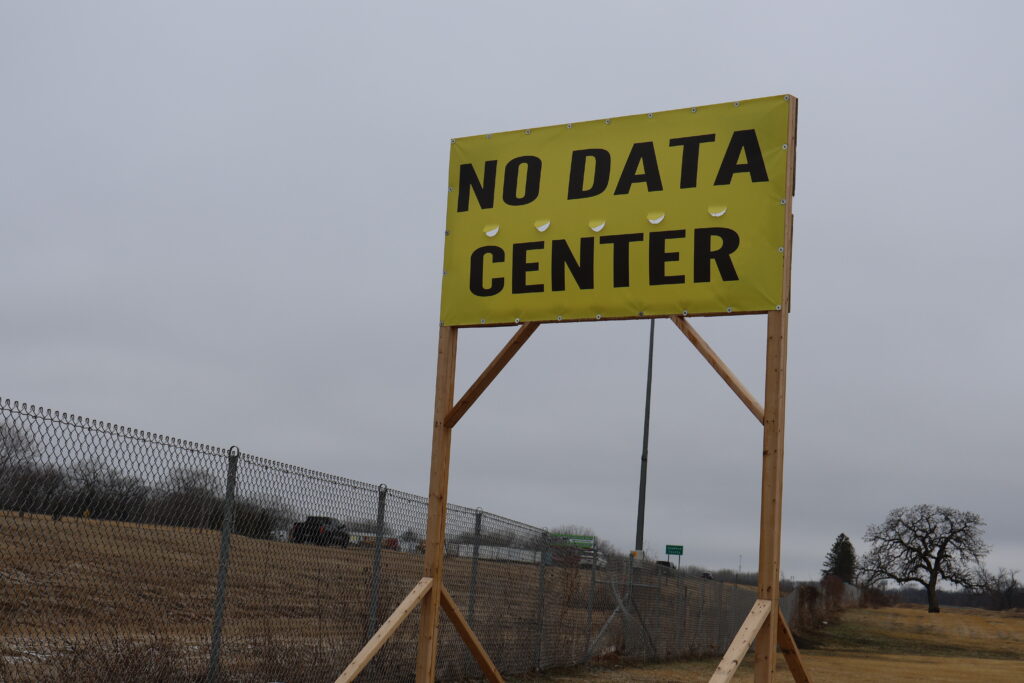
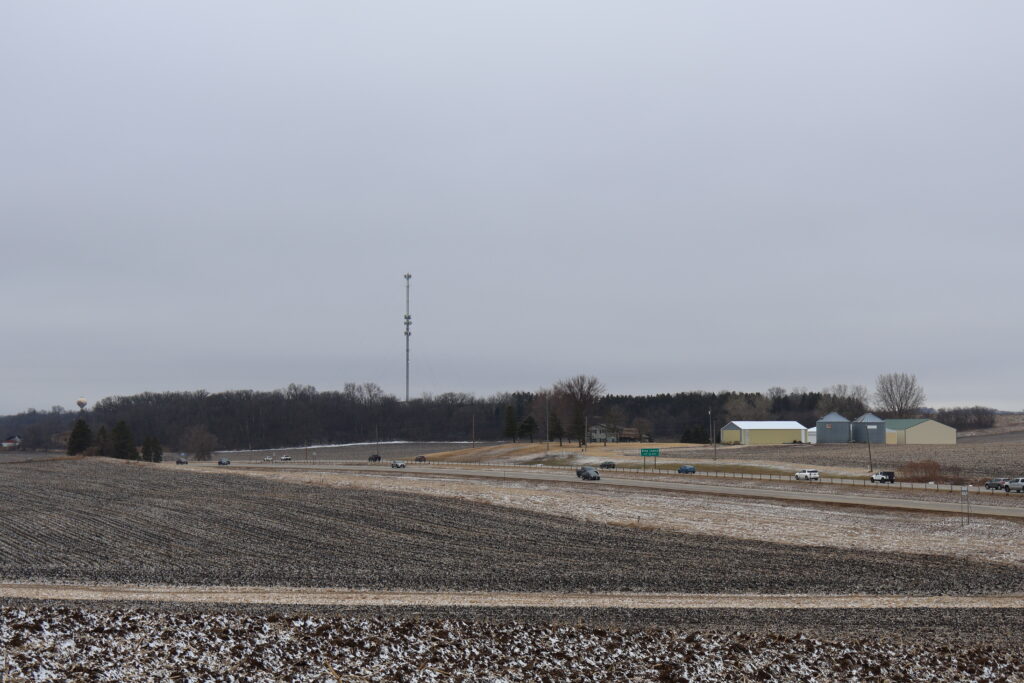
Pine Island, despite its name, is not an island. It’s your average Midwestern farm town, population 3,800. Highway 52 cuts through it like a spine, with little to see on either side except corn and billboards—unless it’s winter, in which case it’s just billboards. Most advertise burgers or death: McDonald’s (seven miles north), Newt’s Burgers (thirteen miles south), judgment day (“After You Die, You Will Meet God”), plus two competing southeast Minnesota cremation services. Only one billboard, on the south end, is locally relevant. It’s newer, smaller, and appears to be homemade. It reads: NO DATA CENTER.
It takes two minutes to drive from one end of Pine Island to the other. I’ve counted. I pass through it on my ninety-mile commute from Rochester to the Twin Cities, so I learned about the data center as soon as the scrappy sign was erected. I was thrilled to see something new; my drive hasn’t changed much in three years. I was less thrilled for Pine Island, which has, like many rural Midwestern towns, become an unlikely microcosm of the AI debate, its residents thrust unwittingly onto the front lines of our digital and physical transformation at the hands of Big Tech.
The sign refers to “Project Skyway,” code name for a proposed 482-acre hyperscale data center and tech campus, whose developer remained anonymous for nearly a year and only was unmasked in February. (It’s Google.) A dozen others have been proposed across Minnesota, and likely hundreds more are in various phases of development across the country. The secretive nature of data center proposals often leave locals feeling vexed and blindsided—the Facebook group “Stop the Pine Island Data Center,” for example, organizes fireside vent sessions and promotes town council meetings where residents can voice their rage. They share alarming articles about similar towns whose fates may portend their own: giant black boxes looming on the horizon, humming incessantly, guzzling water, generating slop.
Nowadays, it’s unsurprising to learn that a tech company worth trillions is fighting, hard, to transform Pine Island, a town whose Wikipedia page claims just two notable people: Ralph Samuelson, the inventor of waterskiing (who was not technically born there, but did retire nearby to raise turkeys), and Lucas Helder, a.k.a. the Midwest Pipe Bomber (who was born there, but moved to Wisconsin before embracing astral projection and mailing strangers IEDs). A town whose greatest pride is the annual Pine Island Cheese Festival, a local treasure visited by thousands since 1936. A town whose claim to fame is, arguably, a poem by James Wright, “Lying in a Hammock at A Friend’s Farm in Pine Island, Minnesota,” which was first published in The Paris Review sixty-five years ago this summer. It’s a seemingly bucolic little poem known mostly for its last line, which has inspired decades of critical debate:
Over my head, I see the bronze butterfly,
Asleep on the black trunk,
Blowing like a leaf in green shadow.
Down the ravine behind Duffy’s empty house,1
The cowbells follow one another
Into the distances of the afternoon.
To my right,
In a field of sunlight between two pines,
The droppings of last year’s horses
Blaze up into golden stones.
I lean back, as the evening darkens and comes on.
A chicken hawk floats over, looking for home.
I have wasted my life.
Every time I approach PI on my morning drive, I think of Wright’s volta I have wasted my life. It’s a good mantra for a commute. On first read, it seems to undermine his idyllic imagery, perhaps gesturing toward the inherent meaninglessness of the natural world, or of man’s place in it. One step further: Is he exasperatedly renouncing his lifelong pursuit of poeticizing it? Or, because the speaker is lying in a hammock on someone else’s farm—William Duffy’s—is he lamenting a life spent anywhere but there?
I’m not exactly alien to Pine Island. When I’m feeling ambitious, I’ll sometimes bike through miles of farmland to the town’s Kwik Trip for a dunker and a Gatorade. The stillness out there is overwhelming. In the summer, the vast green hills and decrepit old barns are surprisingly beautiful, but the scale can only be felt from the ground—driving never does it justice. I often wondered if the poem loomed as large in the local consciousness as it did in mine; having seen little more than the gas station, I pictured life there as a perpetual late-summer afternoon where folks lazed around in existential silence. But I hadn’t wondered much else—at least until last year, when I found out about the data center and its apparent steamrolling of their quiet lives.

Pine Island, 2026. Photo by Thomas John Weber.
The biggest players in the AI boom—Google, Meta, Amazon, xAI, etc.—are pumping hundreds of billions into a nationwide infrastructure project that resembles, on the one hand, a mass reindustrialization of the heartland, and, on the other, mass speculation on a socially disruptive, environmentally draining, and sometimes psychosis-inducing search engine that is not, currently, profitable. Still, more data centers are needed, apparently. OpenAI’s Sam Altman said that one day the earth will be covered in them. Elon Musk wants to build some in space. Demand for computing power is rising: users need to generate more images, videos, emails, companions. It’s no longer a question of if, but who. Whose jobs will be displaced? Whose towns will erect the next content-churning monolith?
If every data center proposed in Minnesota were approved and built, they would use as much energy as all the state’s households combined.
***
I took the off-ramp into PI with a dozen copies of “Lying in a Hammock” in my passenger seat. Starting with the farmhouses adjacent to the field where the data center would be, I began ringing doorbells. Only one man answered; he came out wearing overalls. I asked if he would talk with me about the data center, and a poem. He looked up at the sky, considering my proposal. “No,” he said.
In the nearest neighborhood, about 1,300 feet from the field, I rang four more doorbells. It struck me that I had absolutely no idea what I was doing. After ringing a fifth, I met Stefan, a thirty-eight-year-old wearing a Seahawks T-shirt, shorts, and a gaming headset. He invited me into his foyer where he explained his resolutely anti-AI feelings—in his defense of human creativity, he mentioned the music of Pink Floyd, twice. “Have you read this poem?” I asked. He hadn’t. He called in his girlfriend, Cynthia, who hadn’t read it either. Their joint reaction to the final line was a thoughtful hmm. Their take, in line with lighter critical interpretations, was that a life spent out here in touch with the natural world is not wasted. As the poet and critic David Jauss wrote, “The central irony of the poem is this: only when the speaker is ‘wasting time’—lying in a hammock, being lazy—is he not wasting his life. Only then does he see nature and himself clearly, and only then can he discover peace.”
In the middle of our close reading, Stefan’s aunt came in with groceries. I tried explaining what I was doing in her house. Unfazed, she said she was going to eat lunch, adding “I’m against it,” referring to Google.
Downtown, I was greeted by a welcome sign with a sub-sign attached to it, saying, Cheese Fest: 1st Weekend in June. The cadence was reminiscent of Hemingway’s (apocryphal) six-word saddest story ever, except these six words were not nearly as sad. I walked up and down Main Street looking for people, but the handful of brick buildings were desolate; half appeared to have no tenants at all. A light snow was falling. I daydreamed of the first weekend in June, when the town would come to life again, eat cheese, and search for something called the Golden Nugget.
Pine Island, 2026. Photo by Thomas John Weber.
Across the street was the Pine Island Sports Bar & Liquor Store, where about ten people, median age sixty, were sitting around drinking beer in total silence—or maybe they’d gone silent when I’d walked in. When they learned what I’d been doing all day, though, their interests were piqued. I got the sense they thought my idea was completely harebrained; in fairness, maybe it was. I asked what they thought of the data center.
“Data center? What do you think I am, a rocket scientist?” one guy said. Turns out, most of them were totally ambivalent. To my left, two guys spoke with me earnestly. They had bigger things to worry about: work, kids, life, etc. But they acknowledged the imbalance in the developers’ deal with the city. In exchange for its $36 million tax abatement, Google would pay a $25 million bonus to PI’s school district, distributed over twenty years (not nothing, but in terms of Google’s finances, practically nothing). To my right, the conversation quickly devolved into arguments about journalism, welfare, and immigration—hot topics in Minnesota. A man materialized behind me and said he was going to strap a GoPro to my head. Why? I asked. So we can start a journalism business, he said, like Nick Shirley and the Quality Learning Center.
I decided it was time to go. When I stood up, one of the earnest guys insisted on paying for my beer. I thanked him a couple times and ducked out. Driving home, I realized I forgot to ask them about Wright’s poem. I have wasted my time, I thought.
***
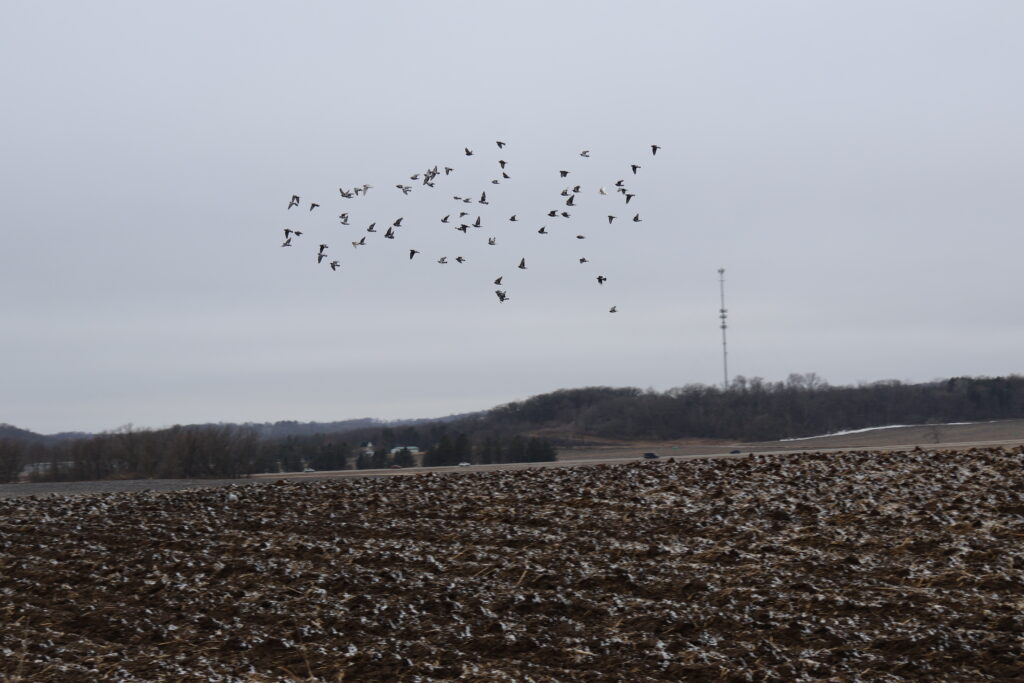
At a “Stop the Pine Island Data Center” meetup, there were about twenty people ranging from children to seniors. It was chilly and overcast; there were no chicken hawks floating overhead, just a V of honking Canada geese. We gathered in the backyard of seventy-four-year-old Rod Lanners, a PI resident of fifty-plus years. His house, set atop a kind of bluff, overlooks the empty field that would host the data center. From here, he would apparently be able to hear it hum.
Attendees brought blankets and lawn chairs and sat around a fire that Rod periodically tended; a child walked around with a basketful of cinnamon rolls. It was almost unbearably wholesome. But the conversation was anxious and, at times, angry. They discussed how to resist, and whether their opinions even mattered to judges and council members. Others sounded completely resigned, and even considered selling their homes—if anyone would buy them. “Get out before they start digging,” was one woman’s advice.
Later, Rod took me to his back porch for a better view of the field. The late winter grayness hardly resembled the poem’s butterflies and blazing stones. I saw some livestock in the distance, but I heard no cowbells over Highway 52’s soft drone. Still, I could reasonably picture Rod dozing in a hammock up here in the summer. I asked if he’d ever read “Lying in a Hammock.” He hadn’t—so I handed him a copy and watched him read it. He took a step back, read it again, and asked if he could keep it. “I can relate to that,” he said. “Once a farm boy, always a farm boy.” Rod seemed most moved by the first twelve lines of pastoral bliss.
***
Pine Island, 2026. Photograph by Thomas John Weber.
The Pine Islanders I spoke to were generally unaware of Wright’s poem, which perhaps isn’t surprising. After all, the town is merely a setting for a meditation on a series of images; the poem is not necessarily representative of its population, and certainly not of its twenty-first-century identity crisis. But Wright didn’t drop Pine Island’s name into the poem’s long, hyperspecific title for no reason. As the critic Sven Birkerts wrote in the literary magazine AGNI, “the precise location is given not to inform, but to memorialize a place and a time. The title is raised over the body of the poem like a marking stone.”
Birkerts theorized that the title and form could be an homage to strains of classical Chinese poetry that specified the exact location and occasion in the poem’s title, and then concluded with a broad assessment or feeling. “Continuity between self and surroundings,” he writes, “was implicit: description further characterized the feeling, while the feeling extended out into the landscape.”
There’s nothing inherently meaningful about living near the site where a popular poem was written, unless, of course, the poem is personally significant to you—the words touched you in the right way, at the right time, as Wright’s did for me. They link themselves inexorably to the landscape, no matter how beautiful or how boring the landscape actually is. One minute, I’m mindlessly commuting, wondering what I’m really doing out here, driving ninety miles to a job I took out of necessity in a place I never imagined spending my life. The next: I see a sign for Pine Island, and I’m eighteen again. I’m reading “Lying in a Hammock” in a freshman poetry workshop in Tallahassee, Florida. I’m half asleep, having just come off a 6 A.M. commute to campus via bus. The first twelve lines are not helping; they’re feeling very imagist, very poem-y—the man is literally dozing off—until the last line slaps me awake with epiphanic force. I find it at once shocking, confusing, and, implicitly, understandable. The moment is memorialized. It’s true—I have wasted my life. And then I walk to the cafeteria to eat heat-lamp pizza and watch The Sopranos on my phone.
Having observed several others read “Lying in a Hammock,” I can say that Wright’s words continue to shock, confuse, and do something else—something private and internal. There’s a pause, a slight step back. A tilting of the head and shifting of the weight. In an interview, Wright shared that the line is, to him, “a religious statement,” one of happiness or contentment, upon acknowledging his “wastefully unhappy” life of blindness and arrogance. Coincidentally, the words found their way back to him. “A very strange thing happened,” he said. “After I wrote the poem and after I published it, I was reading among the poems of the eleventh-century Persian poet, Ansari, and he used exactly the same phrase at a moment when he was happy. He said, ‘I have wasted my life.’”
Evidently, the sentiment is timeless (and probably, within each of our lives, continual). But even if it is a declaration of happiness, there’s an inevitable undertone of regret—because who would want to have wasted their life? Whether you believe it’s born of a disconnection from the world, or of an obsession with trying to capture it, a wasted life is, unquestionably, best avoided. As Rilke concluded in “Archaic Torso of Apollo”—in a line which many readers have compared to Wright’s—“You must change your life.”
***
Nationwide, there are legislative efforts to slow the data center race. In Minnesota, an environmental group has sued Project Skyway’s developers to submit a more comprehensive environmental impact study, as they’ve implied that Google’s campus could one day host multiple data centers. But even if a judge grants a pause, some Pine Islanders acknowledged the next steps of resistance are unclear. Perhaps they’re just stalling the inevitable.
Long before 1856, when the town was settled and platted, the Dakota referred to the area as “Wa-zee-wee-ta,” or pine island, because it was surrounded by a fork in the Zumbro River and had the appearance of an island of pine trees floating in the prairie. In the winter, the Dakota often sought refuge there, their skin tents shielded from blasts of arctic wind by the trees’ thick branches.
Pine Island, 2026. Photo by Thomas John Weber.
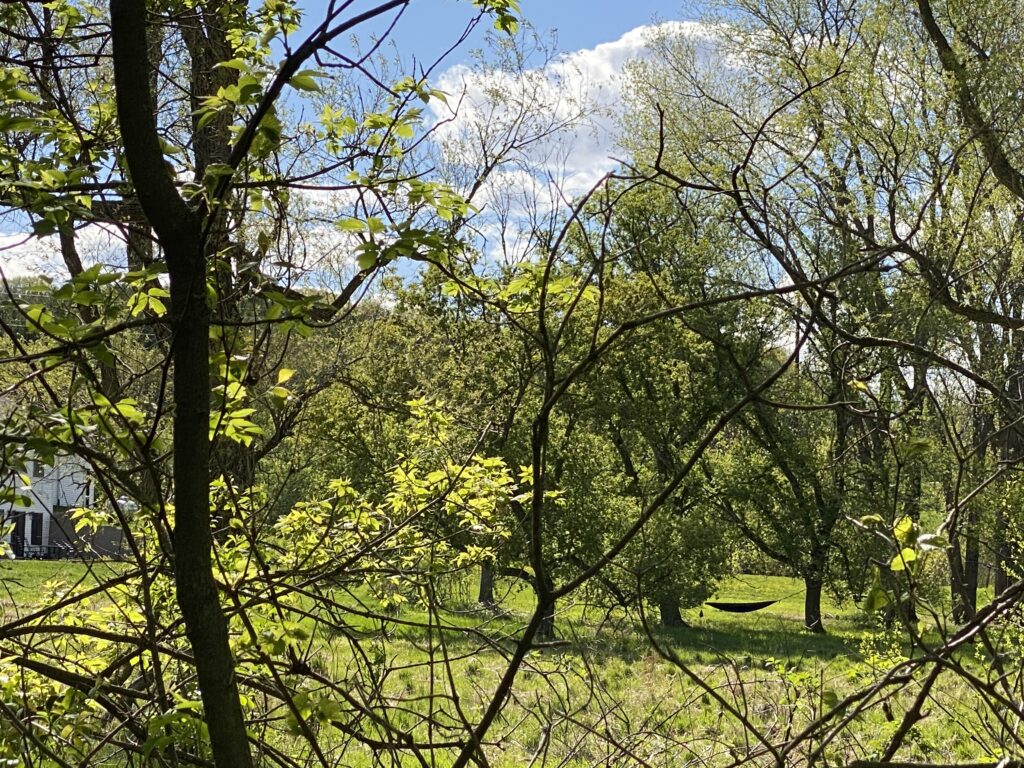
Whether you’re driving toward it or walking through it, Pine Island neither looks nor feels as described—at least not anymore. The only conceivable island of pines left is in the median separating Highway 52’s northbound and southbound lanes. As you approach, the few dozen trees do appear island-like; their trunks are tall and dense, and their branches obscure the center in dark green shadow. You could even extrapolate a napping butterfly or two. But the island is exactly adjacent to the field where the data center will be.
It would be difficult and unpleasant to raise a shelter or hammock in there. The median is flanked by constant traffic, and the diminished plot of trees is hardly dense enough to block the wind or the whirr of a hyperscaler. All that’s left to do is to drive past it, look between the trunks, and steal a glimpse of the golden field while it’s still empty.
[1] In the original version of the poem published in The Paris Review, this line read, “Down the ravine behind Duffy’s empty house.” In subsequent versions of the poem published in Wright’s collections, the line reads, “Down the ravine behind the empty house.” Because this piece refers specifically to the original publication, we have opted to quote the former. The poem was later published as “Lying in a Hammock at William Duffy’s Farm in Pine Island, Minnesota.”
Thomas John Weber is a writer and freelance reporter from Florida. He is currently living in Minnesota and working on a novel.