

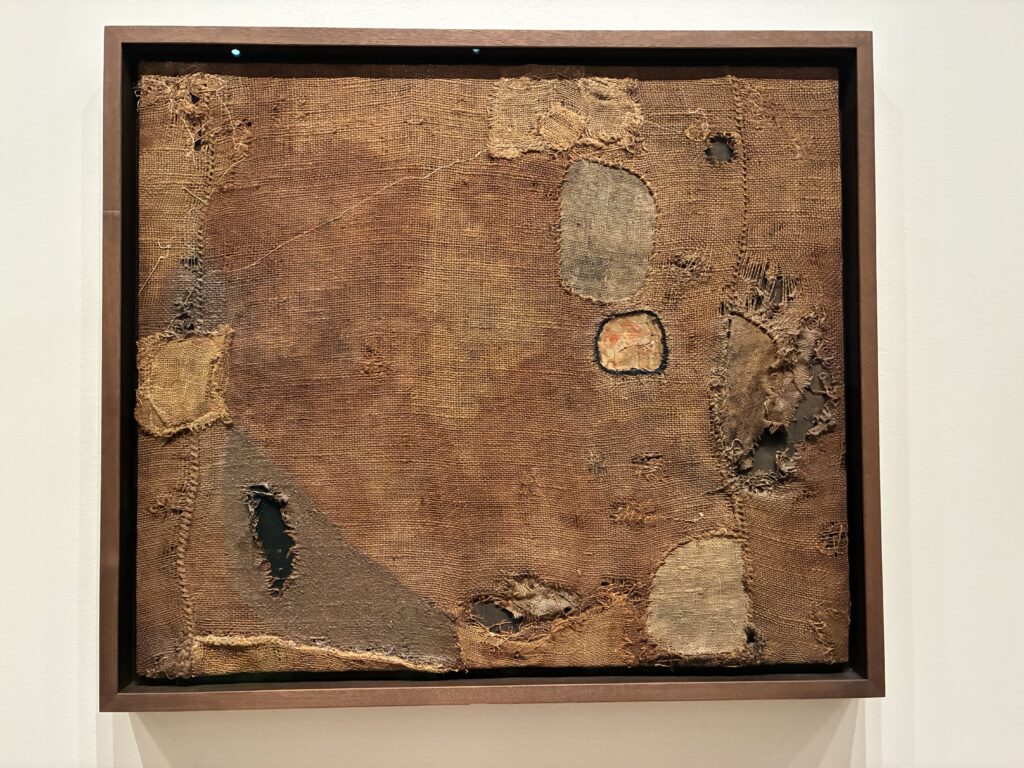
Alberto Burri, Sackcloth 1953, 1953, burlap and thread on canvas, 33 ⅞ x 39 ⅜ inches. Photograph by Hal Foster.
The Ignorant Art Historian is a series by the art critic Hal Foster, in which he tries to “demystify the viewing of art a little, not to deskill it exactly, but to suggest that anyone can do it.” You can read his introduction to the series here, and the previous installments here, here, and here.
Can a painting still be called a painting if it is made of rough burlap riven with holes and tears? Although most of the gashes in Sackcloth 1953 are patched, stitched, or sewn, some still gape, exposing the canvas underneath, which is painted black and brown. Held together by this support alone, the burlap is also stained and bleached, with blotches that range from light brown and red to pale orange and yellow. Why salvage and repair this nasty piece of fabric at all, unless salvage and repair are somehow the subjects? At the same time, gaps go unsewn, sutures fray, and patches don’t match, all of which suggests the futility of reparation, at least any that purports to be complete.
Alberto Burri worked on the painting horizontally, sewing it on a table, before rotating it vertically for us to view on a wall. But the initial orientation is registered in the final one. As we look at the painting, we seem to gaze down on a scoured terrain; patches, holes, and stitches also suggest physical features—a hill, a ravine, a field, a stream, a lake. Landscape is a very common subject in painting, of course, and the dimensions of Sackcloth 1953 suit the genre. Here, though, landscape has become an abstract topography that is tactile as well as visual.
Sometimes the surface of a painting is called a skin. Here, in places, the surface is torn and the slashes are sewn up in a way that suggests scars. The rugged landscape of Sackcloth 1953 thus evokes a wounded body as well. This association takes aim at a central principle in Western aesthetics: that a proper composition should approach the perfection of the human figure. Burri radically disrupts this ancient model, as if to register a resentment against art, or even a discontent with civilization. Unlike most paintings, this one is the opposite of smooth; unlike most paintings, it doesn’t aim to soothe our gaze. On the contrary, as we run our eyes over its rough surface we might fear for our vision. The gashes, holes, and patches are like tears in our optical field—spots of damage made literal.
Painters turned to canvas supports once painting became a portable commodity made for the market. Burlap signals portability, too, but of a rough-and-ready sort. We associate burlap not with art but with use, indeed with waste; in many cities, garbage was collected in burlap bags. By deploying it here, Burri drags painting down to the gutter. Although he recycles the burlap, he doesn’t beautify it in the usual manner of artistic sublimations of lowly material.
Burri was a medic in the Italian Army during World War II. Captured in Tunisia in 1943, he was transferred to a prisoner-of-war camp in Texas, where he began to paint. He continued after his return to Italy in 1946, and by 1952 his work featured burlap, which was left over from supplies delivered to Italy through the Marshall Plan. Austerity is inscribed in this material, then, and exhaustion from the war is suggested as well. Whether read as a landscape, as a body, or as neither, Sackcloth 1953 conveys trauma (“trauma” is Greek for “wound”)—a traumatic period in history, personal and otherwise. Hence, perhaps, the sense of a violation of painting and a resentment against civilization—against a civilization that could lead to such a cataclysm.
What about the implications of the title? Is there an allusion to guilt here, perhaps his own as a soldier of the Axis powers? To don sackcloth is a sign of expiation.