

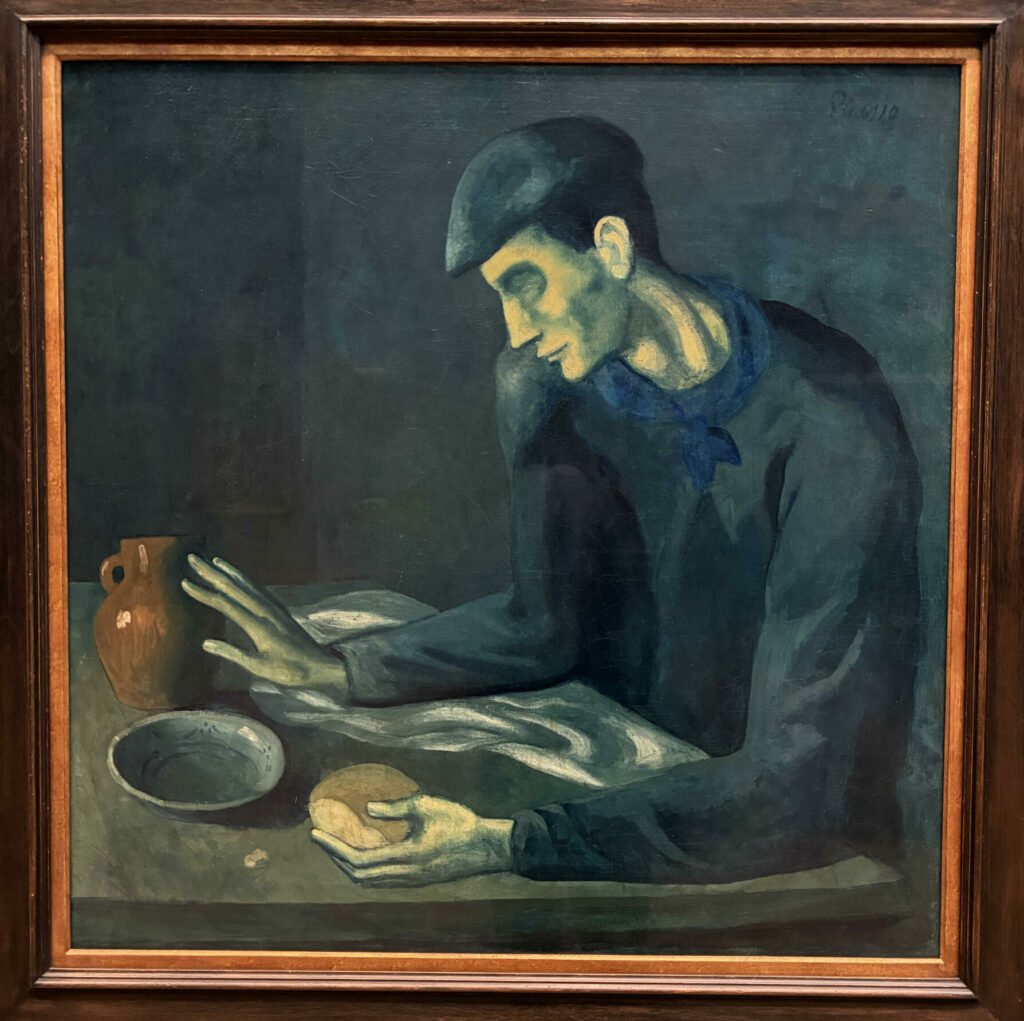
Pablo Picasso, The Blind Man’s Meal, 1903, oil on canvas, 37 ½ x 37 ¼ inches. Photograph by Hal Foster.
The Ignorant Art Historian is a series by the art critic Hal Foster, in which he tries to “demystify the viewing of art a little, not to deskill it exactly, but to suggest that anyone can do it.” You can read his introduction to the series here, and the previous installments here and here. The final entry will appear next week.
A solitary man sits at a simple table. He wears a blue-gray coat and a blue-gray cap with a dark blue kerchief knotted around his neck. His skin is green. He looms over the table, forearms flat on its blue-brown surface. His torso is long and thin. Although his arms are strong and his neck taut, his chest is sunken. Perhaps he is tubercular as well as blind. Certainly he is poor.
The man is not only sightless but eyeless; his sockets, which are dark green, are empty. Nevertheless, they appear to focus, to be concentrated on his touch. Although he is likely a manual laborer, his long hands are soft and sensitive. His fingers are thin and smooth, almost like antennae. He seems to listen to his touch as well. It is as though this touch brings the items on the table into being: a red jug, a blue-green bowl, and a hunk of white bread with brown crust. Touch is also inscribed in these ceramic objects. His right hand barely grazes the wine jug beside the empty bowl. His left hand holds the bread; already gnawed on, it isn’t fresh.
His green skin suggests utter poverty and poor health. The thought occurs that he was once dead, a Lazarus called back on his own. What would it be to return to life, if only for a moment, to once again touch the sensuous world of things?
There is a swirl of white and gray on the table under his right arm—a simple cloth that serves as a napkin. But it might also signify what he can’t quite see with his hands. The other objects seem as clear to him as they are to us. The swirl is a flourish in an otherwise austere world.
The man is scarcely distinct from the dark gray room. It is as though we cannot see clearly anything that he cannot touch—the room above all. Apart from the white-gray swirl, the blind man brings this world into appearance for us; we see little more than he does, and perhaps we see it less intensely. But then we are able to see him. Might he sense that he is being watched? Do his empty sockets reproach our untrammeled gaze? Is that why, after staring for a while, we step back, as if to respect his privacy?
He touches the jug and holds the bread gently. The posture of his right hand recalls that of a priest giving a blessing. And maybe it is a blessing of his very simple repast, a communion of one in a cell-like room. But his communion is only with the physical world. Nothing here requires transubstantiation; the dailiness of the wine and the bread is enough. He is not so alone after all; he is with things in a way that the sighted are not.