

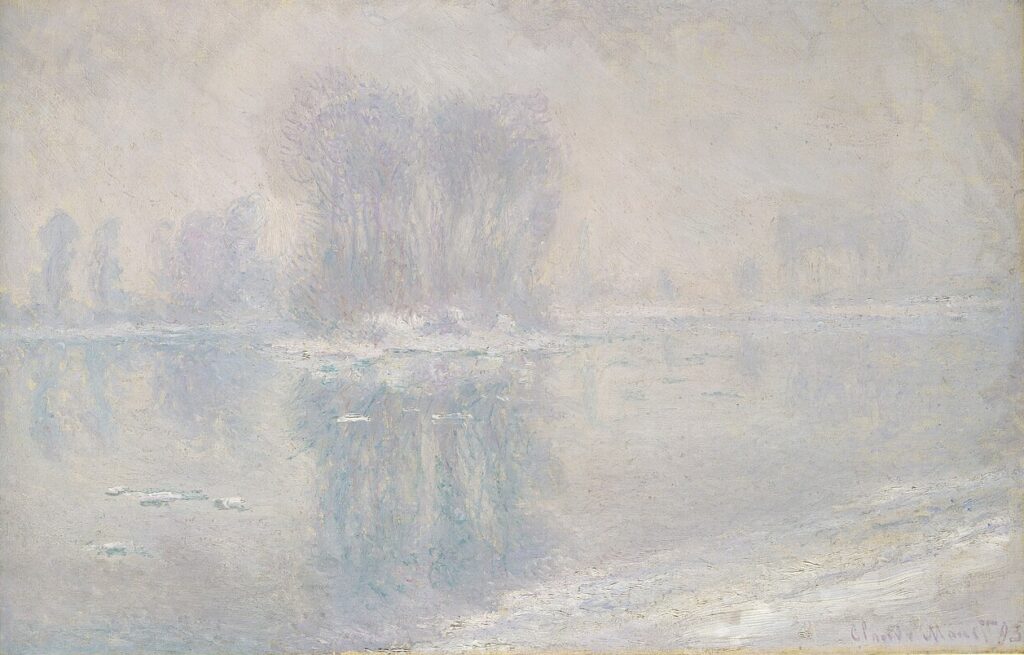
Claude Monet, Ice Floes, 1893, oil on canvas, 26 x 39 ½ inches, via Wikimedia Commons. Courtesy of the Metropolitan Museum of Art, licensed under CC0 1.0.
The Ignorant Art Historian is a series by the art critic Hal Foster, in which he tries to “demystify the viewing of art a little, not to deskill it exactly, but to suggest that anyone can do it.” You can read his introduction to the series here and the first installment here. The next two entries will appear later this month.
Almost everyone passes right by this Monet at the Met. Unlike the paintings of his iconic Haystack or Rouen Cathedral series, examples of which are nearby, this bluish-white blur is easy to overlook. You have to wait on this picture, attend to it, in order for it to appear at all.
Parts of the Seine froze over during the winters of 1880 and 1893, and in both instances, Monet painted the thaw. This canvas from his second effort shows a stretch of the river near his home in Giverny, fifty miles west of Paris. Positioned on the near shore, we look with Monet across the Seine to its far side, a snowy bank registered only by a white impasto line, which bisects the painting horizontally. A row of five poplars stands to the left. At the center is a promontory, or maybe a small island, with its own clump of trees; their reflection in the water almost reaches us. Another cluster to the right recedes into the distance with the bank.
As the river retreats to the right, the water appears dangerously close to us on the left. For all the stillness of the scene, we have no safe foothold in this space. The near bank is a triangle of several white strokes, striated with lines of faint green and blue where it approaches the river. Where the bank drops away we scarcely have a patch to stand on, and it is one covered by snow and ice. The reflections of the trees seem almost stable in comparison, but as watery images they are doubly transient. It is unusual in the genre of landscape to be so ungrounded, and our disorientation is only deepened by the fog.
The blurriness of the painting demands our focus. Concentrated looking is our one haven in this obscure world, but it produces paradoxes of its own. Several small floes break up the surface of the river, which is also the surface of the canvas, where they appear as thin chunks of white impasto. They float atop the darker water, solid for the moment, but soon to melt. Has the river begun to flow again? Everywhere the fluid and the fleeting vie with the frozen and the fixed. Despite the thaw, we feel the cold of the day. This is a river you can’t step in even once.
There is a similar ambiguity in the elements. Distinctions are hard to make out—between air, fog, and cloud, or water, ice, and snow. They are of the same substance: strokes of white, green, and blue. But the sameness offers little stability. There is so much wetness in the scene, yet it is all rendered in dry paint, which refuses to admit that it was once liquid too.
Unlike the Haystack and Cathedral series, which register the changes of the motif over the course of a day, this overcast scene could represent almost any hour. The time of this painting is the time of our looking, which is also the time of the coming into appearance of this world. It is far slower than an impression and never quite resolved; the fog never dispels. Like the last bits of ice in the thaw, the painting holds a little back for itself.