

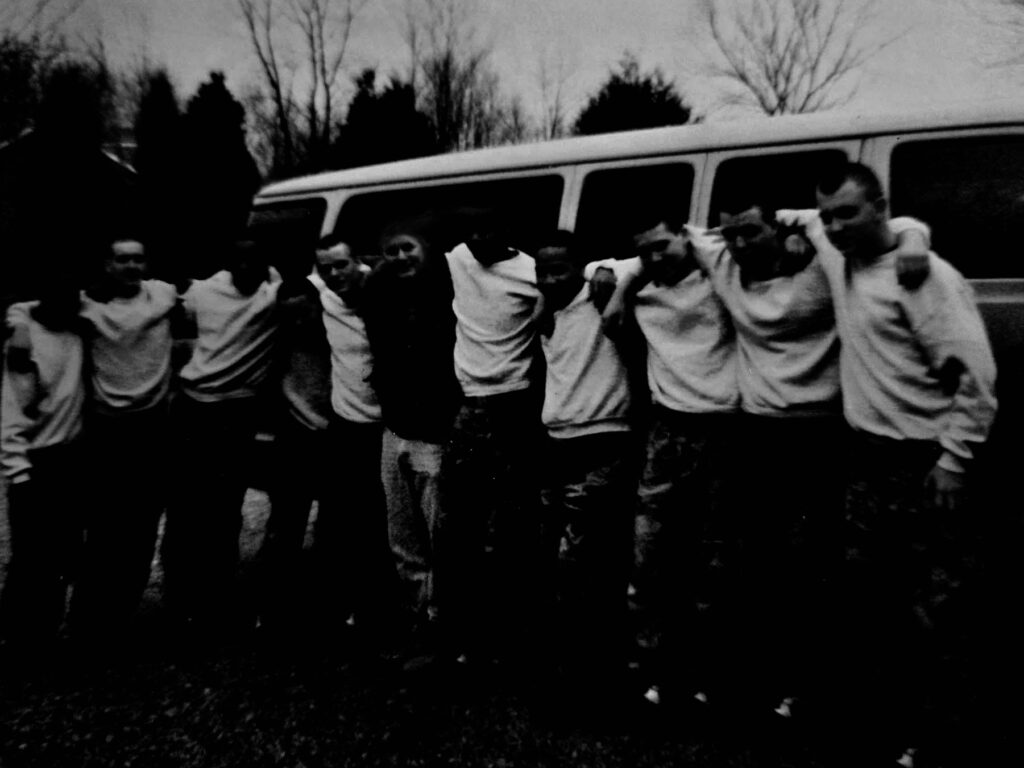
The boys with their van. Photograph courtesy of the author.
My dad used to take me to work with him. He worked at a group home for juvenile delinquents. I remember playing on the floor of a windowless office one afternoon—zooming some toy cars around—when the door kicked open and a teenager flew in. The kid smacked hard against the polished tile floor with the weight of two grown men on top of him. They were trying to calm him down, and his face was pink and wet with tears. He was screaming.
I was five years old. I scooted my cars back into a corner and went on playing.
Such scenes were part of my childhood. These were pretty desperate boys, twelve to eighteen years old, ten of them living together on the grounds of an old tuberculosis hospital. I remember a redbrick home with many rooms—what used to be apartments for nurses—way up on a hill, the path to it winding through the trees. Sometimes the new boys—orientation phases—would tear off down the hill on foot and try to make it into town. This was eastern Kentucky in the eighties. Near the home was a highway, a gas station, and a rundown motel where a man had murdered his wife. That was about it.
Dad was pretty good at finding the boys who wanted to be found, but if you stole a car or broke into somebody’s house, he couldn’t take you back. It was a community-relations issue. Two boys stole my mom’s car once and drove it into a ditch, totaling it. Another boy ran off and no one ever heard from him again. He was fourteen years old, but it said in his file he was a prostitute, and everyone was pretty sure that was the life he’d gone back to—that he’d made it down to the highway and caught a ride.
There were worse places to be than a group home—you could be locked up in a camp, a hundred serious delinquents out in the middle of nowhere, staff not at all hesitant to put their hands on you—but some of the boys didn’t know this yet. My dad was the youngest treatment director in the state. He took his boys everywhere—to movies, baseball games, five hundred miles away to the beach. Some of them had never been out of the projects except to be sent to a home. They thought Louisville was the world. Dad would load them into an old Ford Econoline van and the boys would tell their stories, what they called their “past histories,” and I would wedge in beside them and listen.
At a very young age, I learned a lot about how life can go wrong. It put things into perspective, even if that perspective was a little warped. I remember a friend of mine—I’m guessing we were eight or nine years old—came to school upset because his mom and dad were separating. I looked right at him and said, “Jeremiah Witt’s mom set herself on fire.”
“What?” replied my friend. “Why?”
Of course, in the back of the van, I learned other things, too, like who the Geto Boys were, what a 187 was, and that you could make a lot more money selling crack than working at McDonald’s. I also learned about my dad, seeing him run group counseling and coach basketball and tell stories. Back then he drove a little blue Chevette hatchback, wore jeans and white Reeboks. He was smart and charismatic, short, freckled, and quick, unafraid to jump up in somebody’s face.
It didn’t occur to me, when I was a child, that he was one of them—one of the boys, just a few years older. His mother had abandoned him, though only after filling the formative years of his childhood with drunken stepfathers and boyfriends who broke her nose and threw her out of cars and assaulted her on the kitchen floor. Once, while being beaten up, she screamed for my dad to go get the shotgun. In a rushed panic, he got the gun, but he couldn’t find the shells.
Both his brothers ended up in prison. The man said to have been his father was barely literate. He wore a flannel shirt to a factory job up in Mansfield, Ohio, got his sleeve caught in a belt of some kind, and was yanked into the machinery. The accident damaged his brain in a way that rendered him quiet and ashamed of himself. Having played essentially no role in his son’s upbringing, he resurfaced years later at my dad’s wedding but wouldn’t get out of his truck.
So that was how Dad came up, his basic training in the childhood traumas of abuse and neglect. I suppose his work with troubled teenagers had something to do with wanting to be the father he had never had, but also I think he liked the challenge. His favorite boys were the most delinquent—street-smart sixteen- and seventeen-year-olds, drug dealers, usually, who had adapted to the world around them but were kids still, and in group would ask the sort of questions no one had any answers to. Questions like “If my mom doesn’t want me selling drugs, how come she takes the money I give her?”
These were boys from just outside Cincinnati, from housing projects in Lexington and Louisville. Dad’s roots were hillbilly, but in a group home none of that mattered much.
Some of the boys had major mental health issues. Some were capable of cruelty, but others—despite whatever else they’d done—had held on to their humanity in remarkable ways. When my sister was seven years old, she was hit by a truck. We were about to cross the road after the boys’ softball practice. She got excited and took off on her own. She made it across a lane or two, and then we heard brakes and a thump and she was skidding and scraping along the asphalt, knocked out of her shoes.
Dad ran to her, which left me alone with the boys. I was five years old, my sister in the street. A kid named Chris grabbed me. There wasn’t anyone watching him—he could have gone AWOL, or he could have gone on observing a spectacle, what everyone thought was the death of a child. Instead, he picked me up in his arms. He ran me back into the park to get me away from it all.
My sister survived, but Dad blamed himself for her injuries. He’d poured so much time and attention into his boys, it had nearly cost him his daughter. But nothing changed. He went on working, and it nearly cost him his marriage too.
When he was thirty-one years old, he left the group home for someone else to run. He wanted to do something bigger. He took over another redbrick house on another hill, this one with even more rooms. He started out with two poor country boys, Jackie and Odell. I remember a plaque, their names etched into it after they got their GEDs. Jackie had run off from another placement once and stolen a four-wheeler. He was picked up with three hundred dollars’ cash in one pocket and three hundred dollars’ worth of weed in the other. He hadn’t been gone but a few hours. He was a great kid, though—they both were. Years later Jackie called from prison and said to tell everyone hi.
Two boys became about fifty boys or so, and the home became a business. Some of the people over my dad—his board—gave themselves contracts to feed the boys and clothe them and whatnot. They had a financial interest in the home’s success and believed that, as the director, Dad lacked polish. They flew him to business seminars and told him he needed a better car. He sold his little four-speed Chevette and was leased through the home a Pontiac Bonneville that had leather seats with nine unnecessary adjustment buttons. He occasionally wore a suit, shaved off his mustache, and for the first time in his life began to blow-dry his hair.
They asked him to take over another home at the same time, a place no one else could run. Of course he said yes, and the boys kept coming, seventy, eighty, a hundred of them. I remember a boy who’d been shot in his feet. He had ripped somebody off on a drug deal. When his feet got better, he ran away. Another kid went AWOL in the middle of a basketball game. He jumped up off the bench in his uniform and took off into the night.
The game stopped and everyone went quiet.
A boy named Richie, pudgy and solemn, skilled at stating the obvious, spoke up and said, “Sir, George is goan.”
With this fact acknowledged, the game resumed. Basketball was a way of bringing the boys together. I remember them winning a tournament, beating all the other homes, and a kid we’ll call Andre lifted me up onto his shoulders. He was six foot five and had recently eaten a light bulb. Dad had checked him out of the psych ward to play. From up there on Andre’s great big acned shoulders, as he raced me around the court, I remember glancing down at my mom and seeing a look of frozen terror on her face.
When I was eleven, I joined the team. We had some terrific athletes. One of our boys went to college on a scholarship. He played for Billy Donovan, who coached the Chicago Bulls. We’d take our ten best players and go play the big camp teams, who’d bring out a couple hundred teenage delinquents to stomp the metal bleachers and heckle us. Being the youngest, I got it pretty good. The other players would come after me to steal the ball. I remember making a few plays and everybody shutting up, except for a kid behind our bench who remarked, “I’m telling y’all, that little white boy is good.”
Dad heard about a team at a youth prison in West Virginia that was supposed to be better than us. He loaded us into the van one morning and we drove two hundred miles to play them. This was a maximum-security facility for juveniles, up in Salem. We had to be buzzed in through a thick steel door and then through another one and another, but they wouldn’t let us into the gym. We could hear someone in there screaming.
Then it was silent, and the door opened. On one end of the court, the other team was about to warm up, and on our end—where we were supposed to warm up—a kid was mopping a puddle of blood.
“Let’s get loose,” Dad told us, but we couldn’t take our eyes off that kid pushing the blood around the court.
Kentucky had a youth prison like that too. A lot of the camps are still there. Most of them have pretty dark histories of abuse. We used to go down to Rice Audubon in Louisville for a holiday tournament every Christmas. They had their own gym. We’d sleep on the floor and they’d turn off the heat and try to freeze us.
For my dad those tournaments were like state championships. When I was older, helping coach, it was my job to keep him from getting thrown out. He had a deep sense of injustice and always believed that his boys were being cheated. When we won a championship, he’d take us out for a steak dinner, and the boys, daunted by menus and cloth napkins, would attempt to order hamburgers.
One year, after a softball tournament, Dad drove his travel team nine hours to Myrtle Beach, South Carolina. My mom, my sister, and I went, too—Dad’s idea of a family vacation, us and the boys. My grandmother had a single-wide trailer she’d parked within sight of the ocean after Hurricane Hugo wiped everything out. I remember sleeping on the porch, about twelve boys and the whispers of waves crashing, Dad stretched out next to the screen door with me beside him, so that anyone hoping to leave would have to wake us.
There were times I wanted a break. Our family life was inextricable from the home and everything happening there. Someone was always calling in the middle of the night, and Dad was always going in to work. I think early in his career he really believed he could save his boys. I think he thought they could save each other, but no matter what changes they made, almost always they went right back home to the very situations that had failed them in the first place.
I remember an old car pulling up to our house one afternoon. It was our basketball star, who was still in high school at the time, and another boy named Antonio Sanders. Dad had helped Tony get into high school too. He’d played baseball and was sharp, the sort of kid who could run the group himself.
Both boys had gone home but were back in trouble. The basketball star was going to be sent off to the camps. He came in and talked to Dad awhile, and Dad agreed to take him back as an orientation phase. Tony wouldn’t come in. He didn’t want to start over.
A year later we read about Tony in the newspaper. He’d been shot in his belly. He’d bled out and died in the back seat of somebody’s car, this kid we all loved.
Losing Tony took something out of us, but that happened sometimes—kids went home and got killed. You couldn’t keep them forever. At some point, you had to let them go. Some made it and some never really had a chance.
In all, my dad worked with kids for about forty-five years. He lost more than a few. He lost entire homes. One place burned down when I was twelve. No one was hurt—the boys were off campus—but in the fire they lost their clothes, their food, their beds, everything. Where were they going to go? Dad called everyone together—boys and staff, more than a hundred people total—and promised them he would figure it out. Then he went and sat in his car and cried.
He ended up in a nasty dispute with the county judge-executive over whether the home should be rebuilt. It got rebuilt, but Dad was run out of town. In our local paper he was made to look like a crook. They brought up the Bonneville, how he’d gotten himself a car.
It devastated him. I remember him being unemployed, trying to wash clothes and help out around our house. Once, he washed my wallet, and it embarrasses me to this day, the things I said—that I’d made him feel worse when he was having such a tough time.
He ditched his suit and the blow-dried hair, grew a beard, found an old elementary school three hours away, and made another home of it. When he was starting a place, he’d sleep on a cot in his office, awake every minute the boys were awake. He thought everybody should work like that. One consequence was that I saw him a lot less—he’d watch me play baseball, say hello after the game, then drive straight back to the home—but I didn’t mind. He was always happy when he was building something, and anyway, I knew where to find him.
No matter where the homes were, there were always problems with the community. Our boys went to an alternative school, but if a kid was smart or good enough to play ball at a public school, Dad would give him a chance. It was controversial, sending boys with criminal backgrounds off campus. Things happened. Some of the girls in the community got pregnant, for instance. These were rural school systems in the nineties—the girls were white and a lot of our boys were not.
When I was a freshman in high school, one of our kids—a football player—punched his girlfriend in the mouth and knocked out some of her teeth. She’d called him a name you can’t call people. Physically, this particular boy was a man. He had grown up in Little Rock, Arkansas, back when the city was having such a brutal gang war that HBO filmed a documentary about it. I came out of the lunchroom and just about our whole high school was waiting for him outside the principal’s office, but he was already gone. His counselor had snuck him out a back door, and Dad gave him as harsh a punishment as he could give a kid like that: he sent him home.
Tension with the community only grew worse. The basketball star got in a fight he didn’t start, and everything blew up. All of our public school boys were jumped and pummeled. I was shocked at how the people around me—some of them my friends, my teachers—turned against the boys. Even the girls were in on it, girls I’d grown up with, beating on our boys with their zipped-up purses as they tried to escape down a hall. Dad met with the high school principal, who, refusing to punish anyone, told him point-blank that sometimes you just gotta take your beating.
I was a quiet kid and I got quieter after that, which wasn’t brave but nonetheless served me well. I was thought of as a good student. It was expected that one day I would take over for my dad and run a home, but I wanted to be a ballplayer. In the seventh grade I wrote an essay about it. My English teacher pulled me aside and said, “I want you to read this to the class.”
“I don’t think so,” I told her.
She said, “Okay, I’ll read it.”
I agreed, as long as she didn’t mention my name. My desire to be an athlete was nothing unique, but what I had really put down over the course of a few pages was the sheer, genuine determination to do something with myself. I denied to my classmates that I was the one who had written it. I didn’t want anyone to know I had my own aspirations.
The next year, I wrote my first boys’-home story. It was about a kid named Chance that I’d imagined. This time I was braver: I read it to the entire eighth grade. I remember looking out at everyone and feeling like a magician, that I had cast a spell over them. I didn’t want to be a ballplayer anymore.
No one thought to encourage my writing much beyond that. I was a kid in eastern Kentucky, surrounded by the sons and daughters of men who worked hard, long shifts at the blast furnace, the coke plant. Not a lot was expected of us academically. By my sophomore year of high school, I was taking basic English because the advanced and honors classes conflicted with a conditioning course I needed to play baseball. I was still of the mind that being good at baseball was how I would get to go to college, whether I wanted to play or not. Sports had worked for one of my dad’s boys.
I had a good family and a good childhood, but it was tough on us when things collapsed. Another home closed and Dad lost everything he’d built—lost it all over again—and had to sell his house and even his car. I remember him trying to sell off the vans the boys rode around in, trying to scrounge up enough money to keep from going bankrupt. When I was in college he rented a little apartment with my mom a half hour away from me. I’d go see him, but it was hard getting him out even for an afternoon. I’d call him and tell him I was coming over. I’d beat on the door.
I worried about him, but he was like a phoenix rising from his own ashes about once every eight years. For a while he was down in Florida working with delinquent girls. He moved up to Ohio and sold insurance, a job he hated. On his lunch break he’d email me pictures of abandoned elementary schools. He could walk through a school or an old church and see it all in his mind—where the boys would sleep, where they’d have counseling. Over and over I did those walks with my dad, and more than once a home he envisioned did, in fact, come to be.
In time, his beard turned silver, his back was shot, and he had started over so often that the only boys anyone would send him were the ones no one else would take. These kids were different—they beat the crap out of him. My mom would call me, upset, or send me a picture of him with his glasses broken and his eyes black from getting headbutted, too old to be looking like that.
“Oh, I’m all right,” he’d reassure me.
He needed help, but I couldn’t help him. I begged him to close the home himself, but he kept on. Finally someone sent him a kid he could work with. He built a group, and within a couple of years he had another home running like he wanted it to, the last one.
He’s an old man now, retired against his will. I wish he were at peace, but if you’ve fought all your life, peace is a hard thing to come by. My dad, like all fathers, had his flaws. He was old-school when you couldn’t be anymore. He made too many enemies, took too many risks, and broke rules he shouldn’t have broken. He took in more kids than he was licensed for—quite a few more—and was not honest about it. I believe he did this not simply out of the kindness of his heart but to see what he could build. The bigger the home, the more kids he could have, but also the more workers he needed. Working with aggressive, screwed-up teenage boys is hard, and he hired people who weren’t as skilled as he was—who didn’t care as much as he did—and this was a problem. He fired them, and that was a problem too.
Running a small group home, helping the kids he could directly help, and accepting that he had helped them weren’t enough. He was a dreamer, and had a habit of overlaying the dreams of others with his own.
“This could all be yours,” he used to tell me, meaning the lives in his hands, the boys, the staff, the home.
I didn’t want it. My dad was driven to help kids in a way I was not. He had a wound I didn’t have—he’d never had a father, and yet he had taught himself how to be a very good one.
Watching him with his boys and being around them, sitting in on group counseling, the countless trips in the van, the endless stories—to him, that was my training. To me, it was something else. It was a chance to be with my dad, to come to know his heart.
Eventually, he had to let me go too. But I did work for him for a while. My senior year of high school, when I was still too young to be alone with a group, I worked the night shift. I remember my first Friday, going to school all day and then making the long drive into the mountains, already worn out. Dad would fire you if you fell asleep. I’m not sure he would have fired his son, but I didn’t want to embarrass him either. I sat out in the hall with another guy, drinking coffee. The guy was a big talker, but I didn’t want to talk. I combed through files and read about the boys’ lives, the things they’d been through. Around 3:00 A.M., when the night grew long and my eyes heavy, my coworker still yammering on, I got down on the floor.
“What are you doing?” the guy asked me.
I broke into a set of push-ups—an old trick my dad had suggested to stay awake. I did sit-ups, too, and jumping jacks, and every twenty minutes or so I stepped into the bedrooms to check on the boys, their heads shaved down to their scalps, their eyes closed, their teenage faces dreaming.
Soon I would play my last baseball game. I would graduate from high school and slip out into the world.
Late that night, the guy I was working with finally quit talking and began to snore, his cheek laid across the logbook. There I was in an old grade school turned into a home, a place my dad had dreamed into reality, seated in the quiet carpeted hall with all these scattered lives gathered into the rooms around me. The only soul awake, I realized, was me.
I closed my eyes and listened to the silence.
Joe Bond’s debut novel, Hope House, told from inside a group home for boys, will be released in the U.S. on May 26 and in the UK this fall.