

By Sprite Gravier
Let’s not pretend The Hardacres is prestige television. It’s a well-dressed soap with delusions of Dickens, a six-episode miniseries that wants to be Downton Abbey but ends up more Downton Haddock. And yet, despite its predictable arcs, saccharine glaze, and a plot that moves faster than Victorian capitalism ever allowed, it’s worth your time. Not because it’s brilliant, but because it’s oddly nourishing, like a tin of smoked fish you didn’t expect to enjoy.
The Rise of the Hardacres: Suspension of Disbelief Required
The central premise—that a destitute family can rise to wealth on the back of a herring empire—is charming if you’re drunk, and tolerable if you’re sober and generous. The show asks you to believe that cucumber-sandwich aristocrats would not only tolerate but celebrate a herring substitution at a tea party disaster. That scene, like much of the series, reads better in script than it plays on screen. The herring saves the day, but not the logic.
Still, once you swallow the premise (and the fish), the characters begin to matter. They’re well-rounded, even when the plot isn’t. You root for them, not because the writing demands it, but because the actors earn it.
Matriarchs, Misfits, and Missed Opportunities
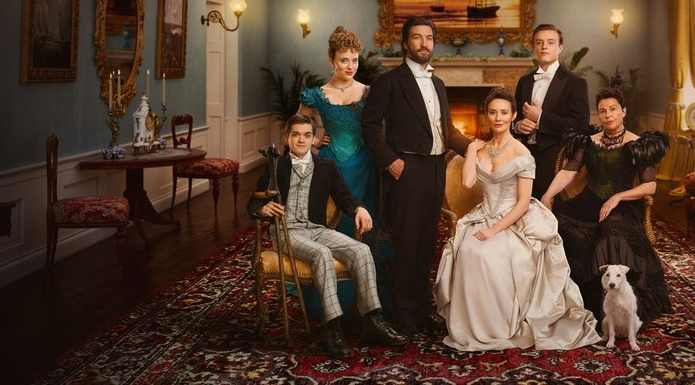
Claire Cooper, as Mary Hardacre, anchors the series with the poise of a middle-aged Lynda Carter: regal, resilient, and emotionally compelling. Her performance gives the show its spine, even when the plot goes limp. Her husband Sam Hardacre (played by Liam McMahon) is the most predictable leading man imaginable: noble, boring, and about as narratively useful as a decorative wheelbarrow.
Julie Graham, however, detonates the screen as Ma Hardacre. She’s a brash, rough-edged Queen Mother barreling through upper-crust society like a bulldozing tornado. Every scene she’s in feels like a working-class coup. She’s the show’s true aristocrat: unapologetic, unsentimental, and utterly magnetic.
Adam Little, as Joe Hardacre, is sexy as fuck. That’s not a critique, it’s a fact. Shannon Lavelle’s Liza Hardacre is endearing and earnest, the kind of character who earns your affection without begging for it. Zak Ford-Williams, playing the crippled son Harry, is adorable but tragically underused. The series flirts with darkness early on, when Harry is beaten in front of his mother, but never follows through. In a time when disability was a social death sentence, The Hardacres could have mined real pathos. Instead, it offers a soft-focus version of hardship, where everyone’s pain is politely framed and quickly resolved.
Mrs. Dryden: The BAFTA-Worthy Backbone
Ingrid Craigie’s Mrs. Dryden is the show’s secret weapon. Initially coded as a moral scold, she evolves into something far more compelling: a woman whose rigidity masks a deep well of empathy. Her scene with the pregnant Liza, where she assures her that love will follow the birth, is one of the random emotionally true moments in the series. It’s not just touching—it’s earned. Craigie’s performance recalls Frances Conroy in Six Feet Under, a quiet force of emotional intelligence wrapped in starch and sorrow. Give her a BAFTA and a better script next time.
Sentimentality vs. Substance
Let’s not pretend The Hardacres overcomes its sentimentality. It doesn’t. It ladles it on like gravy over undercooked meat. But the characters, especially the women, are intriguing enough to make the meal palatable. The show’s emotional scaffolding is shaky, but it holds. Just barely.
Holly Sturton, as Adella Fitzherbert, deserves to be in films. She brings a quiet magnetism to a role that could’ve been pure ornament. The Fitzherbert clan, meanwhile, exists mostly to be disrupted by the Hardacres’ rise. And thank heaven for that.
Final Verdict: Watch It, But Don’t Worship It
The Hardacres is comfort viewing for the emotionally literate. It’s not groundbreaking, but it’s not insulting either. It’s the kind of show you watch when you want to feel something, but not too much. When you want to root for someone, but not cry when they fail. It’s a good way to pass the time, and in this economy of attention, that’s no small feat.