

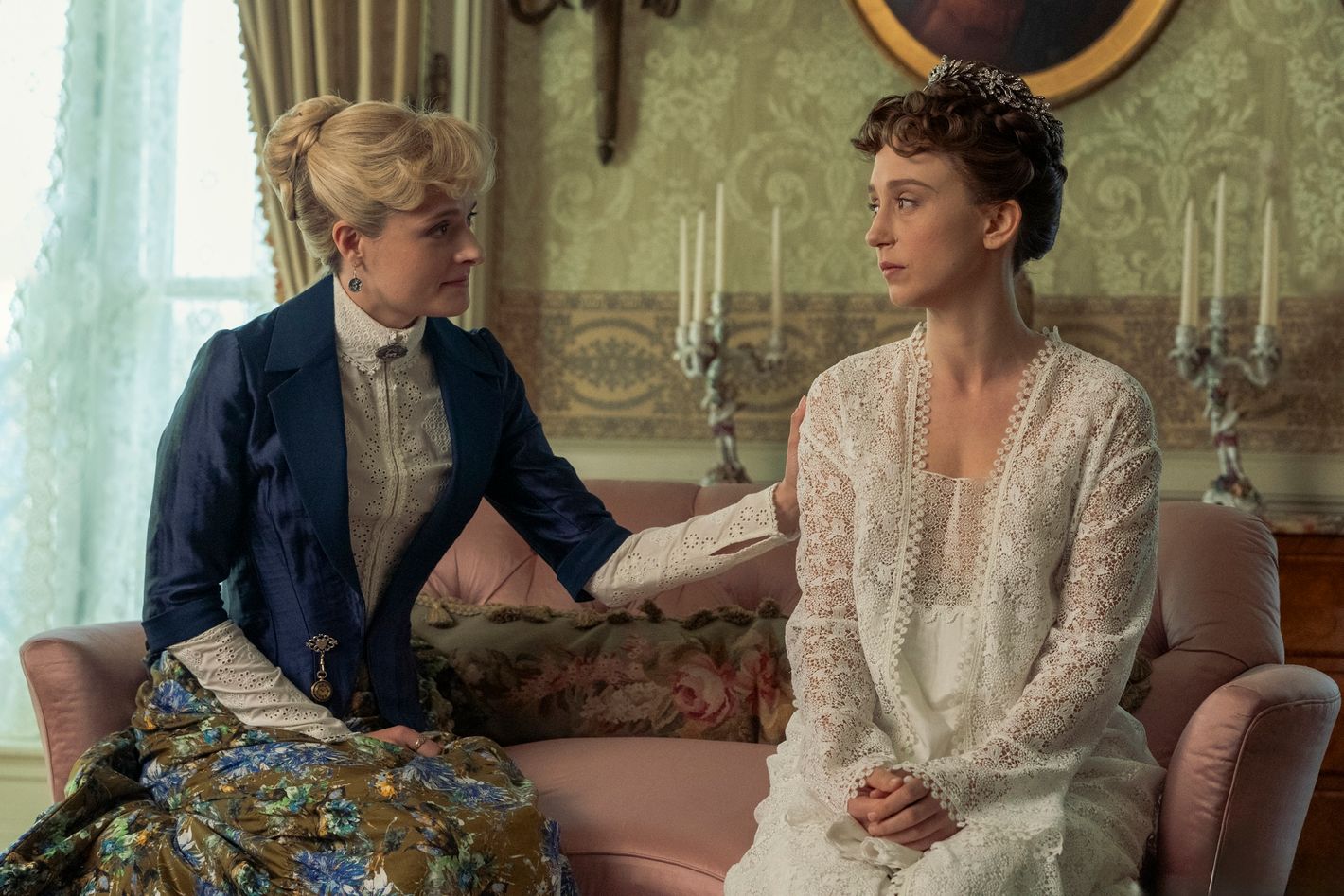
Spoilers for the season finale of The Gilded Age follow.
And so, the third season of The Gilded Age comes to a close — not with a bang (that was the last episode) but with a break. Though George Russell (Morgan Spector), who was shot by a hired assassin in the penultimate episode, survived, the near-death experience taught him to reconsider continuing his relationship with his wife, Bertha (Carrie Coon). Sad for Bertha Russell, certainly, but everybody else seems to be in a good place. Peggy Scott (Denée Benton) ends the season engaged, and Gladys Russell (Taissa Farmiga) now actually likes her arranged marriage. Agnes van Rhijn (Christine Baranski) and Ada Brook (Cynthia Nixon) are back to being happy sisters. Even Oscar van Rhijn (Blake Ritson), whose sometimes-lover died in a deeply random carriage accident earlier this season, has found a suitable lavender marriage for himself in Bertha’s former maid turned sugar baby. Look, this is all nice, but it’s past time for The Gilded Age to heighten drama. The people crave blood. It’s time to kill off a major character.
Like soap operas, The Gilded Age is melodramatic and often ridiculous, with a world populated by stock characters who live through endless plot twists. But if nobody important can die, the stakes level out. Both times someone was in deathly peril this season, the show went on to telegraph that they were never truly in danger. First, Peggy fell sick and a white doctor refused to treat her, which, it turned out, was just a device to introduce her to the hot new guy, Dr. William Kirkland. Then, George Russell neared financial ruin after overextending himself to make a country-long railroad. Ultimately, his son Larry (Harry Richardson) found him the cash he needed when some copper mines had more copper than they’d thought. Then, George was shot (gasp), but by the 20-minute mark of the next episode, he’d officially survived due to the smart work of Peggy’s beau. And so, ultimately, he ended the season as rich and alive as ever, just angrier at his wife.
By point of comparison, look at Gilded Age creator Julian Fellowes’s previous show, Downton Abbey. In the third season, two of its top characters, Matthew Crawley (Dan Stevens) and Lady Sybil Branson (Jessica Brown Findlay), died from a motor accident and post-childbirth eclampsia, respectively. It was a shocking reset — I personally remember my seventh-grade history teacher calling out of school to mourn her favorite heartthrob’s death — and it lent stakes to the entire rest of the series. If they could die, then who next? Was Lady Mary in danger every time she got in a car?
Now, this is not to say that The Gilded Age has been an entirely bloodless affair. People do die: Just ask Oscar’s almost-boyfriend John Adams (Claybourne Elder) and Ada’s season-two husband Reverend Luke Forte (Robert Sean Leonard). Still, while both those characters were fun to have around — said with all the love in the world toward John and his very stately nose — neither was central enough to the series to feel like a real loss. And it’s not like we’re lacking options: People in the 1880s died of all kinds of things, and they did so regularly. Life expectancy was 42 years old! Granted, that was due to high rates of infant mortality, but there was tuberculosis, pneumonia, consumption (another name for tuberculosis), factory accidents, scarlet fever, and more tuberculosis. Death was a part of life. Yet, when people on The Gilded Age go to the doctor, it’s so they can meet a hot guy like Dr. Kirkland.
It’s time to let the 1800s medicine get to someone. The show wouldn’t be able to induce sickness in a history teacher if it killed off any of the characters that we would actually want to go away. But to get the audiences back on the edge of their seats, fan-favorite characters like Peggy Scott and George Russell can’t keep being rescued. Kill someone, Julian, and make it bloody.
Related